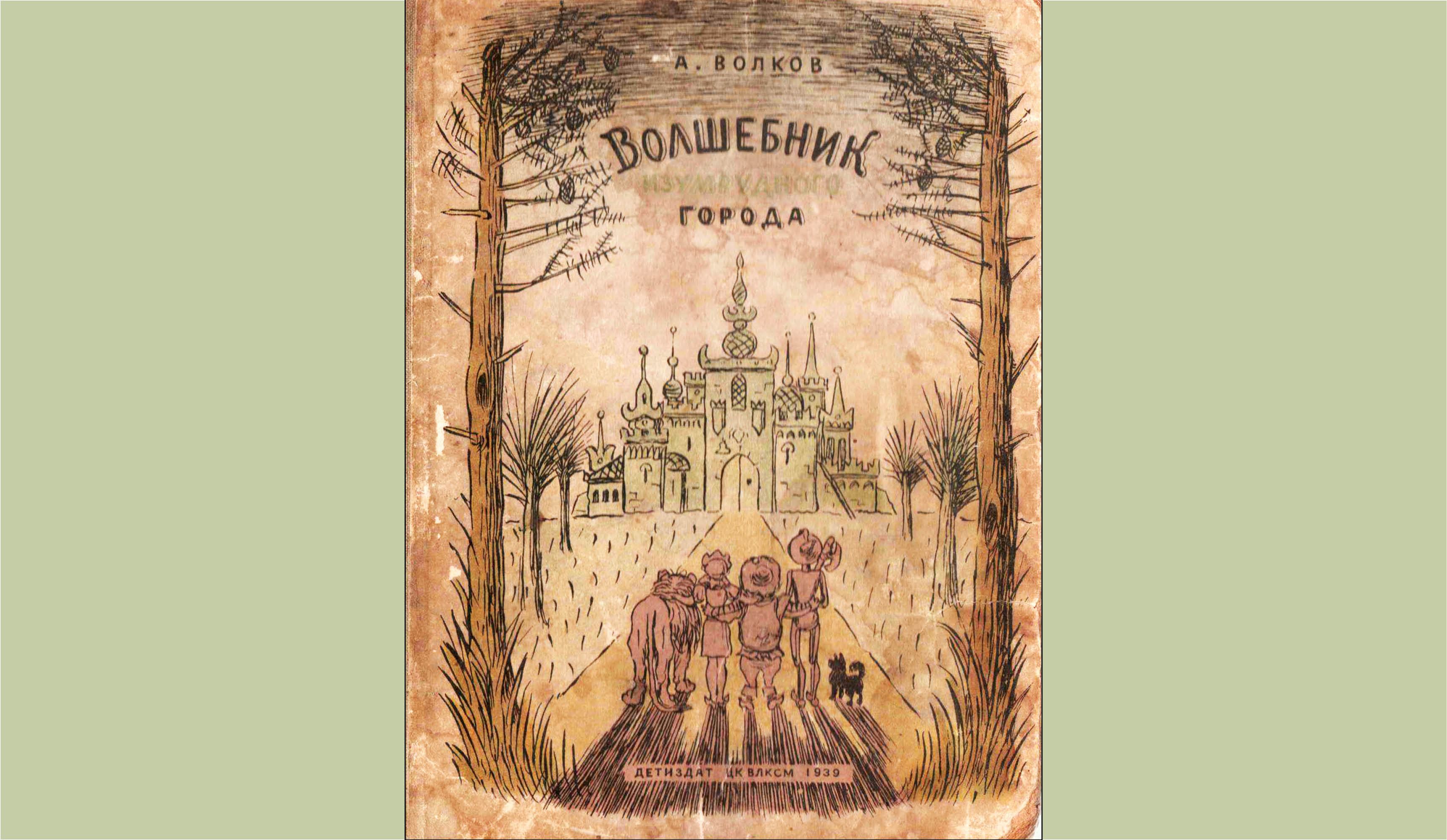
The year I was born, the USSR published seven books for every citizen. I can’t say I read my seven that year—neither did most of my fellow countrymen, whose tiny apartment bookshelves sagged under the weight of all those volumes. The catch was that it wasn’t easy to find something worth reading. Every book had to toe the Communist Party line. Once I was old enough to read, I feared books that opened with portraits of party leaders, sure that if I continued, it would change my perspective completely.
In the 1930s, a Soviet mathematician, Alexander Volkov, answered the call of the red intelligentsia—educated party types urging writers to help guide the younger generation. So he sat down to write a children’s book—a loose retelling of L. Frank Baum’s The Wizard of Oz.
Volkov’s version, The Wizard of the Emerald City, takes plenty of creative liberties with the original story. Names were changed and characters added; the wicked witches, Bastinda and Gingema, turned into oppressors of the Munchkins and the Winkies. The Land of Oz expanded into new territories—with Blue, Violet, Yellow, and Pink countries—and adopted a kind of confederate system of government.
Ellie, the Soviet version of Dorothy, was unlike anyone I knew. In many ways, she embodied the ideal Pioneer: diligent, disciplined, always delivering slogans about friendship and the value of education. Yet she acted with an uncommon sense of free will that, to my Soviet self, felt extraordinary. Something in that story unsettled me, made me question things. I was drawn in, absorbing ideas from two opposite worlds at once—the USSR through Volkov and the United States through Baum.
I was ten when I first felt the creative hunger. King Kong had hit the screens in my hometown and completely taken over my headspace. I wanted to stay in that world, so I told the kids from my block that my uncle had brought me a videotape from Germany, containing all eight parts of the King Kong saga. There was no tape, of course, only my imagination. I spent hours telling them about King Kong’s adventures, each installment of the “films” exploring a new land and a new idea. The grand finale, I claimed, was called Kong 8½. (I hadn’t heard of Fellini back then, but it seemed like a funny joke.)
Much later, I reread Volkov’s books. They were not simply the words of a storyteller inviting readers into his world, but the testimony of a witness swept away by imagination—dragged, almost against his will, into Oz. As if a tornado had pulled him off course.
But at one point, Baum’s world began to feel confining, and Volkov drifted away from the yellow brick road, beyond the borders of Oz, and into a realm entirely his own, one with underground kings, followers of a fiery god, aliens, and wooden soldiers. With each subsequent book he wrote, Volkov ventured further into the wild, illogical country of his own imagination. Art grew beyond craftsmanship, and the former mathematician became a liberated creator.
Modern readers often accuse Volkov of plagiarism, saying he failed to create a world of his own. But I still remember that tornado of freedom that swept me up from the very first pages, down the yellow road into the unknown. In his books, I found the life‑giving elixir of imagination—the kind that can turn a pragmatic mathematician into a maker of worlds.
Comments
No comments yet.
Add a Comment