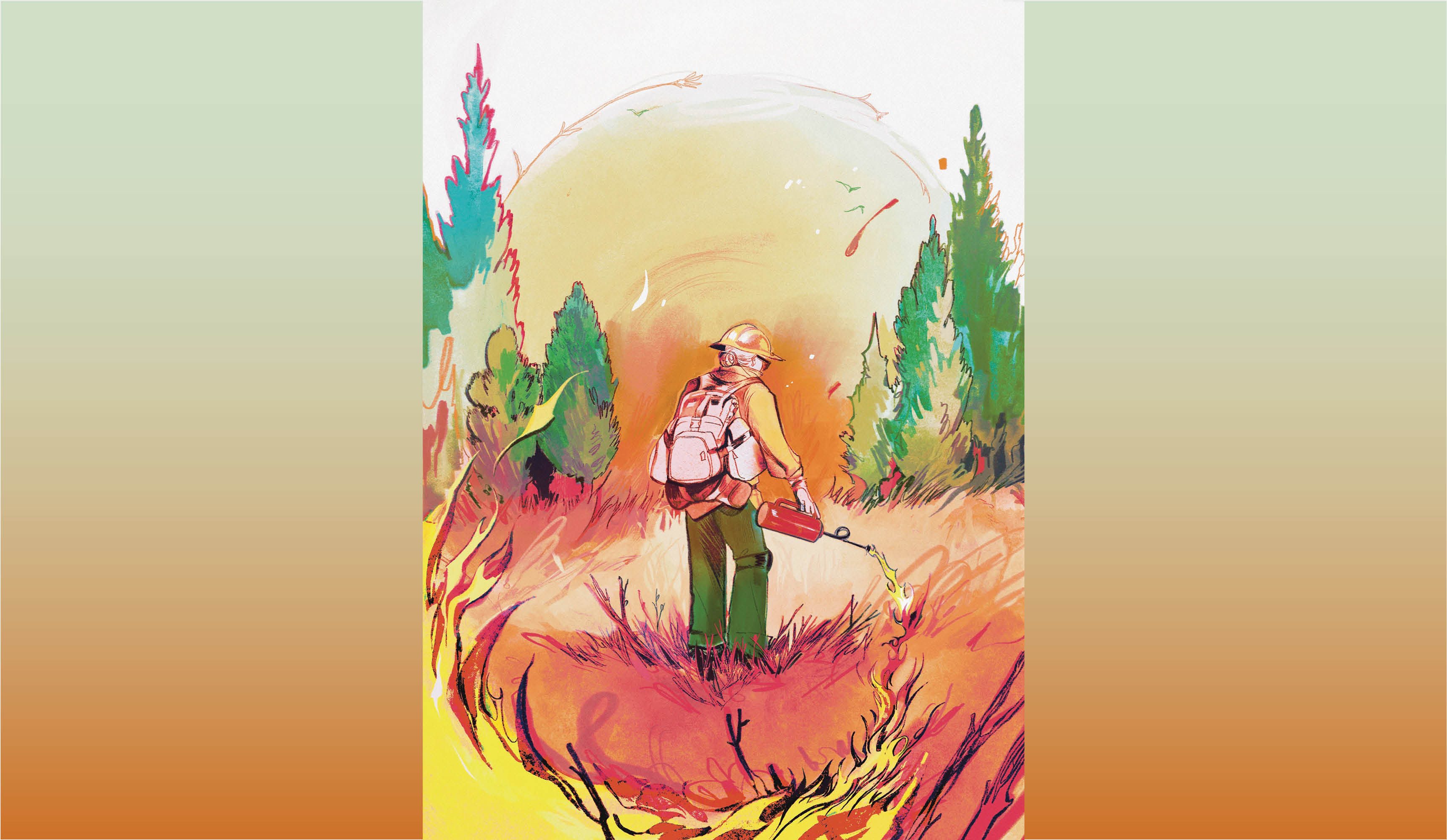
The first sip of water from my bladder is like hot tea. I spit the mouthful into the black and watch as it sizzles, steam puffing up from the charred ground. I take another sip—lukewarm—and then suck greedily at the rubber tube that extends out of the top of my pack and down over my shoulder. Sweat rolls through my eyebrow and into my eye, stinging. I’m already half crying from the smoke.
The fire creeps its way through the weeds and scrubby manzanita trees a couple of feet in front of me. I’ve paused in my digging, leaning on my hoe for support as I guzzle water. Ahead of me, a chainsaw growls urgently. My crewmate Mike (all names have been changed) cuts a path through the brush, taking the lower limbs off trees, cutting down manzanita and ponderosa pine saplings, and slicing huge cylindrical rounds out of downed logs. Brenda is following close behind him, pulling and twisting the brush away from his saw as he cuts and hauling it several feet away from the fire. Her gloved hands are deft and never come too close to the whirring chain.
Cutting and swamping—two tasks I do slowly and clumsily, unsure of myself without supervision. That’s why I’m digging. There’s nothing particularly complex about swinging a hoe, over and over, cutting through small vegetation and scraping the duff away from the dirt. We’re putting in handline: a perimeter two feet wide of bare mineral soil, built right up against the hungry, burning edge of the fire. I am twenty-four years old, wearing an orange hard hat, leather boots, a dirty yellow button-down tucked into green flame-resistant pants, and I’m fighting my first wildfire.
I grew up in the Rogue Valley in Southern Oregon, where massive wildfires decimate the landscape every summer. My childhood memories are like sepia photos: everything a blurred, pale brown as the air filled with smoke. Some mornings I would wake up unable to see the houses across the street.
I remember the sun hanging dull red-orange in a brown sky. I was told not to look directly at it, but it was hard to keep from sneaking glances, just a couple of seconds at a time. In my mind, the wildfires were so powerful they even cowed the sun, making it tame and beautiful. Out the window, I watched helicopters zip through the sky, trailing huge buckets of water on long lines beneath them. My friends and I made up stories about being scooped up by a bucket while swimming and dropped onto the flames.
Even now that I’m a firefighter, the smell of wildfire smoke—fragrant and woody—makes me nostalgic.
When I was little, it would have been easy to think of wildfire as evil. Some days, it felt that way—like the fires were hungry, all-consuming behemoths intent on burning down the homes at the outskirts of town and razing the forests I loved. Fire trapped us inside during the summer and made my mom talk constantly about moving away from our hometown.
But I was lucky enough to know—to be taught, in my public school classrooms by visiting ecologists—that wildfires weren’t evil. I learned that fire is a natural and necessary part of our ecosystems, and that the reason the wildfires we see today are so devastating is because we tried to suppress all fires for so long. Now, we’re dealing with the repercussions of attempting to live separately from fire.
We are not supposed to live separately from the land. That feeling—that the land should affect us and we should affect it—is the catalyst that made me start working as a wildland firefighter. I’d been working as a biological technician on a National Wildlife Refuge in Mississippi. For long hours in the wet heat, my coworkers and I would stand in the sun, moving six inches at a time, cataloging every plant species growing across two-hundred-foot transects. “Is this Rhynchospora uniflora?” we’d ask each other. “I can’t see the seed heads. It might be Rhynchospora fascicularis.” At dawn, I would drive the refuge boat through the winding bayou, a brackish waterway that flows in both directions—inland during high tide and out as the tide falls—while my coworkers recorded the calls of secretive marsh birds. When endangered Mississippi sandhill crane chicks hatched, we would kayak or wade out to their island nests and weigh and measure the chicks. When the chicks grew to gangly adolescents, not quite fledged, we would sprint across the savanna to run them down, scooping them up like footballs and snapping colorful plastic bands onto their legs. The bands would let us identify the cranes with binoculars as we drove around the refuge, recording their behaviors, their mates, and the genealogy of the flock. We also recorded bat calls and frog calls, identifying different species.
We snaked long camera probes down gopher tortoise holes to see if they were occupied. We tracked patterns: the fluctuating plant biodiversity of a specific site, the location of crane nests year to year, the correlation between Henslow’s sparrows and the most recent prescribed burn in each section of the refuge.
Yet everything I was doing felt removed from the natural world: We were the scientists—the birds and plants and animals and ecosystems were our subjects. We studied them, and we tried to disturb them as little as we could. Almost godlike, we watched and subtly manipulated their world, but we were unaffected by it.
Again and again, the data I collected in Mississippi proved one thing: Fire was the most significant factor positively affecting the refuge. Henslow’s sparrows were only found in sites burned within the last three years. The cranes made their nests in the most open areas of savanna, passing over the dense, tangled jungles of units that hadn’t seen recent fire. The open savanna plots had tremendous biodiversity of plant species, while the control sites (unmanaged by burning, mastication, or thinning) sometimes had as few as six. Only six different plant species in a two-hundred-foot transect: Smilax laurifolia, Aristida stricta, Pinus elliottii, Ilex glabra, Smilax bona-nox, Gaylussacia mosieri. Over and over and over. The Ilex glabra over my head and the Pinus elliottii thin and starved for light.
I didn’t like this separation, the scientist-object divide like a glass wall between myself and the world. The fire crew on the refuge experienced no such divide. The two firefighters who lived with me in the refuge bunkhouse would come home each evening soot-covered, exhausted, and energized. They’d been out all day “dragging torch”—walking through sections of the refuge carrying a can of flammable fuel that spewed in a little stream from its nozzle. This stream of fuel ignited as it dripped past a flame on a wick, then quickly spread to the grasses and brush. The fire crew would watch the wind carry the fire across the savanna, holding it at the edges of each unit with firebreaks and constant supervision, keeping control of the burn. The fire would consume the landscape, eating through saw palmettos and toothache grass, burning the heads off young longleaf pines and reducing downed logs to thick hunks of charcoal. Driving past one of their units the next day, I saw that everything was charred black or brown. The bottom needles of the larger pines drooped sadly. The land looked open and dead. But within a week, it would start “greening up” again. The ground speckled with green as grass and wildflowers popped out of the wet ash. Vibrant new saw palmetto leaves poked out from between parchment-paper old ones.
The real work of maintaining the refuge was being done by the fire crew. Everyone else was necessary—the office staff (somehow the office had more staff members than either the biology team or the fire crew), whose job it was to keep the lights on, bills paid, supplies ordered, and paychecks processed; the biology team, who collected data and tracked the recovery of endangered species in order to apply for grants; the handful of volunteers and their coordinator, who worked in the visitor’s center, keeping the public interested and informed about the processes of conservation. All of this work was important, but several degrees removed from the actual conservation of the ecosystem. The cranes nested where the fire crew had recently burned. The savanna was savanna because of how hard the firefighters worked to keep it that way.
The work of burning to care for the land is not new—fire is an active land management tool that has been used by Indigenous peoples since humans have been in the Americas. The ecosystems we live in are adapted to human interaction—many plants rely on Indigenous harvesting practices to grow and spread. Both forests and savannas depend not only on wildfire started by lightning to keep them open and healthy, but also on intentional, human-cultivated prescribed burns.
Frequent low-intensity fires clear brush and downed logs from the ground, releasing their nutrients back into the soil. This prevents the accumulation of living and dead matter that fuels the catastrophic, all-consuming wildfires that wipe out entire forests. With regular fire, huge trees can grow, uncrowded by smaller ones shoved up against them. Sunlight can hit the understory, feeding the shrubs and berry bushes that in turn feed birds and animals, whose droppings and decaying bodies fertilize the soil. More openness means easier hunting and foraging for humans, as well as easier movement and foraging for animals—a cycle of health and reciprocity that is only possible when humans are living in tune with their ecosystems.
More often, we act like we live in antagonism with the land, and when we do this, the land returns our antagonism. In our ever-more consumptive society, the human “need” for more power, more fuel, and more space eats into the land, destroying it. And when we destroy the land, it destroys us.
Thirsty for power, we dam up rivers and watch the salmon populations that feed us fall and fall and fall. We bulldoze, clear-cut, and concrete over the land, and temperatures become unlivable due to the lack of shade and water and the heat radiating from the asphalt. We farm enormous monocrops and blights wipe them out. We pollute our own airways with smog and exhaust, pesticides and carcinogens, and watch as respiratory disease and cancer rates rise.
We consume the land and it consumes us—with wildfires that devour our homes and our forests, with toxic algae blooms that make Oregon’s water undrinkable and kill the fish, with devastating hurricanes that flood and destroy cities. We act as if we can exploit the earth for profit and comfort, but we are not separate from it. In betraying the land, we are just betraying ourselves.
In the lobby of a hotel in New Orleans, at 4:00 a.m., just before I started working in Mississippi, an older man behind the front desk said something I carry with me. He was telling me about the small farm he and his wife lived on.
“I don’t know how people can farm and not believe in God,” he said. “You need the rain, and God gives you the rain.”
I recognized the feeling he was talking about. I think, sometimes, we forget that the world loves us. He feels the love through God. To me, it’s biology, but it’s really the same thing. His words reminded me of one of my favorite quotes from Alice Walker’s The Color Purple, when Shug says: “I think it pisses God off if you walk by the color purple in a field somewhere and don’t notice it. People think pleasing God is all God cares about. But any fool living in the world can see it always trying to please us back.”
It is not a coincidence that we can survive on earth. We were made for it, and it was made for us. The earth did not start off this way—its geochemical makeup would be vastly different if it wasn’t covered in life. Life built it to be our home, molecule by molecule, changing its makeup and complexity as it cradled us and built us, cell by cell, nourishing us and supporting us. When I stand in the Illinois River until my feet go numb, when I pick and eat thimbleberries growing from soft-leaved bushes, when I watch orange flames dance through the leaves of a manzanita, I feel the absolute love and care of the earth—biology—God—the universe.
Fighting wildfire is complicated in this age of overcrowded forests, hot and dry temperatures, and the need to restore healthy fire to the land. What should we let burn, and what should we try to stomp out as soon as possible? These decisions must weigh weather forecasts, agency policy, available resources, expected fire behavior, and dozens of other factors. Small fires, like the first one I worked on, are doing the good work of eating through the underbrush. However, in mid-May with no rain in the ten-day forecast and increasing winds coming, it was an educated guess as to when we’d be able to contain it if it blew up. As I dug line around my first fire, containing and suppressing it, I felt half ashamed that my work was stopping this healthy fire. But I trusted the people more experienced than I was.
Today, I’m sitting under a tree at fire camp: a tiny tent city with logistics tents, rows of porta-potties, and a catering trailer serving six thousand calories per firefighter per day. I’m watching pale smoke smudging the blue hills north of me, blending them into the sky. I’m currently assigned to a 1,200-acre fire burning in such steep, remote, and inaccessible terrain that the people in charge won’t put anyone on the ground to contain it yet. The land is a broken jumble of rock faces and scree slides, old snags from another fire in 2016, and steep slopes. We’ve been doing mapping missions every day—terrifying experiences where my coworkers and I sit in our tiny helicopter as it buzzes like a fly around the perimeter of the fire, the green-black divide tilting up and dropping away nauseatingly as we bank left, then right, to capture each wiggling finger of fire. There are no yellow hard hats dotting the ground beneath me. No firefighters on the line. We’re just monitoring this one for now. Although I’m itching for action—the thrill of adrenaline as we hike up toward active flames, the rhythm and camaraderie of putting in line with my crew, the sweet exhaustion of my muscles at the end of a hard day, the extra hazard pay—I can’t help but be grateful that all we’re doing today is letting the fire burn.
Comments
2 comments have been posted.
I love this essay so much!
Liz nakazawa | January 2026 | Portland
Wow! Love this piece. Especially this line: "He feels the love through God. To me, it’s biology, but it’s really the same thing." What a beautiful peek into a very niche experience. Thank you for sharing.
Michelle O'Neil | December 2025 | Greenville, SC
Add a Comment