In 2017, I moved to Toronto to pursue an undergraduate degree in visual art. The next year, Canada passed the Cannabis Act, legalizing cannabis under specific restrictions. One aspect of the new law allowed adults eighteen and older to grow up to four plants for personal use. While I had no intention of growing marijuana to its budding stage, my apartment lacked warmth, and I hoped these plants might brighten it.
I found a website that exclusively sold mail-order cannabis clones—seedlings that are exact genetic copies of their parents—and ordered two OG Kush clones. First cultivated in Florida in the 1990s, OG Kush is an important ancestor of many well-known West Coast strains, like Bubba Kush and Headband.
Growing the plants also fulfilled an assignment for one of my studio art courses, which asked us to make and critically think about an object within the context in which it’s installed. Through my naive desire to push boundaries, I framed the artwork through the lens of being Black, daring the university to prohibit me from working with this now-legal substance. In actuality, I was somewhat terrified that I had misread the law and that growing these plants might still get me in trouble.
The growing season had ended in Toronto, so I began to research hydroponic gardening, a method that uses water-based nutrient solutions and artificial lighting to grow plants indoors, allowing for more private, year-round cultivation. Before legalization, I knew that many people used hydroponics to grow cannabis in their closets or garages. I decided to purchase an AeroGarden, an all-in-one hydroponic herb grower I’d learned about years before when my dad gifted my mom one for Christmas. It’s somewhat gimmicky and overpriced, but also very easy to use as a beginner.
After it arrived, I squished the two OG Kush clones into the AeroGarden’s holes, filling the other spots with the seed pods that had come with the machine—basil, dill, mint, and parsley. For around seventeen hours each day, its bright LED lights shone on the plants, acting as an indoor sun. In the evenings, I’d watch the machine’s glow, listening to the gurgle of water cycling through the tank. In the mornings, I’d sit next to the herbs, drinking water, my face lit up by my own lamp in an attempt at treating my seasonal affective disorder. Every week, a red light on the front of the machine came on, indicating it was time to feed my plants, and I would add a capful of brown liquid fertilizer to the tank.
By the spring, the herbs had run their course, so I started to grow flowers, placing the AeroGarden on the floor next to a full-length window so the plants could grow taller than the twelve inches the LED light allowed. The fuchsia-blossomed phlox became leggy and climbed toward the window to absorb more light. I was now a gardener; there was no going back.
I planted my first soil-bound garden two weeks after Breonna Taylor was killed. It was March 2020, and I had just arrived in Louisville, Kentucky, where my parents lived. My sister and I both left Canada when it was clear that the border would close indefinitely for casual travel due to the pandemic. Anticipating quarantine to continue throughout the summer, I asked my parents if I could start a garden. We picked up some potting soil, and using several pots I found in the garage, I sowed zucchini, arugula, chamomile, soybeans, and pansies.
After growing and protecting the seedlings for weeks, I started to acclimate them outdoors. I had read that this process must happen slowly, as things like weather, insects, and animals all have the potential to harm the young plants beyond recovery. A week passed, and an unexpected cold snap hit Louisville. I woke up to frost on the window and ran outside to find almost everything I had been tending to dead. At the time I felt silly for crying about it, but I now realize that in the absence of normal life, even seemingly small losses felt enormous.
The weather warmed, and when I wasn’t gardening I would walk to the end of the cul-de-sac my parents lived on, where I met white pine alongside several honeysuckle shrubs. My brother had shown me the entrance to the woods behind a neighbor’s house, using a big stick to point out the creek. Those months in Louisville were my last moments with my brother as a child. He changed shapes as fast as the cucurbits did, and soon the boy I used to carry in my arms was taller than me.
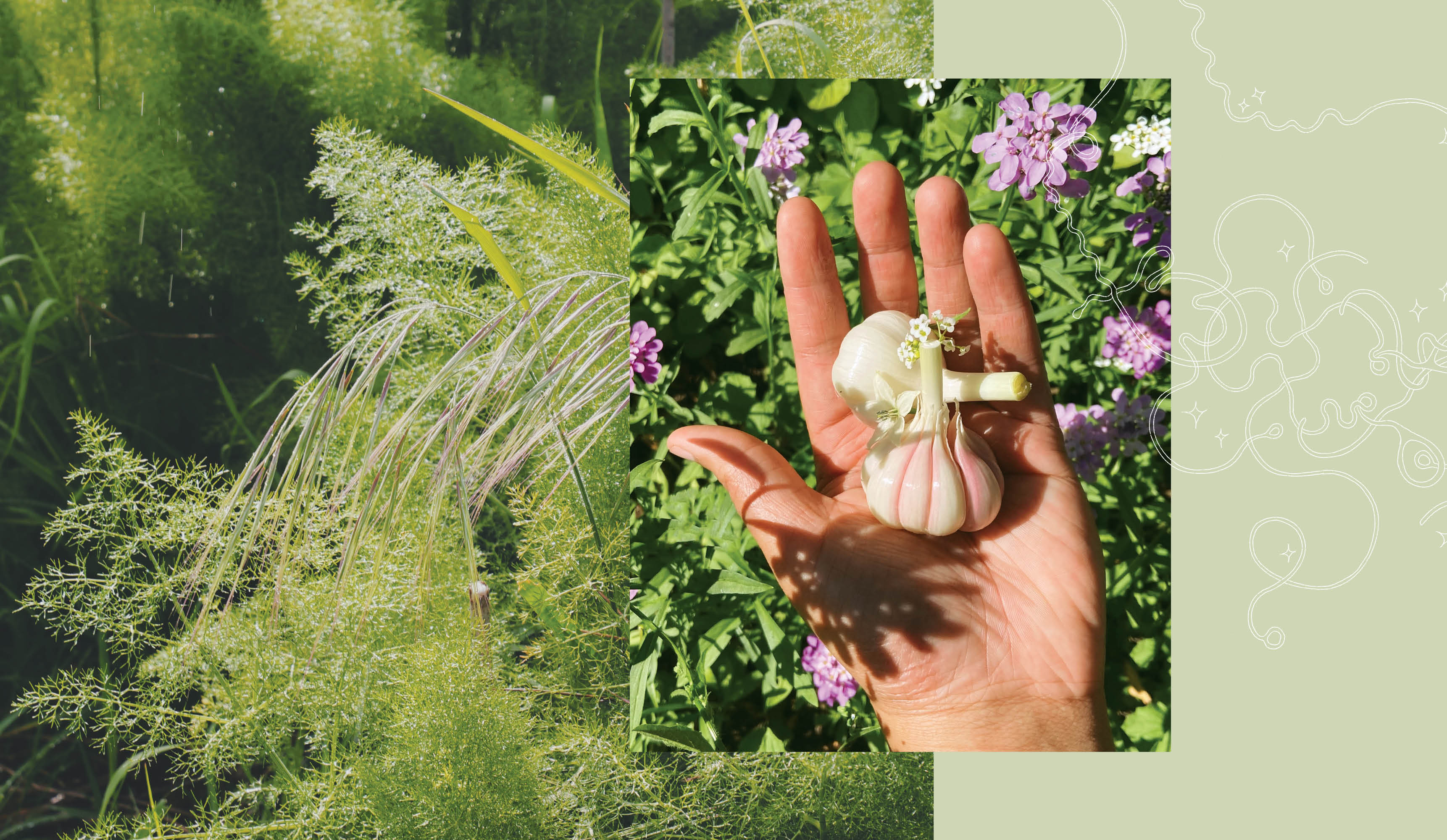
That summer, another fast-growing being emerged from the forest and caught my attention: garlic mustard. As its name suggests, garlic mustard is an allium-flavored plant. In Kentucky, it’s considered an “invasive” species, producing an allelopathic compound called sinigrin that inhibits the germination and growth of neighboring plants and damages mycorrhizal communities. This gives the plant a competitive advantage over its native neighbors, reducing biodiversity. However, the production of sinigrin is actually costly to the plant’s fitness over time. Research shows that, if left undisturbed for twenty to thirty years, garlic mustard may heavily tamp down on the creation of this compound, thus self-regulating its rapid growth. Once the plant feels like it’s safe to reproduce, it no longer needs to use this competitive advantage. This adaptive process happens over a long time scale, from a few years to several decades, one often out of step with human chronology. Alongside conservation efforts that mitigate harm, what if observing how plants like garlic mustard adapt to their new environments offers us different approaches to collaborating with “invasive” species?
“All there is, while things perpetually fall apart, is the possibility of acting from where we are. Being against purity means that there is no primordial state we might wish to get back to, no Eden we have desecrated, no pretoxic body we might uncover.”
—Alexis Shotwell, Against Purity: Living Ethically in Compromised Times
In early 2021, I moved to Portland. I met Jade Novarino through a mutual pen pal, and she asked me to cook for an upcoming event she was hosting through Campo Colectivo, a cooperative project she helped start that focuses on regenerative agriculture and bilingual farm education. Campo was hosting a series of film screenings with food pairings from a local chef or artist. I created a menu to pair with the film Chão (Landless) by Camila Freitas, which was projected on the side of a truck once the sun set. The film follows a branch of Brazil’s Movimento dos Trabalhadores Rurais Sem Terra (MST), or Landless Workers’ Movement, whose members occupy the land of a sugarcane factory and fight for its return to those who worked it. As we watched, strawberry and beet juices stained our hands red, and the crops in the field beside us mirrored those in the film in front of us.
Jade is an artist and farmer whose collaboration and friendship I am immensely grateful for. Recently, after her last market day of the season, we spoke on the phone while she did her chores, and I could hear the ducks quacking in excitement as she fed them their breakfast. Jade’s approach to farming acknowledges that some spaces will always be left untended. She also knows that even if weeds are pulled, they still have important gifts to offer. For instance, dandelions have vigorous taproots that pull lots of nutrients from the soil. Knowing this, Jade ferments them into a fertilizer, returning those nutrients to the soil.
When I asked about her feelings toward weeding, Jade told me that she doesn’t want to feel hateful toward weeds, noting that it can make the process of tending a garden both boring and frustrating. Instead, she observes weeds’ growing patterns to understand what the plants are telling her about the soil—a lack of nitrogen or magnesium, for example. As a small farmer, she brings a thoughtful and playful perspective to her work. She is willing to learn from the land and try new things, utilizing technologies and methods like mulching or understory cover-cropping to make efficient use of the limited resources of time, land, water, light, and energy.
People come to farming with various degrees of privilege and poverty, and Jade reminds me that often those who need support are the ones who are helping. Each week, on restaurant produce delivery day, Campo donates produce to the Western Farm Workers Association, a membership-based organization that strives to improve farmers’ living and working conditions. Rather than seeking to maximize output by increasing efficiency, Jade and Campo work with the land in a regenerative way, building mutual aid into their farming practices from the beginning.
“Constitutionally, we are entangled, coproduced beings, and this fact produces an ethical call. We should care about others because the entanglement of our selves is simultaneously an entanglement with other beings’ pain.”
—Alexis Shotwell, Against Purity: Living Ethically in Compromised Times
By the late summer of 2021, the weather in Portland had been warm and dry for months, and forest fires were beginning to ignite. At this time, I met an artist named Christina Kingsbury, with whom I would produce a collaborative artwork for the Art Gallery of Guelph, in Ontario. After an initial phone call, we started writing to each other in a shared document. We treated it like a virtual letter—taking our time, but always remembering to respond.
As drought raged across our respective northern Ontario and Oregon geographies, we took hot walks among the weeds near our homes and wrote to each other about what we saw and felt. I was starting to feel kinship with non-native plants, demonized for their invasive tendencies. While I noted their potential to alter native ecosystems, I wondered about their autonomy. Many, if not all, of these plants were brought to this continent through colonial trade, often used as ornamental landscaping without consideration for the consequences. Together, Christina and I started to think about how we might form relationships with these plants. Noting that many of them grew in disturbed landscapes—landfills, roadsides, or undeveloped urban lots—we considered that they might be unexpected allies as our climate changed around us. Perhaps these plants might trace the harm that was—and continues to be—done.
On August 23, Christina replied to a poem I shared the day prior. This is an excerpt from her response:
We are in the midst of a drought here—it is heavy, so hot, the soil is incredibly parched and dusty. At the landfill, I am watering this almost-one-acre garden with what feels like a tiny watering can.
I do this while our planet burns … and what is this small gesture of offering water and prayers to a dying plant in the face of all that?
I tilt the orange plastic watering can toward the ground, an American bumblebee flies from blossom to blossom, gathering nectar and pollen. The yellow and white blossoms of late summer—coreopsis, yarrow, wild carrot, Ratibida pinnata, goldenrod, and compass plant—are drying to [a crisp]. The nectar within the blooms is drying and the pollinators need to work so much harder to forage for what they need. To have enough. To survive and nurture future generations into being.
The grief in my bones and blood pours out with the water in my can. And I am completely humbled.
To feel small is to become aware that in the face of everything, the American bumblebee is foraging for nectar, the Ratibida pinnata are growing and breathing and dying, the crown vetch are fixing nitrogen into the dusty soil, the microbes and fungi are decomposing what needs to be transformed … that every being and element here is engaged in this enormous and collective ongoing effort of healing and regeneration.
And to be aligned with that, in such a small way as watering a huge drying garden with a small watering can, feels right.
Through our exchange we began to realize how much this artwork we were creating was rooted in language. The term transplant came up as a way to consider the connections between plant and human bodies beyond colonial categorization. Transplants are resilient, making homes in the hostile new environments they’re placed in and adapting to survive. To notice transplants is to notice disturbance—for instance, a stand of wild fennel emerging from a landfilled riverbank. They tend to be the species found in polluted landscapes or sites that have been depleted of resources to support native life. We then considered the phrase transplant thinking as a framework that provided a shift in position, inviting us to consider interspecies solidarity and collaboration. This framework recognizes the parallels between human bodies that have been transplanted against their will through displacement and enslavement, and plant bodies that have migrated without agency. It also recognizes the systematic erasure of wildness and ferality in favor of order and control. Transplant thinking is not a method to restore us to an Edenic beginning. As a prefix, trans- means “across,” “beyond,” and “through.” In the face of rapid ecological change, collaborating with transplants creates new multispecies solutions that might help us move through it.
The other day, I asked Christina how her gardens grew this year. We both found ourselves struggling to find time to tend, questioning how one faces all the competing demands of life and a personal capacity that is constantly in flux. Christina described settling into her wild approach to gardening, accepting and observing how the weeds grew among the cultivated plants.
One of Christina’s three gardens is an ongoing artwork, called ReMediate, that she began with collaborator Anna Bowen at the former Eastview Landfill in Guelph. In 2014, Christina and Anna invited the public to sew together a 2,800-square-foot quilt using handmade paper embedded with native seeds they’d collected. Over time, the paper quilt disintegrated, and the seeds sprouted. Christina has always had an interest in the landfill site and the ways it differs from the idea of a perfect native garden. Instead, she’s curious about increasing its biodiversity over time. Thus, these days, the wildflowers coexist with the vetch.
In the summer of 2025, Christina arrived at ReMediate to find entire sections of the garden ripped out and replanted. There had been no communication to her, before or after. The mulched-over spots may have been sprayed with herbicides or, she hopes, tilled. I noted how painful this must have felt, and Christina told me that she likes to talk to her gardens. If she had known this was happening and still couldn’t have changed it, she would have helped the plants prepare for what was to come.
Christina posits that the desire for purity is a coping mechanism derived from the denial of our current reality and an inability to process the grief that comes with it. To fully acknowledge the violence held within disturbed landscapes is immense. It’s far easier to spray, prune, and bury. Despite the fact that we are positioned differently in relation to this harm, it is harm we all have to face. Christina tells me she’s questioning how we might build our capacity to be present with this complexity. For her, forming relationships with sites of disturbance has given her the resources to grieve. And by feeling the grief more deeply, she has found the strength to respond to the heartbreak of this moment rather than distract herself from it or collapse into it.
In his book Wild Things: The Disorder of Desire, Jack Halberstam describes a colonial understanding of wildness that sees certain bodies as savages, in need of taming through Western civilization. Bewilderment, he writes in an essay of the same name, contains notions of wildness, also suggesting “a becoming that moves in an opposite direction to colonial knowing,” that is, a disorientation of time and space, an enchantment, wandering toward (or back into) the unknown as a different kind of knowing. He writes:
The woods name and spatialize geographies of terror for some, refuge for others; they metaphorize disorientation and loss. The forest is the site of fairy tale and real monsters, teddy bears and racists, rapists and mountain men. But, in a world in which wild spaces are disappearing rapidly, the woods signify other forms of life, nonhuman life, vegetal life, that may represent a future absent of humans altogether. The woods remember a time without humans and possibly dream that such a time will come again.
By July, the rain had stopped in Portland, so the dampness of Wisconsin’s Driftless region, where I was spending a two-week artist residency, was welcome. Having never been glaciated, the landscape in this rural part of the state is much hillier than the mostly flat Midwest that surrounds it.
One morning, four of us woke up at 4:30 a.m. to walk up a big, beautiful hill before sunrise. The weeds were tall and dewy, making my shoes squelch as I walked. When we made it to the top, my pants were soaked all the way through to my underwear. But as we looked around at the landscape, and each other, I forgot I was tired and wet. The pink-and-blue sky shifted to yellow as a white orb of light rose from behind the hills. Foggy mist enveloped our sight lines, hugging the valleys and turning the tall grasses into silhouettes. Dewdrops on spiderwebs glistened in the new light, and my camera gave up on trying to focus on them. With the sun behind us, we waved our hands to the hills ahead, watched our giant shadow bodies dance, then descended back to the warm car.
At the end of my residency, I tied a string to two posts and hung up cyanotypes I made from a photo of a dead fawn I’d encountered while foraging for nettles with a friend. Tiny elderflowers were scattered about the images, placed quickly on the photo transparency as the sun exposed the light-sensitive emulsion. I looked around the residency’s metals studio for wildflowers and wood, finding bee balm, wild carrot, and a log covered in turkey tail mushrooms. As I worked, a nearby resident asked me if I was building an altar. I paused, stepped back, and told him, “Yes, by accident.”
Before packing our things to leave, we walked around the place that had been our home for the past two weeks and each artist shared what they had made. I brought everyone to my altar and blew a few bubbles to honor the fawn. We walked together to the creek where we’d placed our cast aluminum sculptures now shimmering on the shallow floor, crowded onto the wooden planks sitting just above the cold water, and passed around two bottles of wine. Behind us, some watercress, a peppery and bitter transplant, had formed a slightly worrying bed of green in the creek. I knew that if I returned next year, the patch would be thicker, in spite of the waste that had been dumped at the mouth of the spring, thriving somehow through the contamination. I said thank you, knowing the words would never be enough.
Comments
1 comments have been posted.
Thank you Meech for sharing. I love that instead of offering solutions or just wishing for old times your piece accepts the damage but still chooses relationship, curiosity and responsibility. It reminds me that care doesn’t have to be big or heroic to matter. Also that people (or plants) that come here after they’re brought by someone else are still here even if some people don’t want them to be. We can never go back in time - we can only go forward.<br><br> Very little in life is actually simple but we like to treat it that way. Our categories to keep things “proper” or contained make us feel safe but they also keep us from seeing what’s really there. Lets all keep our eyes open and welcoming to all life, plant or animal or human.
Shawna McKeown | January 2026 | Portland
Add a Comment