Bi-ko-lan! Bi-ko-lan!” shouted a cacophony of vendors in the outdoor marketplace. “American! American!” It was 1979, and I was a twenty-year-old from Junction City, Oregon, going back to Taiwan, my birthplace, for the first time as an adult.
I’d prepared for this solo trip by reading Maxine Hong Kingston’s The Woman Warrior, which helped me learn a little about being Asian American. It took going back to Taiwan to understand my mother, Chu-Yin. She was a World War II survivor who had also endured poverty, starvation, and a childhood of abuse from two sets of stepparents. Chu-Yin was a woman who could be shouting in rage one moment, then quickly switch to cooking furiously to offer her family the gift of food. She shared her early memories with me in a hushed voice tinged by shame. Her pain came from being sold twice to other families in another village to work as a servant.
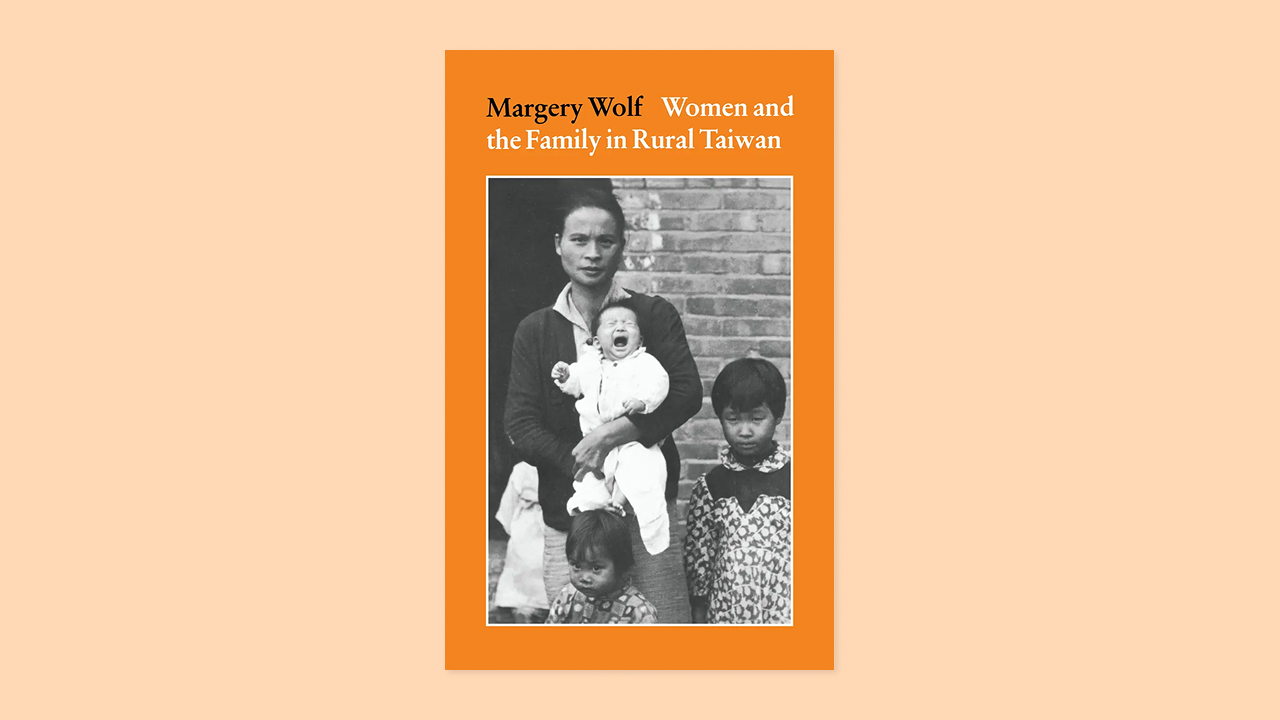
I immersed myself in Taipei for six months. I took Mand-arin classes and taught English to businesspeople and traveled around the island. Always, I was a “bi-ko-lan.” One day, combing through books laid out by a street vendor, I found a copy of Margery Wolf’s Women and the Family in Rural Taiwan. A noted American anthropologist, Wolf had dedicated her career to researching women and families in rural Taiwan and China. I still have this book, though it’s now dog-eared and barely holds together.
I bought Wolf’s book, thinking it might help me to learn more about rural Taiwan during my mom’s time there. I immediately gained a clearer picture of the woman who at times behaved desperately but supported me and loved me fiercely. The title of one chapter grabbed my heart: “Girls Who Marry Their Brothers.”
My mom used to say she was a “sim-pua” with whispered embarrassment. I didn’t know what the Taiwanese word meant. In her book, Wolf explained that a sim-pua was an adopted daughter who was raised as a kind of second-class child and, when she reached physical maturity, was quietly married to her foster brother.
My mom’s stepparents stopped her education after she was eight years old so she could work. She regretted never learning to read or write in any language. Wolf’s work deciphered my mom’s internalized misery: “Taiwanese folktales and proverbs lean heavily for their pathos on the ill-treatment of adopted daughters. A girl with a sullen expression has a face like a sim-pua; a sobbing child cries like a sim-pua.”
It came as a revelation: My mom wasn’t making anything up. I understood what had seemed like mythology: why my mom ran away from this family when she was thirteen and worked all her life for her independence, even after she married my American military father. Through reading this book I gained a clearer picture of Chu-Yin and her lifelong battle to overcome her childhood legacy of being sold off and unwanted. Wolf’s anthropological study arrived at the right time and in the right place: it came to me in my mother’s homeland, and mine. This discovery fueled the direction of my career and led to the creation of my seminal radio documentary Mei Mei, A Daughter’s Song, which is about my mom—and me.

Dmae Lo Roberts is a two-time Peabody winning radio producer, writer and theatre artist. Her 1989 Peabody award-winning documentary Mei Mei, a Daughter's Song is a harrowing account of her mother's childhood in Taiwan during WWII. She adapted this radio documentary into a film in 2015. She won a second Peabody award for her eight-hour Crossing East documentary, the first Asian American history series on public radio. Roberts received the Dr. Suzanne Ahn Civil Rights and Social Justice award from the Asian American Journalists Association and was selected as a United States Artists (USA) Fellow. Her stage plays and essays have been published in Oregon Humanities magazine, But Still, Like Air I’ll Rise (Temple University Press), Reality Radio (UNC Press), Alexander Press and The Sun magazine, and Mothering in East Asian Communities book collection by Demeter Press. She published her memoir The Letting Go Trilogies: Stories of a Mixed-Race Family (2016) and “Speaking Your Truths,” a collection of youth writers about their pandemic experiences (2023).
Comments
No comments yet.
Add a Comment