Klan Mentality
In 1981, after a labor arbiter reinstated the two cops fired for leaving dead possums in the doorway of a Black-owned business, the Reverend C. T. Vivian, director of the National Anti-Klan Network, traveled to Portland to help local organizers prepare for what would come next. Accusing the police of having a “Klan mentality,” he warned that the arbiter’s decision would surely embolden White supremacists and lead to violence. The Portland Police Bureau’s Intelligence Division responded by opening a file on Vivian.
It would not be long before his fears would be realized. In 1988, a racist skinhead gang murdered an Ethiopian immigrant named Mulugeta Seraw, beating him to death in a Southeast Portland street.
Portland for years had been a center for skinhead activity—much of it racist, much of it anti-racist, and conflict between the two frequent and bloody. The skinhead presence was so prominent that Portland was sometimes called “Skin City.” But whenever possible, the PPB’s Gang Enforcement Team—and especially its resident skinhead specialist, Loren Christensen—downplayed the political dimension and framed the conflict as a gang rivalry, insisting on a kind of equivalency between racists and anti-racists. In his 1994 book Skinhead Street Gangs, Christensen asserted unambiguously that “the antiracist skinheads are just as violent as the racist—at times, even more so.” The cops’ investigative priorities reflected this attitude. Though the police would conspicuously surveil the homes of anti-racist skinheads and take pictures of anyone visiting, on at least two occasions they failed to investigate shots fired into these same houses.
For Jon Bair—who, as a young man, went to prison for killing a racist skinhead—the cops’ biases made perfect sense. “I believe the police exist to protect the powerful,” he told an interviewer decades later, “and our groups existed to protect those who don’t have power. So the motivations are really different right from the beginning, which puts us at odds with the police. White supremacy is not a threat to the police. People who hold racist views, they’re not a threat to law enforcement. So it makes sense that they’d be treated as less of a threat.”
Mulugeta Seraw’s murder shocked the conscience of the liberal city, and the police were suddenly—if briefly—moved to act. Extra staff were assigned to answer phones, conduct interviews, and perform surveillance. The FBI joined the effort, and the district attorney empaneled a grand jury. Three members of East Side White Pride went to prison, and White Aryan Resistance founder Tom Metzger was held liable in a civil trial. Even as WAR was bankrupted, Metzger remained defiant. “The movement will not be stopped in the puny town of Portland,” he boasted. “Don’t you understand? We’re in your colleges. We’re in your armies. We’re in your police forces. . . Where do you think a lot of the skinheads disappeared to?”
In her book A Hundred Little Hitlers, Elinor Langer compares this sequence of events to a morality play. By focusing on Nazis—in particular, a despised youth subculture and an outside agitator—liberal Portland was able to avoid facing the racism of its own history, its culture, and its institutions.
Anti-War, Anti-Bush
During the same period, at the end of the eighties and the start of the nineties, unruly demonstrations would occur any time President George Herbert Walker Bush or Vice President Dan Quayle came to town. Police regularly responded with arrests and violence.
That most prolific of Portland Police memoirists, Loren Christensen, recalls: “On every [presidential] visit, the protestors came out in force, and every time they ripped up the streets… [They would] vandalize property and fight the police. They carried out their resistance with lots of laughter, cheering, dancing… It was party time for all of them.” As Christensen tells it, it was less of a party for the cops, who worked “for 12 to 14 hours without a break, without water, and without using the restroom. During a couple of the big anti-Bush riots downtown, we worked from 6AM to 2AM.” The fatigue was corrosive to discipline. “After 14 hours of intensity, squad leaders, sergeants, and lieutenants can have trouble controlling troops pushed to their physical and emotional limits. In fact, supervisors can have trouble controlling themselves.” The resulting violence was sometimes counterproductive. “There were times when an overly aggressive police officer or sergeant in charge of 10 officers would ignite a peaceful protest into a riot.”
Compared to the protests against the 1991 Gulf War—which reached upwards of fifteen thousand people—demonstrations against presidential (or vice-presidential) visits were relatively small, though they generated a lot of arrests. When 150 people blocked the path of Dan Quayle’s limousine in September 1989, twenty were arrested. The following May, three hundred protestors threw eggs, fruit, and small explosives at President Bush, who was in town for a fundraiser. Seventy-five cops attacked the crowd, producing a prolonged brawl and twenty-five arrests. In September 1990, Quayle returned and was greeted by about three hundred protestors. Fifty-one were arrested, one of whom successfully sued for $25,000. When Bush returned a year later, about four hundred protestors were met with almost two hundred cops. The Oregonian reported, “Flags were burned, rocks and eggs were thrown at police, Republicans were spat upon and jeered at, 30 protestors were arrested and two policemen were slightly hurt.”
It was during this period that a White House staffer gave Portland the nickname “Little Beirut.”
“The Hokey Pokey” at the X-Ray Cafe
A small collective that helped with logistics for the protests took Beirut as their name— “Boisterous Extremists for Insurrection against Republicans and other Unprincipled Thugs.” One member of this group, Douglas Squirrel, was identified in police files as the “leader of the anarchists,” which then led to his arrest when the cops attacked a punk show in the summer of 1993.
Based on an informant’s tip that a disturbance was imminent, police amassed all available officers and lined up in helmets outside the X-Ray Cafe, an all-ages club located just past the west end of the Burnside Bridge. A standoff ensued, which was later mischaracterized as “The Anarchist Riot.” Mostly kids from the club just taunted the police. The X-Ray’s DJ played “The Hokey Pokey” over the club’s outside speakers, and video from the incident shows a few people doing the dance. (The cops did not dance.) When some of the kids tried to leave through the police lines, a ruckus ensued; then the crowd reversed course, taking a side street, marching through downtown, and leaving a total of two broken windows in its wake. Some riot.
Thirty-one people were arrested. But Squirrel alone was held for five days. Files released as part of the resultant lawsuit revealed an extensive pattern of political surveillance, with informers infiltrating meetings and collecting intelligence unrelated to any criminal investigation, in violation of Oregon law. One file included notes from a 1992 meeting of the People Overseeing Police Study Group, discussing possible reforms to the civilian review board. Resolving the lawsuit, a judge’s order further restricted police intelligence activity, but the surveillance continued—often against the same targets.
POPSG founder Dan Handelman was named in a 1998 Criminal Intelligence Report that surfaced after police arrested twenty-five people protesting the bombing of Iraq and then questioned them about their political activities and about the leadership of the demonstration. The document identified Handelman as the “leader” of the Peace and Justice Works Iraq Affinity Group and expressly classified him as a “non-criminal,” while noting that he had been “very active in calling for, arranging, and sponsoring these demonstrations concerning U.S. involvement with Iraq.” The continuity here was pretty tight: POPSG—which would later become Portland Copwatch—was itself an outgrowth of the anti-war movement, founded soon after the Gulf War as a committee of Portland Peaceworks (later, Peace and Justice Works) as a domestic expression of the organization’s anti-militarist ideals.
Collecting political intelligence without any justifying law enforcement pretext information clearly violated both state law and the judge’s prior order, but remedies remained elusive.
Anarchist Bicyclists
A few weeks after the X-Ray Cafe episode, the cops started targeting what their files called “anarchist bike rallies.”
Beginning in October 1993, dozens of cyclists gathered together once a month for a group ride called Critical Mass. “Come ride your bike or board,” one flier suggested, “for a sustainable, environmental future and against the death culture of cars.” For more than a decade, these rides would be subject to continual police harassment. Mostly, cops would arrive in numbers and write tickets—lots of tickets. The January 1994 ride featured eight cyclists, eight cops, and eight citations. A memo from Sgt. B. L. Mulvihill to Central Precinct Commander Mike Garvey explained, “Because this group continues to demonstrate or rally each month, and because no approach we have made alleviates the problems associated with each demonstration, it is time to pick up our pressure and issue citations for every violation that occurs.”
Police would often aggressively flank or follow the Critical Mass ride, trying to control its direction or break it up into smaller groups. These tactics could be extremely dangerous: In January 1999, a cyclist was struck by a squad car. But one police sergeant explained the Bureau’s priorities: “Safety is not the issue. Following the law is more important.”
There was a moment of hope in January 2005, when the new mayor (and former police chief) Tom Potter joined the Critical Mass ride himself. A spokesman for the mayor explained that Potter wanted to show his support for bicycling and “see for himself the dynamics of the evening’s ride, and witness the interaction between bicyclists and police officers.” As Potter saw it, these events called for “some problem-solving, not for some enforcement.” The attempt to point the cops in a new direction worked—for exactly as long as the mayor was present. No citations were issued the night that Potter joined the ride. The next month, however, the cops arrived in larger numbers, mostly on bikes, and escalated enforcement. Potter had clearly overestimated his influence, and his efforts at amelioration largely backfired. The cops saw his overture to Critical Mass as a sign of disrespect. “They were a little upset with me for being there,” Potter admits. The policing of the event thus took on a renewed significance, and became part of a power struggle over the control of policing. “There is intense hatred between the Mayor’s office and the Police Bureau,” Mary Volm, a former spokesperson for the Portland Bureau of Transportation, explained. “And so Potter goes out and makes an effort, and then all of a sudden the traffic division is out cracking down. So who runs the city?”
By 2007, the overbearing police presence, innumerable citations, and frequent arrests came to be too much, and the rides finally ceased. Ironically, though, bicycling had by that point become much more mainstream, and as Critical Mass faded out, other large group rides were gaining acceptance. “These group rides are becoming more common,” a 2009 PPB training video, Bicycle Traffic Enforcement, explains. “At first glance, the groups may resemble Critical Mass, but they are often nothing like it. These aren’t protests aimed at traffic disruption, but are semi-organized processions of good-humored fun-seekers who don’t want confrontation with law enforcement.”
Think Global
In the latter half of the nineties, the left enjoyed a growing upsurge of activity on several fronts—the labor and environmental movements especially, and the two together in the anti-globalization movement. Demonstrations became more frequent, larger, and more lively, featuring drum corps, giant puppets, and Radical Cheerleaders. They also sometimes included a civil disobedience or direct-action component, aimed not just at making a statement but at interfering with the operations of some business or government agency—or disrupting the smooth functioning of the city more generally. Anti-sweatshop activists swarmed into Niketown so often that the store would sometimes preemptively close when a demonstration just happened to occur nearby.
Police violence was common, usually at the level of pushing and shoving. Looking back on this period, Portland Copwatch recalled the special role of the mounted patrol, which was “routinely called in to break up protests” and responded in ways that were “aggressive, dangerous, and often out of control.” Between 1997 and 2002, Copwatch documented “scores of indiscriminate horse charges, pepper sprayings, illegal orders to disperse, and a few tramplings that…endangered bystanders almost as often as protestors.” Sometimes token arrests occurred, usually at the very end of a march, triggering a long and stressful standoff, often prolonging the event for hours.
Two things happened right at the end of the century that moved the police to take a more aggressive approach to public assembly of all kinds. One was the November 1999 World Trade Organization protests in Seattle, where tens of thousands of demonstrators outmaneuvered and overwhelmed the police, blockading the streets and effectively delaying the ministerial meeting. Police in Portland, as much as anywhere, were determined not to let their city become the next Seattle. The other precipitous event was Mayor Vera Katz’s selection of Mark Kroeker to be the chief of police.
Kroeker was hired in December 1999, having spent most of his career in the Los Angeles Police Department—where he had been second in command during the 1992 riots—then moving on to advise policing missions in Bosnia, Haiti, Rwanda, and Burundi, and working with the Palestinian-Israeli Anti-Incitement Committee. In other words, after decades in leadership at the famously militaristic LAPD, he spent several years as a police strategist in conflict zones, or post-conflict societies, and then brought his skills to Little Beirut.
Church, State, and Family
Throughout his time in Portland, Chief Kroeker would be continuously ensnared in controversies of his own making.
Early on, he managed to alienate both his officers and the broader public by imposing a new dress code that prohibited long hair, beards, or earrings, while at almost the same time reducing the Bureau’s education standards. Portland Police Association Vice President Kurt Nelson worried that the haircuts marked a step toward militarization, and might create an “us vs. them” mentality. PPA Secretary-Treasurer Tom Mack similarly worried about the police becoming “an occupying army,” and thought that he detected something more sinister underlying the increased regimentation. “Will I be able to keep my own hair and eye color,” Mack asked, “or has Chief Kroeker decided that blonde and blue will present the best uniform appearance?”
The most pronounced of Kroeker’s scandals came at the end of his first year, in November 2000, when the Portland Alliance ran a front-page story about comments he had made to a conference of Christian cops a decade before, denigrating queer people and urging patriarchal discipline within the family. “We are increasingly becoming a valueless, a lawless society,” he told the assembly of pious lawmen, “and we become so more as we move to that day [when] ‘alternative lifestyle’ is being used for certain forms of perversion.” He went on, solemnly and apocalyptically: “On this terrible issue of homosexuality, the other clear evidence in our society shows that, as we have moved away from control of certain criminal activities, the result has become a disaster.”
This was not mere prejudice; it was a philosophy of prejudice, a social theory, and a political program. In his speech, Kroeker articulated a coherent and deeply conservative worldview, in which the stability of the broader society depends on the authority that the father exercises over the family. He urged women to learn “how to be a submissive wife” and advocated corporal punishment, reminiscing about striking children with a three-foot paddle at a Christian summer camp.
Springtime for Kroeker
Nowhere was Kroeker’s authoritarian and militarist program more in evidence than when his troops confronted crowds.
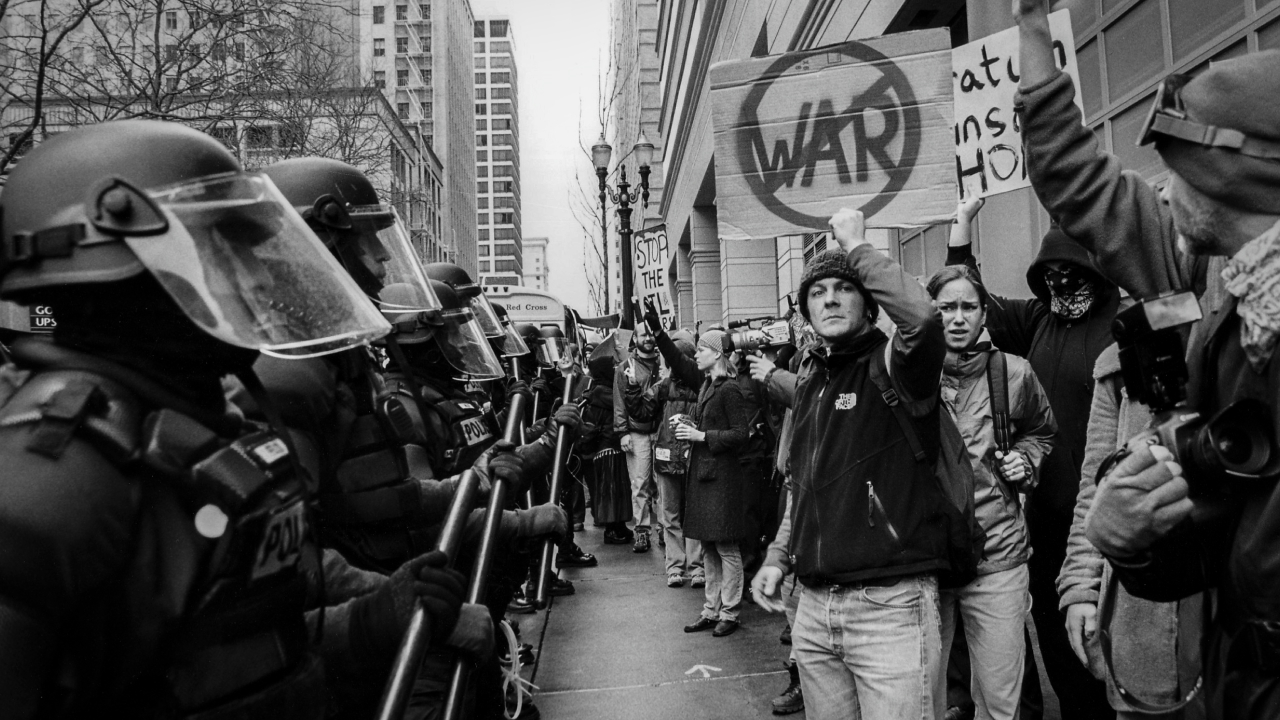
On May 1, 2000, a parade advertised as a family-friendly celebration of worker power and the coming of spring only made it a few blocks before it was attacked by the mounted patrol. Some in the crowd responded by throwing things at the cops, and the police declared a “street-level emergency.” Riot cops then pushed the group to Waterfront Park and ordered them to disperse. But as the marchers left the park, police attacked again and again, dividing the crowd into smaller and smaller groups. Dozens were injured—clubbed, pepper-sprayed, hit with less-lethal munitions, or trampled by horses.
The police and their media apologists immediately began making excuses, focusing especially on the absence of a parade permit, the presence of “people dressed as anarchists,” and reports of vandalism and violence. But Willamette Week conducted a careful analysis of the cops’ video evidence and found that they were lying on almost every point: no broken windows, no barricaded streets, no terrified schoolchildren. Even The Oregonian came to decry the use of “riot control where a riot didn’t exist.” Complaints poured into the mayor’s office.
A week later, the mayor and police chief held a public forum at the Maranatha Church of God. Nearly five hundred people attended, and dozens demanded answers that the officials onstage were unwilling or unable to provide. Kroeker’s only response to the controversy was to promise better “command and control.” His feeling, apparently, was that the problems on May Day derived not from too much militarization, but from too little. His solution was to create the Rapid Response Team, which drilled in “Mobile Field Force Tactics.” The RRT consisted of between sixty and seventy officers, organized into squads made up of one leader, twelve officers, a videographer, and a medic from the Fire Bureau. Over time, Portland’s riot squad would be looked to internationally for its expertise, advising and training similar units around the world.
Reclaim the Streets, Protect Our City
May Day 2000 was an early example of an emerging police strategy, which scholars would later describe as “strategic incapacitation.” Under this theory, Patrick Gillham writes, police distinguish between two categories of protesters—contained and transgressive—in order to target those perceived most likely to engage in disruptive activities. Contained protesters, often referred to by police as “good protesters” are generally known by police, use conventional and legal tactics, negotiate with police, make self-interested demands, and are generally older. By contrast, protesters considered “bad” or transgressive articulate more abstract demands, use unpredictable and often illegal tactics, do not negotiate with police, and are generally younger.
The “contained” protestors would be allowed to proceed with their demonstrations, albeit within strict boundaries. The “transgressive” protestors would be met with coercive force. The process of classification would depend, in the ideal case, on extensive intelligence into all the protesting groups. At the start of the new century, however, the Portland Police often relied on the permitting system as a blunt instrument dividing the “good protestors” from the “bad.”
In the year following May Day 2000, the riot cops got plenty of practice with their new approach.
A September 26, 2000 “Reclaim the Streets” event in downtown Portland was scheduled to coincide with similar events worldwide, including anti-IMF/World Bank demonstrations outside their annual meeting in Prague. The RTS organizers, mostly young people who lived on the streets, closed off a city block for an unlicensed dance party. As Copwatch observers described it, police aggression then “turn[ed] what had been a pleasant, mildly disruptive gathering into a tense stand-off that degenerated into indiscriminate police violence… Police attacked RTS participants and bystanders alike with horses, pepper spray and clubs.” Regardless, the protestors held the street, and as hours wore on the size of the crowd grew to over three hundred. The police action itself seemed to draw people to the demonstration. By 7:30, the cops were standing impotently in back-to-back skirmish lines. The crowd then started to march, weaving its way through downtown as the cops struggled to keep up. At least thirty people were arrested over the course of the day, and dozens injured, two with concussions. Commissioner Jim Francesconi praised the police for their “amazing restraint.”
A few weeks later, an October 22 March Against Police Brutality proceeded without incident, a rare success that the police would cite again and again to show the ease and utility of the suddenly-crucial permitting system. What they neglected to mention was that the permit cost the organizers hundreds of dollars, granted police control over the timing and route of the march, and required one marshal for every ten protestors. Police used the application process to collect intelligence on the participating organizations, and the demonstration itself was subjected to intense and conspicuous surveillance and a heavy police presence.
Less cooperative were the two thousand or so champagne-happy revelers filling Pioneer Square on New Year’s Eve as 2000 turned to 2001. Police claimed that members of the crowd, disappointed to hear that there would be no fireworks, started spontaneously breaking windows and attacking cops. Nine were arrested and an unknown number injured as police tried to break up the crowd. Witnesses, however, told the Portland Alliance a different story, saying that the disturbance began when the police suddenly attacked a pair of drunk but harmless teenagers, leaving a pool of blood and several teeth on the sidewalk as they dragged them away—then people started throwing bottles.
Despite or because of his officers’ uneven record, when Kroeker appeared before city council a few weeks later to explain the Bureau’s crowd control strategy, the downtown business class showed up in support, packing council chambers and wearing stickers reading “Protect Our City.”
Counterculture Crackdown
As winter turned to spring and everyone started to think again about May Day, the police brought new pressure to bear against the anarchist counterculture. Early 2001 saw an increase in police harassment of the local anarchist/punk scene, with cops regularly stopping, questioning, and photographing young people in black clothing, paying particular attention to patches and tattoos. That March, forty cops raided a party at a punk house in the Alberta neighborhood, charging in with guns drawn and beating numerous people with their fists, flashlights, and nightsticks. Police took Polaroid photos of everyone present and asked what they knew about the underground direct-action groups Earth Liberation Front and Animal Liberation Front. Nine people were taken to detox, though most were sober. Three were arrested, and two—Chad Hapshe and Bjorn Einertsen—were charged with assault and, amazingly, kidnapping. (The police alleged the two young men jumped Sgt. Michael Fort and dragged him into the house, locking a door behind him.) When the suspects were arraigned on April 2, two plainclothes police officers—later identified by Portland Copwatch as Officer James Stradley and Detective Sergeant Neil Crannell, both of the Gang Enforcement Team—videotaped everyone entering the courtroom.
Just before trial, Hapshe and Einertsen were offered a plea deal. To avoid risking a nine-year mandatory minimum sentence, they pled guilty to Assault III and were sentenced to ninety days, divided between jail and a forest camp, followed by three years probation. The prosecuting attorney admitted that the evidence for the original charge was lacking: “As the case progressed, it became more problematic whether the kidnapping could be sustained at trial.” “Why,” then, the Portland Mercury asked, “did the DA take a routine assault charge and for six months aggressively prosecute it as a trumped-up kidnapping?” The paper supplied its own answer: for the sake of “putting a scare on the punks and activists.”
Policing the Progressive City: Portland, Oregon, from Settlement to Uprising was published by AK Press in 2026.
Comments
No comments yet.
Add a Comment