Brenda Gail Hudson said her story shows how easy it is to fall into homelessness.
The youngest of five kids, she grew up in a loving home in Arkansas that ate dinner together every night at five o’clock. But her life began to fall apart when her father collapsed to the ground one night and died from a heart attack as she held him in her arms.
Then fifteen years old, she was sent to live with a relative in California, where she said she got hooked on drugs and alcohol. She quit school, was pregnant by seventeen, and ended up homeless. Now fifty-seven and living in Bend, Hudson said she’s been sober for fourteen years.
Two summers ago, her husband handed her an unusual letter inviting her to join a group of thirty Deschutes County residents to come up with solutions to youth homelessness. At the time, she was working cleaning houses and wondering how to spend her time after her daughter and grandson had moved out. For Hudson, the letter felt like a calling.
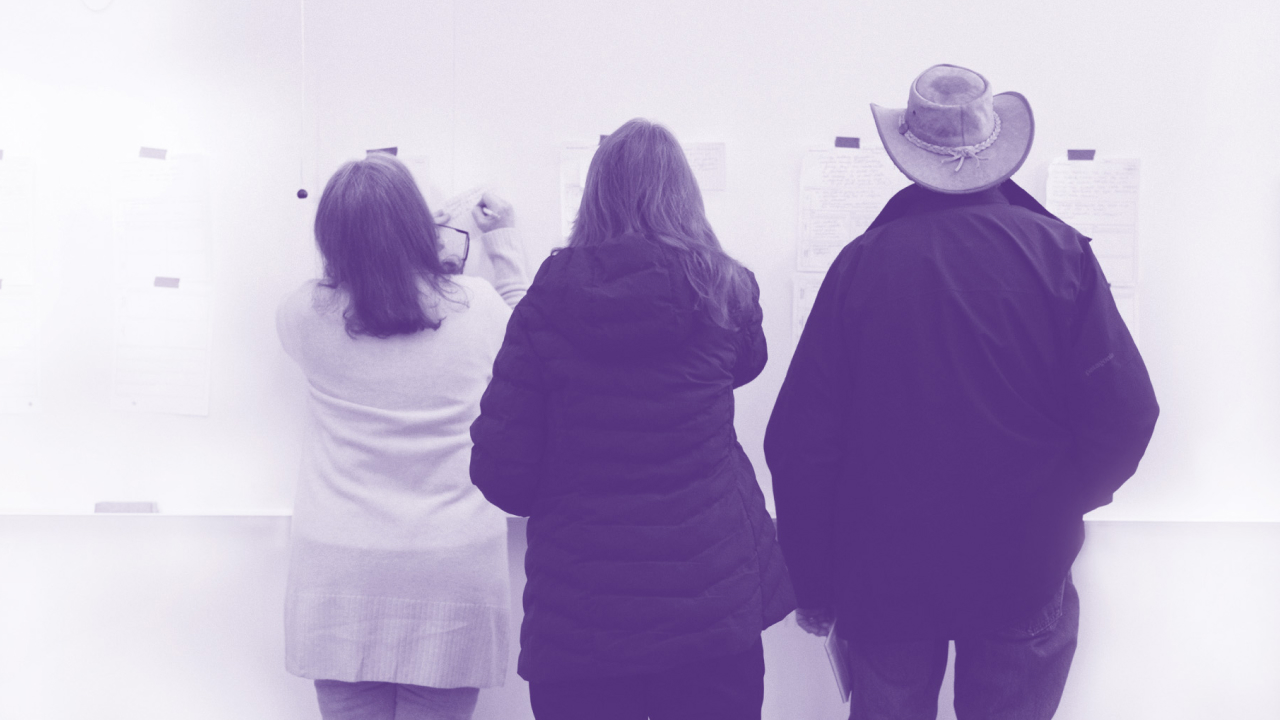
Over two weekends, she participated in what’s known as a civic assembly, a randomly selected and demographically representative panel of regular people who have access to expert information as they talk through potential remedies to pressing problems.
“My story seemed to have really touched a lot of people, and other people’s stories really touched me,” she said. “It’s just an overall good thing to get a whole group of people that don’t know each other to talk about something that needs [to be] addressed.”
Civic assemblies and other varieties of lot-based participatory democracy are catching on in Oregon and other states as a way to give regular people more say over their government outside of electoral politics. The idea is to create “minipublics” whose members will overcome their political reflexes while deliberating with people they might not normally talk to.
Oregon has a long tradition of democratic experimentation: It was the third state to adopt an initiative and referendum process, and the first to approve an initiative. Some experiments have focused on the kinds of participatory elements that are seeing renewed interest globally amid cratering trust in government and democratic backsliding. Some have run into challenges related to funding and follow-through from elected officials. But there are signs that these experiments could help rebuild civic trust.
Linn Davis, a program director for Healthy Democracy, a nonprofit based in Portland that seeks more deliberative public engagement, said that participatory democracy can solve policy problems while having a larger social impact.
“It can change how people perceive government: It’s not something [from] on high that does things to us and for us, but it’s a tool,” he said.
Hélène Landemore, a professor of political science at Yale University and the author of Politics Without Politicians: The Case for Citizen Rule, argues that using elections to distribute power for more than two hundred years has exposed the shortcomings of elected representation.
Elections favor those candidates with charisma, money, and connections—regardless of their governing ability, she said during a recent Oregon Humanities talk. Meanwhile, elections filter out shy citizens and exclude those outside elite circles from real decision-making,
she argued.
There is a more democratic way of distributing power, she said, which has its origins in sixth-century Athens. It involves selecting a group of citizens through sortition—that is, random lottery—who are then paid to participate in gatherings where they evaluate reliable information and deliberate before making recommendations on a pressing issue.
According to a database maintained by the Organisation for Economic Co-operation and Development, 733 lot-based citizen panels had been held worldwide as of 2023. This intergovernmental organization of developed democracies described the expansion of these panels in recent years as a “deliberative wave.”
Notably, civic assemblies helped pave the way for the legalization of abortion and same-sex marriage in Ireland. They’ve become integral in Paris and Belgium. Landemore said in an interview that in addition to better results, she’s seen how civic assemblies bridge divides.
“It really rewove the social fabric between people who normally would hate each other in the context of electoral
politics,” she said.
One of Oregon’s early experiments with participatory democracy was the Bend in the River Media Referendum, a nearly forgotten gathering spearheaded by Ken Kesey, author of One Flew Over the Cuckoo’s Nest and leader of the Merry Pranksters.
In the fourth and final issue of The Bend in the River Reality, a newsprint magazine produced for the occasion, Kesey wrote that the inspiration for the project came at a land-use conference after a Montana pig farmer asked the author if he was “one of them eck-ollygists flew in here to talk to yerselfs?” The farmer suggested televising the conference like a political convention and then letting “folks at home vote t’see who won.”
The result of this exchange was a four-day assembly of delegates from across Oregon who gathered in Bend on July 4, 1974, under the shadow of the Vietnam War and the Watergate scandal. (The undertaking was funded by a grant from the three-year-old Oregon Committee for the Humanities, which later became Oregon Humanities.)
More than one hundred delegates discussed what Oregon should look like in twenty-five years. That included managing the state’s population surge, putting a moratorium on nuclear power, regulating the use of computers to track personal information, and other topics. The public was invited to participate via ballots printed in newspapers.
Press accounts described the event as unwieldy thanks to the outsize presence of Kesey, an eccentric countercultural figure. The Oregon Journal noted “some sincere folks” among the participants, including a ten-year-old girl interested in park development and a “quiet elderly gentleman seeking social reform.” The paper concluded that the “question remains if this was a new experiment in grass roots government or a game
of charades.”
“We have spent so much time grinding axes—that’s why other people have been chopping down the trees,” Kesey commented on the event’s shortcomings, according to the Oregon Daily Emerald.
Years before Kesey’s experimental assembly, Ned Crosby developed the idea of “citizens juries” as part of his doctoral dissertation at the University of Minnesota. These juries range from a dozen to two dozen people selected to be a representative slice of a community. They then deliberate on a policy issue with the help of a moderator and experts.
In 1974 Crosby founded what would become the Center for New Democratic Processes, which has since worked on participatory panels across the country and internationally. By the early 2000s, Crosby had turned his attention to the way voters were increasingly struggling to find reliable information on initiatives.
Oregon’s busy ballot initiative system has asked voters to make sense of technical legal language and misleading campaign messaging while making weighty decisions affecting issues such as LGBTQ+ rights, state finances, and drug decriminalization.
To clear matters up for voters, Healthy Democracy proposed the “Citizens’ Initiative Review,” which applied Crosby’s ideas to Oregon’s initiative system.
These reviews focused on demographically representative panels of voters who were paid to spend multiple days evaluating selected initiatives, hearing from experts as well as supporters and opponents. The panels of around twenty members, supported by trained facilitators, would publish their findings in the voters’ pamphlet along with statements from members opposing and supporting each initiative.
“It’s a testament to the work of these [panels], and their quality,” said Davis, the program director for Healthy Democracy. “But it’s also a testament to the absolute garbage of misinformation around ballot measures.”
After agreeing to a trial run during the 2010 election, lawmakers made the Citizens’ Initiative Review permanent. That made Oregon one of the first states to institutionalize a sortition process, Davis said. The panels reviewed a total of seven initiatives, and voters followed their recommendations four times.
Other states and cities have since used similar reviews. Research has shown the reviews have had limited reach, but have improved voters’ knowledge of ballot measures and are more effective than conventional voter guides. One study found that more than 40 percent of Oregon voters sought out the Citizens’ Initiative Review statement, suggesting “widespread knowledge increase in the electorate,” according to researchers. Another study found that Oregon voters had more faith in the democratic process after becoming aware of the panels.
The legislation that established Oregon’s Citizens’ Initiative Review didn’t include ongoing funding. Healthy Democracy had to secure philanthropic support to pay for the panels’ facilitation services, which Davis described as untenable. The program has been on hiatus since 2016.
Davis hopes increased interest in the reviews will lead to dedicated funding from the state.
The same year the Citizens’ Initiative Review went on hiatus, a nonprofit that had been quietly finding common ground in a remote corner of Oregon was poised to expand.
The High Desert Partnership had secured a $6 million state grant that would transform the plucky nonprofit’s work: using a collaborative approach to improving land management for the benefit of migratory birds and livestock.
But the situation immediately became complicated, recalled Brenda Smith, the group’s leader. The award came on January 26, the same day as a violent confrontation that resulted in the arrest of right-wing agitators who led the occupation of the Malheur National Wildlife Refuge in southeastern Oregon. Federal staff were barred from entering the refuge during the ensuing investigation, just as the nonprofit was about to begin its work.
What allowed the project to advance, Smith said, is the same thing the nonprofit had spent years building: trust and cooperation between ranchers,
government officials, conservationists, and others.
“What we find a lot of times, especially with land management, is that there’s a similar vision of what a healthy landscape looks like,” Smith said, adding that disagreements are usually over how to
get there.
Harney County, where the refuge is located, is Oregon’s largest in size, and about 75 percent of its land is managed by the federal government. It’s seen plenty of friction between agricultural interests and federal agencies over land use. The High Desert Partnership began more than two decades ago when a refuge manager and a local rancher started talking about how to fix frayed relationships.
After getting conservation groups, land management agencies, and ranchers together, all agreed that invasive carp were degrading Malheur Lake’s water quality, Smith said. Managing carp was added to the refuge’s Comprehensive Conservation Plan, which has never been litigated.
Steve Grasty, a former elected official in the county, credited that approach with giving the community a sense of ownership of the refuge, which meant there was less local support for the armed takeover in 2016.
“Overall, this community owned that plan,” he said. “And when you had outside forces trying to take it in a different direction, it didn’t fly.”
Since then, the partnership has secured funding for projects that help wildlife habitat and livestock, Smith said. Those include improving century-old irrigation ditches and managing invasive plants: reed canary grass and a hybrid cattail.
The nonprofit’s work involves “one hundred cups of coffee” to foster relationships with community members and explain what participating in one of its collaboratives entails, Smith said. The group has six collaboratives that are overseen by contracted facilitators and organized around land use, economics, youth engagement, and other issues. The collaboratives seek broadly supported solutions instead of voting for competing projects, she said.
For Smith, the partnership’s biggest accomplishment has been its “spillover effect,” which has made the local school board and city council more collaborative.
Before retiring at the end of 2016, Grasty easily prevailed in a recall vote over his opposition to the occupation at the refuge. He said that while the partnership wisely avoided political entanglements, its work did influence politics.
“Those of us in elected office couldn’t ignore it,” he said.
Landemore, the YALE political
scientist, said that the US is catching up with the rest of the world when it comes to participatory democracy. The advantage of being late, she said, is that it can learn lessons from elsewhere.
One lesson: Participatory democracy efforts should be connected to a political process that can deliver results.
“There’s always the question of, ‘Are we trying to help an actual problem that is posed in terms that the system can actually do something about?’” she said.
In 2025, voters in Fort Collins, Colorado, approved a civic assembly’s recommendations for restoring an old sports stadium. More recently, Los Angeles used a civic assembly to recommend changes to the city charter.
In Oregon, citizen panels discussed city council compensation in Milwaukie, the housing code in Eugene, and the state’s pandemic recovery between 2019 and 2021. Milwaukie adopted its panel’s principal recommendations, while the influence of Eugene’s panel is less clear considering the complexity of its task, Davis said. The panel on the pandemic, he said, had less impact and was launched too early.
The Deschutes Civic Assembly on Youth Homelessness concluded in October 2024 amid a divisive national election in a politically divided county, sending its twenty-three recommendations to local governments. Those recommendations included making it easier for homeless people to get official documents, offering free internet hotspots and financial literacy classes to students, and strengthening the foster care system
Local governments, including those in the city of Bend and Deschutes County, committed to evaluating the assembly’s recommendations and responding publicly.
Their responses noted that some of the recommendations were already being enacted, including advocating
for more school support and increased public transit and supporting local nonprofits. The local school district noted that it was already offering financial literacy classes and hotspots, as recommended by the assembly.
“There’s a lot of things that are out of people’s hands,” said Hudson, who participated in the assembly. “And it’s just so much about the homeless—it’s a mess.”
Still, Hudson described participating in the assembly as “a gift from God” that led to a job as a case manager for a local nonprofit that works with homeless people.
Josh Burgess, the founder and head of the Central Oregon Civic Action Project, which organized the assembly, said delegates described the experience as “transformational.” About a year later, more than two-thirds reported being more civically engaged and having more trust in other citizens and institutions, even if they felt local governments could have done more with the assembly’s recommendations.
Burgess said it was clear that the assembly was unlikely to uncover a new solution to the problem of homelessness. Instead, he said, the assembly focused on priorities for building community solutions, which he said officials have considered in their decision-making process.
Landemore said she sees Bend and other communities’ first civic assemblies as trials demonstrating the value of participatory democracy. Compared to the narrower topics considered by civic assemblies elsewhere, youth homelessness is an extensive problem.
But Landemore said civic assemblies should become more programmatic, last longer than a few weekends, and have access to resources to address a problem’s root causes.
Burgess said he hopes to make deliberative assemblies a permanent feature of the region’s civic infrastructure. His group has already begun another on artificial intelligence.
Kyle Bozentko, executive director of the Minnesota-based Center for New Democratic Processes, said it’s ideal to have decision-makers fully support a participatory assembly.
“But they also have to be willing to give up power,” he said. “And that presents its own set of challenges.”
Jim Labbe grew up in Portland in the 1990s and recalls ballots dominated by anti-property tax initiatives like Measures 5 and 47.
“I always felt the Portlanders weren’t cheap, they just wanted accountability,” said Labbe, the interim leader of Participatory Budgeting Oregon. “To me that meant they should have more say over how funds are spent on their behalf.”
Labbe is now helping lead the effort to put that principle into Portland’s city charter as part of the Your 2 Cents campaign. If it qualifies for the November ballot, Portlanders will vote on whether to enshrine what’s known as participatory budgeting into the city charter.
An estimated seven thousand jurisdictions, including New York City and Boston, use a form of participatory budgeting, which was pioneered in post-dictatorship Brazil. The process typically involves a series of community meetings to brainstorm ideas that are then formalized and put to a vote.
Former Portland mayor Ted Wheeler pitched the idea during his 2016 campaign, and it was considered by the committee that authored the city’s recent charter reform. If approved, the current proposal would set aside the equivalent of 2 percent of the city’s general fund—about $16 million for the current budget—for participatory budgeting. Portland’s process would be designed by an oversight board and be open to all city residents, including noncitizens.
Putting participatory budgeting in the city charter is intended to prevent interference from city officials, which has happened elsewhere, said Carmen Brewton Denison, policy and communications director for Participatory Budgeting Oregon.
The selection process for city advisory panels can filter out underrepresented voices, she said. Additionally, participatory budgeting in other cities has focused on potholes and other infrastructure, as well as more innovative ideas, like mobile shower stations for New York City’s homeless population, she said.
If the campaign qualifies for the November ballot, voters will consider the initiative in the wake of a city budget shortfall that has meant cuts to city shelter beds and public safety programs. Brewton Denison said the initiative has been designed to ease concerns that it could cause further budgeting complications, while still giving the public a meaningful say over spending.
“It puts faith in community wisdom, and that we can actually engage in a productive civic discourse,” she said. “We have more wisdom in our communities than we even know.”
Comments
No comments yet.
Add a Comment