I dreamed that we were choosing between two record players. The first one played the record beautifully. The record was John Coltrane’s A Love Supreme. The player was small and old, though: wooden, scratched, kind of battered.
The second player was a lot shinier and bigger, and it had a lot more buttons. It also had a background whine, a machine noise that was so loud.
We tried all the different settings on this second player to see if we could get rid of that noise. There were lots of options to try, and some of the buttons and combinations of buttons did fun things, too. One setting made the music sound like it was underwater. I wondered, in the dream, if this setting had been used in experimental music. There were so many buttons and combinations, and we spent so much time trying this and trying that and trying to remember what we had already tried, that we forgot that the first player had played the record beautifully.
The horrible whine never went away. But as we messed with all the buttons we got used to it, or it started to seem like we could, at least. We became more interested in our futzing than in the project we had come here for, the project of listening.
When I woke up from this dream, I laughed. And my heart is broken, too. Oh, sweeties. What are we here for?
In the past several months I’ve had many spontaneous conversations that have quickly gone deep. These conversations have unfolded with a startling variety of interlocutors: grandmas in their flower gardens, old-timer neighbors who definitely don’t share my politics, a barista with a tree swallow tattoo, a fourteen-year-old canoe carver, a storyteller eating free lunch, a mail clerk. Two themes have echoed through all of them.
The first one: This is so hard. This is not working. We have to do something different. I feel this first theme as a quiet coalescing of intent that hinges on the we. We have to do something different. No one is going to do it for us. This theme often arises as we listen to my baby daughter babble in the stroller—as we consider her future, feel into what will be possible for her, or not.
The other common theme is mostly implicit: Hello? Are you there? I’m here! Do you hear me?
This one feels like we are trying to come back to our senses—like we know the social fabric needs repair, like we are pushing to rebuild muscles that have atrophied during the pandemic and in our touchless screen-centered culture of the past decade. I feel a sweetness in this, a vulnerable hope, a clumsy hurry to connect. A listening for the possibility of trust. Here we are, humans in real bodies in a real terrain, meeting each other for a moment. Do you see what I see?
At the end of one of these conversations I was given a little bag of pine seeds. The mail clerk had asked me how our community orchard project was going.
“We’re finalizing the lease,” I said. “A forty-nine-year lease! We’re going to start planting this spring.”
“Do you think you’ll want pines?”
“Hm! Maybe! Evergreens are such good habitat for the birds!”
She told me that she had collected cones from the most beautiful pine in town. When she brought the cones inside, they opened up and many seeds spilled out. Pine seeds are tiny with a delicate golden wing. They spin and spin as they fall. Their turning helps them disperse on the wind and drill into the soil where they land.
“What kind of pine is it?” I asked.
She didn’t know. But she gave me directions to the tree so I could go see for myself. “I don’t know what the seeds need to grow,” she said. “But I have a lot of them. Would you like some? For the orchard? It’s just the most beautiful tree.”
I picked up one of the little golden seeds and held it high and dropped it. It spun to the mailroom floor, gleaming. I licked my finger to lift it up.
The mail lady didn’t know that I had been dreaming all winter of labyrinths and medicine wheels, circles of council and protection, wheels of the year—that I have been singing “Turn Turn Turn” and “Simple Gifts” over and over—’til by turning, turning we come round right. I have been trying to map and feel, for myself and in myself and in my seasonally changing garden and in this end-of-the-road mountain valley in the corner of Oregon where I live, with all its difficult history and its possible futures, a kind of spiral understanding of time that can help us recognize when patterns are repeating and make a different choice this time around. Living processes are cyclical. Each revolution is a chance to change.
This is not working. We have to do something different. No one is going to do it for us. Have we grown enough to meet the next choice point differently? What about this time? How about now, together?
In many ways, the orchard, which my family and I are helping to steward into being with neighbors and our local Grange, is an outgrowth of these themes, these questions. An apple tree on standard rootstock can live for four hundred years. Together with our kids and our neighbors, we’ll show up over and over, imperfectly, to take care of the trees, to replace them when they die, to gather their fruits. We’ll decide what to do, together, here, for as long as I am alive.
Of course I took the little bag of seeds, with effusive gratitude. I tucked it into my baby’s stroller. I don’t know what those seeds need, either, in order to germinate and thrive—but if we listen closely, I think we will be able to hear it.
My sweet four-year-old son is spellbound by coral reefs right now. Cities of the Sea is a book from the library he’s been poring over as I have been wrestling with this essay. He will tell you all about different species of crabs and the life cycle of jellyfish and the kinds of sounds that a parrotfish makes.
My one-year-old daughter, meanwhile, is just learning to speak, and when she sees a bird, she doesn’t say “Bird!” as my son did at her age—she tries to call the call of that bird. We just returned from a place we love in the desert, a place that has been many places, and her conversational efforts have expanded to meet the Eek! and Craw! of scrub jays and ravens.
When I think about the future, it is a home that my children are living in. So I try to love the future: actively, rigorously, with all the breadth I can muster. The future is not something that is going to happen to us. It is something we are orienting toward, and making, daily. When I listen for it, today, I hear the buzz of bumblebees on the apple blossoms in our garden. I hear the tractor across the road, too, lifting its wide machine wings, spraying something blue on the alfalfa.
Some people say that our future is among the stars. Certainly a lot of signals and a lot of noise are already reverberating out from Earth—radiating into futures far from now. The man-made object currently farthest from Earth is Voyager I, launched in 1977. Voyager I has traveled the equivalent of sixteen billion miles. It is expected to reach a distance from Earth of one “light day” in November of this year.
Aboard each of the Voyager I and II spacecraft is a Golden Record carrying cosmic fingerprints of our planet and our species. There are measurements and ratios, formulas and images. And there are the Sounds of Earth: a message in Morse code, the plop of mud pots in Yellowstone and the rumble of waves on shorelines, rain and trains and greetings in many languages. There are songs on the record: Beethoven, folk songs from around the world, a Diné chant. Home songs.
Once you’re that far out from our tiny blue dot, all songs are home songs.
As grandiose as this project may seem, this effort that was made to distill all that we are here on Earth into one recording, it’s also beautiful to me, this message in a bottle that tries to hold a telling of us. An echo of us beyond us.
It’s also so, so lonely.
Voyager I and II will be in empty space for forty thousand years before they come anywhere near another planetary solar system. It’s hard to even imagine the shapes of our voices at that scale of time and distance. The odds of any sentient being “out there” in the vastness ever finding that record and hearing those sounds are close to nil.
The odds of creating a new home for ourselves in space, ever, are also close to nil. With all our tools and cleverness, we have not been able to create a closed ecological system to keep so much as a shrimp alive for more than a few years—not even here on Earth, where we are sheltered from radiation and where we are not alone.
Life is here, where we were made, where we can breathe and sing.
If anyone finds the Golden Record, it will probably be us. We have not lost track of Voyager I, the machine traveler that carries what we’ve sung. It takes an array of seventy-meter-wide antennae to receive its signal, and a sophisticated amplifier to hear it, but we are still listening. We can go to NASA’s Golden Record website any day and listen to the Sounds of Earth: riveters and chimpanzees, whales and waves, the sounds of a mother kissing a child. We can go outside and listen. Try it. What rings true? What feels like home? What sounds would you choose to share us, now?
Some days I can hardly hear the Sounds of Earth I want to hear, the machine whine is so loud. Some days I am futzing with buttons and I forget. Some days I am bent under a powerful grief, wondering if my son will ever see a coral reef. So many of those undersea cities are already graveyards. Some mornings I read a think piece that does not give a damn about birds or about my children and I feel a spike of adrenaline and, like one of the tree swallows in one of our birdhouses, hyper-oriented to threats against the nest, I swoop and rage, like I will fucking claw out the eyes of these men who are stripping the future down for parts to make machine gods and go to Mars.
Other days I laugh. Oh, sweeties. The future is not something that happens to us. We are trying to find our way. The choice before us is not a choice between static, predetermined futures, but rather an ongoing orientation: What do we love? How shall we make more of it? What can we do, how shall we move? Do you need what I need? Do you hear what I hear? What are we going to do, together, here?
Early parenthood is the most neuroplastic period of an adult’s life. Anyone who is in a close caregiving role for an infant experiences a powerful shift of hormones and identity, a relational and physiological rewiring to make space for a radical reorientation to care, protection, and learning. Mothers who have carried a pregnancy, with all the hormonal and physical and social changes of childbearing, birth, and postpartum, are as neurophysiologically ready for adaptation as an adolescent. There is incredible opportunity in this time to develop new patterns of behavior and thought.
Some of the changes we experience are initially experienced as losses; “neural pruning” temporarily reduces the size of a new mother’s brain, with a loss of gray matter of up to 5 percent, to make space for the emergent connections that are required when you suddenly, ardently, love a vulnerable little creature who will hopefully outlive you.
“Bounce-back” culture (“Get your body back! Get your life back!”) minimizes the potential of this time. But it is precious.
Traditional Chinese Medicine holds that the way a mother is cared for and the things she pays attention to during the first forty days postpartum will lay the foundation for her next forty years.
Giving birth to my son was so traumatic for me, and his first six months so full of additional stressors and ruptures—a skull surgery for him at two months old, the suicide of a close friend—that I knew it would be impossible to “bounce back” to anything. At first I felt like a great fire had destroyed me. I was gutted, hollowed. We needed so much help. Help was given: Thank you. I cried every day for months. I felt love and loss at scales I had never been inside before.
I spent some time that fall in the redwoods with my partner and my brother and my baby son, sobbing and praying. I thought that if I sat inside the black burnt cave of a tree that had survived a fire, I would get answers about what to do, how to rebuild what was broken, how to mother. How to grow more fully into myself with each new revolution around the sun, despite my lost center. I thought I would be given directions or a song. What I heard instead was a perfect, velvet quiet. Hush. Listen. Hush.
When I say that my daughter is trying to speak back to birds in their own language, I can also tell you that when birds sing, their brains release oxytocin, the hormone that helps earthly creatures know that we belong.
And when I say that my son is in love with coral reefs, I can also tell you that the tiny coral polyps, the babies of a coral reef, are all conceived at once in the great froth of eggs and sperm that the entire reef releases together into the warm water under a summer full moon. These polyps, which were once thought to be passive drifters, actually have just enough power of locomotion to subtly influence their direction of travel along the great currents of the sea. And what they are drawn to, what calls them to orient and locomote and eventually invites them to attach to a likely scaffold and begin their growing and building, is the sound of a healthy reef.
So, in the good work of encouraging new reefs to grow in places that may be more resilient to climate change and ocean acidification, or in sanctuaries protected from the many other ways we are laying waste to life in the ocean, those who are trying to help the corals can play the sound of a healthy reef, and the polyps will try to come home, and make it.
It feels important to say that this discovery about the coral polyps was made with the help of AI, which analyzed a vast volume of bioacoustic and other data to lift this homing signal out of the noise. It feels important to say that the humans futzing with that machine at that time were asking this question: How do corals make their way home?
It feels important, too, to try to say something about how hard this is, how fraught: We are destroying your home, over there, but let us sing you a home song, over here, instead, and maybe here, instead, you can make your home, little ones.
I want to make futures with the people who feel how hard it is, who are asking questions like this, who are pointing our most powerful tools to such purposes—who are trying to listen closely enough to find the home song in the noise.
Coincidentally, the one rock and roll song on the Golden Record, Chuck Berry’s “Johnny B. Goode,” was the theme song for the radio show my brother John ran in high school.
During a long conversation recently about what is really important, John and I tried out a shorthand for the fork in the road we both see: parking lot world vs. gentle green world. What we are trying to protect—in ourselves, in those we love, and in the world—is adaptive capacity: a breadth of possibilities and the ability to choose.
My brother says we should amplify stories about the gentle green world, and the choices we should focus on are choices about how to get there. He feels that if we keep repeating the story about parking lot world over and over—apocalypse fire war noise launchpad matrix grid machine—it will be the only story we know, and so it will feel inevitable. He says we should mute that story and tell stories instead about the people who listen to coral reefs.
When I asked my brother what he would choose to put on a Golden Record if one were to be sent out into space right now, what Sounds of Earth he’d share at this moment, he said: “The sounds I’d hear sitting next to a rainforest next to the ocean. I’d send the best and richest of what Earth has to offer, the lively space of encounter between these two extraordinarily biodiverse ecosystems.”
“And do you think that is what we would actually hear,” I asked, “if we zoomed out from Earth and listened?”
“It’s one of the things we would hear. Those sounds are still happening. It’s important to be aspirational. The kinds of stories we tell about Earth and about ourselves matter,“ he said. “I would want to send out a signal from Earth that showed how precious it is.”
“And if you were thinking of that signal as a call for help?” I asked.
“There are lots of different ways to call for help. Panic and fear are contagious. So is love.”
Did you know that the groove on a record is one single spiral waveform? The music we hear was physically imprinted on the sensitive medium of the vinyl. The groove—with its bumps and valleys, its tiny texture—holds, somehow, every sound that was made in the recording session: every note of every instrument, every drumbeat, every swoop and growl of every voice, the reverberating textures of the air in that room. Every breath that was breathed during the session is stored in that wave. When we play the record, it turns and turns and the needle travels—spirals—in toward the center, feeling the groove, sensing the wave, somehow sending what it senses to the receiver, which translates the wave back into the sounds that were made on that day.
I don’t really understand how this works. But here we are, listening.
The Morse code message on the Golden Record, decoded into alphabetical language, is the Latin phrase “Ad astra per aspera”—through hardship to the stars.
My son doesn’t want to go to the stars. He hears people talking about colonizing Mars and doesn’t understand why anybody would want to go to a place without birds, grandmothers, or rivers. He wants to stay here on Earth.
But he recently had a dream about going to Mars. “How does a tree grow to Mars?” he asked me when he came to our bed to snuggle first thing in the morning, as he does every morning.
“That’s an amazing question,” I said. “What do you think?”
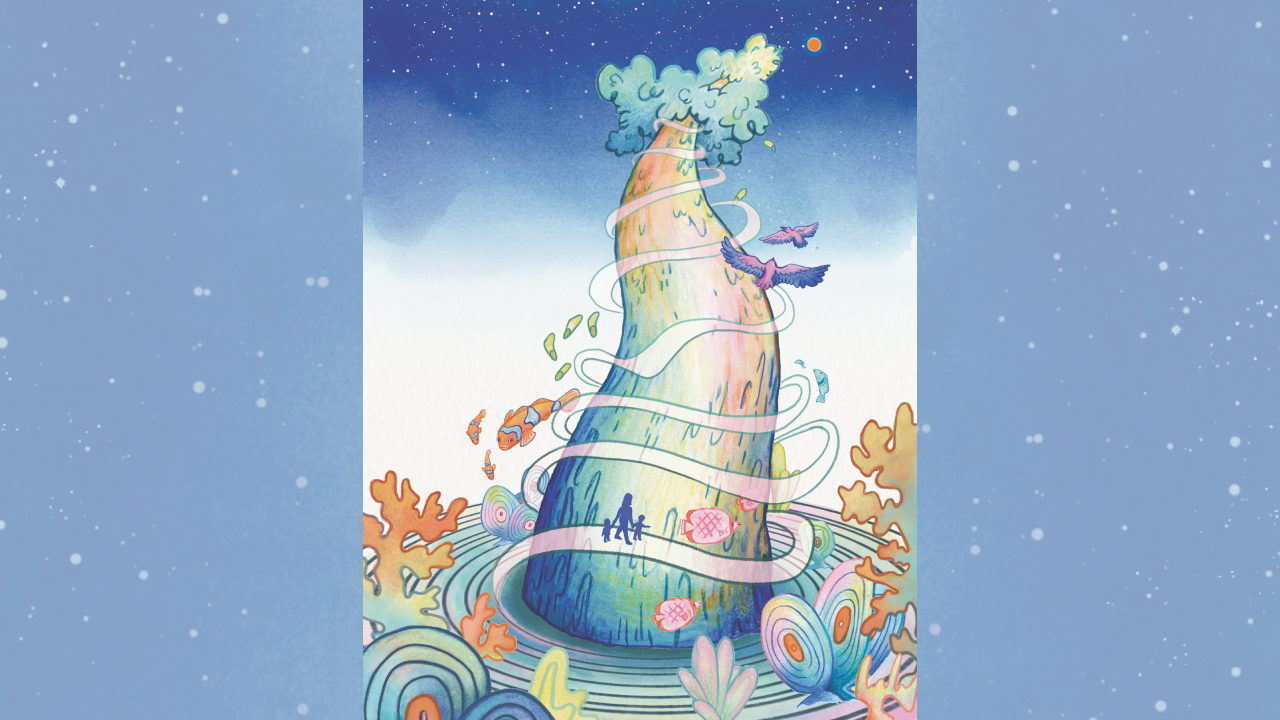
So he drew us a picture of his dream: a beautiful blue and green circle of Earth, and emerging from Earth a huge tree with many branches, like a ladder. High in the branches the tree held a beautiful red circle: Mars.
How does a tree grow to Mars?
I don’t want to go to space. Not one bit. The people who think of Earth as a launchpad are wrong, and they are cutting our home out from under my children.
But I don’t want to close down the future, either. I can see the seeds whirling. I can hear us changing. I can feel myself growing: a new ring each year, with each revolution around the sun, rooted, with room inside myself for more than I could hold before.
So let’s see if we can see it together. If we are going to go to space, let’s grow there. With roots here, on the only planet where it is possible to be alive as we are. Let’s make soil as we grow to Mars. Let’s reach for light as we grow. Let’s be nourished and entangled underground. Let’s grow up and down and out there slowly, a new ring each year: a ring that met a fire, a ring that holds a change, a spiraling record of conversation with insects and drought and rain. Let’s go with a craw of ravens, an eek of jays. Let’s be a home to nestlings as we grow.
If we’re going to go to the stars, let’s be Life finding a way.
Google’s AI says the Latin phrase for this could be “Domum per aspera.” Through hardship, homeward.
Let’s put that on our record. But instead of Morse code, this time, let’s sing it. Maybe the tune is from another old song about homecoming: “Dona Nobis Pacem.” Maybe we sing it in a round.
Comments
3 comments have been posted.
Your utterly beautiful article gave me so much hope. I mentioned it to several friends as well as in my newsletter for the equinox. Thank you.
Joanna Brook | September 2026 | Eugene, OR
Wonderful piece Christina. Your Dad shared it with me. Gives me hope.
Robert Beck | September 2026 | Wisconsin
Your words always bring me such joy. Thank you so much for sharing these thoughts!
Leslie Shalduha | August 2026 |
Add a Comment