My mom was working dispatch at the county 911 office the night the call came in. She had fielded plenty of calls in her time about crashes on the back roads of rural northeastern Missouri, but none quite like this.
Sue, the deputy on the line, did her best to help my mother emotionally prepare.
“Loretta, I know that you know the job and I know that you’re going to do the job, but this one is going to hit home,” Sue said. “I’m going to give you a plate number and you’re going to know it. And you need to call Flight for Life.”
In a real small town, people often know one another’s license plates. My mom certainly knew the numbers the deputy read off, as would many others around Paris, Missouri. The car belonged to the Carter family. The father was the music minister at First Baptist. He and his wife led all the youth programming there. The vehicle in question was owned by their teenage daughters, Kayla and Alicia.
Kayla and Alicia, best friends to my sister, Nora. Alicia, girlfriend to the eldest of my younger brothers, Mark. Kayla and Alicia, who had just been over to the house the night before, eating cake and ice cream. Kayla and Alicia, who so often had one or two or more of my siblings in the car with them.
My mother placed the request for emergency medical transport before forcing another dispatcher to take over the call. This was a breach of protocol, and her coworker started to protest before she looked at the screen—those plate numbers and names—and understood what was happening. Mom fled the county building, and, seated in her own car, screamed as loud as she had ever screamed, before driving home as fast as she could safely go.
At the house on the corner of Walnut and Monroe, all the lights were on, blazing through the winter evening. Relief set in for a moment as she saw all her own children accounted for.
Then, taking a breath, she delivered Mark and Nora the hardest news they had ever received in their lives.
I was the much older sibling who had already been gone from home for years when all this happened, and I heard about it late, as I did most things. I would only come to understand later what it had meant for everyone involved, and to more seriously wonder about its lasting impact. To think about how Mark didn’t date for years. Or how Nora didn’t seem to make a lot of new close friends, when she’d had so many as a teenager. How whole swaths of life seemed to be cut away from them, made strange and impossible to have.
That understanding came slowly, then more abruptly, the night a driver decided to run a red light a few blocks from my apartment in Brooklyn, New York, throwing my body from the crosswalk and landing me at Kings County Hospital with a broken face. In the emergency room, my heart stopped, then started again, and while I didn’t see any tunnels with gleaming lights at the end of them, I did experience the before and after of a major trauma, and learned how one false move with a steering wheel or brake can put you outside of your own body and your own life, uncertain about how to find a way back in.
Everyone in town knew the stretch of road where the girls died—where their car skidded on the ice that had gathered on a sharp curve, then hit a concrete culvert and flipped down the embankment. Others had been hurt there before. But it would take those two deaths, with their overflowing memorial in the church at the heart of town, before anything was done about it.
I’d had an uneasy relationship with cars even before I was mown down by one.
My path was different from that of my younger siblings, who did most of their growing up in that small Missouri town and had only faint memories of riding a city bus. We moved there from Portland when I was sixteen. I’d given hardly any thought to getting a driver’s license, as the buses in Portland had always taken me where I needed to go. And on the cheap, too. Other people associate cars with freedom, their first big chance to move through the world on their own. But me? My big memory of mobility-based autonomy was being allowed, at age eleven, to ride the not-quite-two miles on the No. 71 bus from Brentwood-Darlington over to the library in Woodstock. Buses and books: worlds opening up into worlds. The bus transported me outside the confines of our neighborhood, and books would take me to all the many places I didn’t yet know how to name.
When we moved to Missouri, I got around by making friends with others who had cars. Then, in short order, I was back in a city, riding buses again. I did acquire a license, for the sake of a post-college cross-country road trip. But a car in a city? Why would I ever bother? And as the seriousness of climate change grew with each passing year, so did my advocacy for a world with fewer cars and more buses and bikes.
Then there was that fateful night in Brooklyn. After that, the noise and pace of cities became overwhelming. My concussed brain couldn’t handle it. My nervous system felt overloaded too easily.
I moved back to the Northwest and tried living in the major yet smaller cities here, but the frequent close brushes with cars and the volume of traffic kept me on edge. I found myself sitting across from therapists, discussing PTSD and CPTSD diagnoses.
I became convinced that living in a small town was the answer. Less traffic, less noise. Yet it seemed to be common sense that to live in a rural place, I would need to be able to drive. By that time, my eroded driving skills had fused with the fear of harming someone else like I had been harmed—or worse, like Kayla and Alicia had been—to the point that the mere thought of driving led me to panic, my shoulders and stomach clenching with anxiety, my breath short.
Still, I tried. For a while I had a patient partner who watched me repeatedly sit in the driver’s seat of his Volkswagen only to shake my head and make him trade places. I eventually graduated to tepid rides in the cars of friends, creeping around a few city blocks. That’s about as far as I got for a long time.
At last, I took a gamble and moved to a small town anyway, one that according to my own research and experience seemed like it would give me the best chance of successfully getting around using some combo of bus, bike, and my own two feet.
That’s when I came to live in Oregon’s Rogue Valley, where I discovered just how wrong the “common sense” about transportation in small towns can be—and learned that the concerns I and other transit advocates too often label as “urban” are just as valid in a rural context.
I began to see more links between my siblings’ experiences and my own, and to think about the ways that cars tear us away from life—not just in the form of major trauma, but in more mundane and everyday ways.
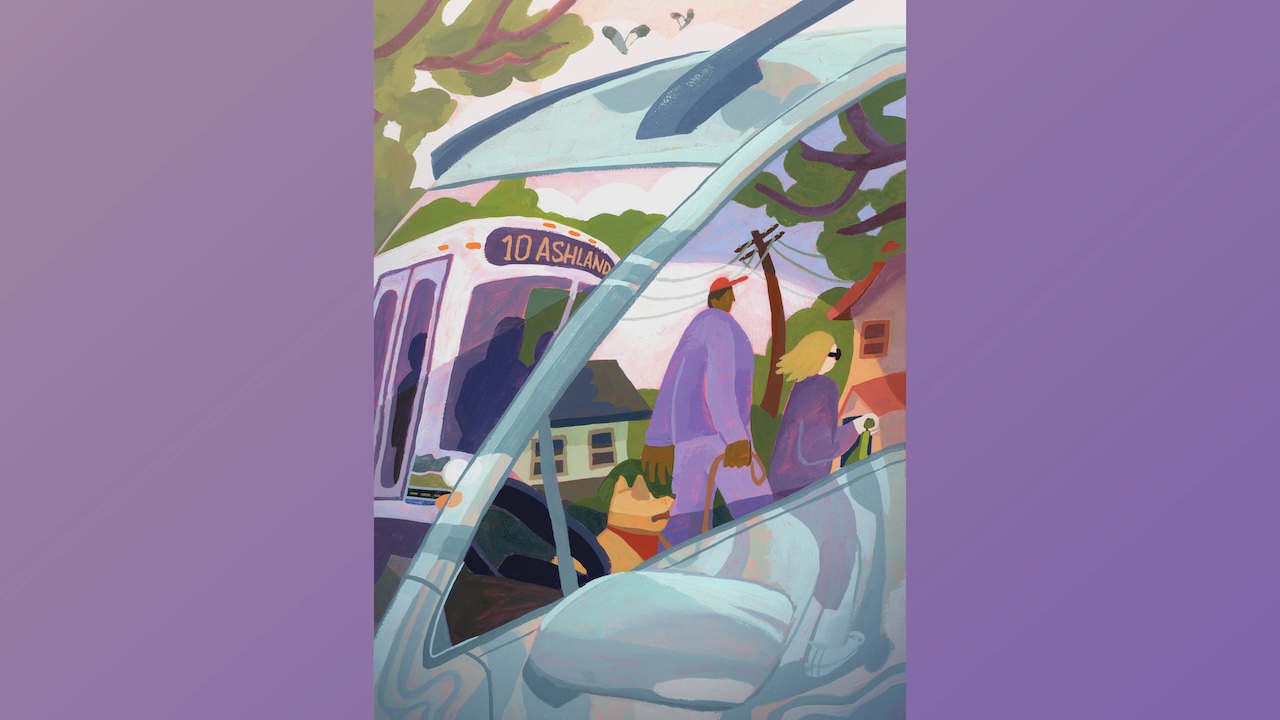
“Bus blindness,” Katrina Ehrnman-Newton calls it. Thin and petite, in a skirt and cardigan, she looks the picture of a librarian, which she is. She’s also a newly elected board member for the Rogue Valley Transportation District, having campaigned on a platform of bringing a transit rider’s perspective to decision-making.
We’re meeting for coffee just up the street from my Ashland apartment and talking about why people appear unable to see these large, colorful vehicles moving through town. I’m so glad she has a name for this phenomenon, which I witness often yet sometimes think I’m making up.
Bus blindness looks like my conversation with a woman who has worked for decades in a store on Main Street—who, when I told her how I get around, asked simply, “There’s a bus?” Main Street, where the primary bus through town runs regularly three times an hour.
Katrina smiles in recognition. “Every twenty minutes!” she emphasizes.
It also looks like the older resident who told me she had to miss the reading in nearby Medford by an author we both like. “I don’t like driving at night,” she said.
“I don’t either,” I told her, “so I took the bus.”
She tilted her head and puzzled aloud over her failure to consider this option. “I used to take the bus all the time in other cities,” she said. “I don’t know why, but I just don’t think to take it here.”
Katrina knows the bus connection to Medford well. Before taking her current position at Southern Oregon University’s Hannon Library, she commuted there by bus every day for her job with Jackson County Library Services. There are fifteen branch locations in the JCLS system, and she’s been to all but two using transit.
“I got all the way to Shady Cove,” she tells me. “And I have gotten to Ruch. It’s hard, but you can do it. There is not a bus that goes all the way to Prospect or Butte Falls. And that is sad, because I would have liked to scratch those off.”
People in the area don’t usually hear “Shady Cove” and think “public transit,” but Katrina knows the two coexist. And she’s emphatic that they need to. Transit isn’t just nice to have in rural areas; it’s a necessity.
“I’d like to see us continue to center—in the way public transit operates—the people who absolutely have to have it. Because I think when you do that, you really, ultimately, you catch everybody.”
She continues: “When you say, what is the worst-case scenario? … They need to be in Shady Cove in the winter and are unable to walk. How does that person get to Medford to go to a necessary medical appointment? You need a small functional bus that can go up into a mountain and either has an additional vehicle to connect with them to get them to the bus, or something like that, and then back down. It’s like, okay, how are we doing that? And how often can we do that? Is there a way that we can do that on demand so that we’re not setting ourselves up for failure?”
Katrina will have her work cut out for her. As I write this, news is coming in of drastic cuts to the Rogue Valley Transportation District system, a result of the Trump administration’s withholding of federal transportation dollars to Oregon because of its status as a sanctuary state. No matter that he won the popular vote in Jackson County—regardless of political persuasion, residents here are facing job losses and an inability to get to work because of this politicized use of the national transportation budget.
I worry about how this impacts not just my fellow bus riders, but all the good work RVTD and other local transit districts have done—not just in offering service, but in challenging the idea that bus systems can’t work in rural areas.
The perception that transit doesn’t exist in the rural US is so persistent that dedicated media, this essay included, must be generated routinely in order to correct it. Regionally, the Stop Requested series from Oregon Public Broadcasting has done a great deal of work on this front, introducing listeners to public transit routes connecting the locations of OPB’s radio transmitters around the state. But its success is due in part to what it takes for granted: that listeners and readers believe rural transit to be a novelty, something unfamiliar and slightly exotic.
Think about the rural places you know. Do you imagine them connected to an entire transit network? Filled with bus stops and bus riders? Many are, no matter how limited or idiosyncratic the service might be.
I’ve started using the word uncanny to describe bus blindness and similar phenomena. Uncanniness is when something that was once familiar is made to feel unfamiliar or strange, even creepy. Public transit—once the ubiquitous and traditional way of moving between small towns in the countryside—has come, in the current era, to seem out of place, untrustworthy, or even nonexistent.
This erasure comes not only from the outside, but also from those who live in these places and adopt the dominant cultural blinders, denying what’s right in front of them, from bus riders and buses to entire transit systems.
How does this collective inability to see what exists around us come to be?
We could claim a conspiracy on the part of auto companies and highway construction interests, patterns of vehicle dependency encouraged by car-centric planning, etc. We could talk about cycles of disinvestment even in regions that talk a big game on caring about climate; we know that transit averages half the carbon emissions of driving, yet even here in Oregon the state legislature failed to advance any meaningful measures to support transit in this year’s transportation package. Disinvestment means less reliability, which in turn feeds distrust in transit systems as a method for getting where we want to go.
I couldn’t get there that one time, so I probably can’t get there this time. And so on.
But this leap from I probably can’t get there to no one can get there, and from that to transit doesn’t exist, is curious. It’s an instructive example of how the logic (or illogic) of culture actually functions: not in linear proofs, but in a slide of loose associations, reasonable evidence drifting into error and denial.
Such popular illogic is one small part of how the monopoly of car culture shifts our very reality. It’s not just that we somehow can’t see the buses and bus stops right in front of us: We actually rebuild the world to fit our misperception. If we can only imagine arriving by car, then in order to get to the places we want to go, we justify constructing more roads, more lanes, more parking lots, etc. That makes it harder to walk and takes money away from transit, making it harder to imagine going anywhere without a car, and round and round we go.
This is how you end up with teenagers all across the country driving solo on icy back roads every winter, risking their lives.
The numbers support what might otherwise read like hyperbole. Globally, vehicle collisions are the leading cause of death for young people. That includes young folks inside cars but also many outside of them—those just biking in their neighborhood or walking to school.
And in the United States, rural communities are overrepresented in traffic fatalities: The death rate per mile traveled is 1.5 times that of urban areas. The US Department of Transportation reports that “over 83,000 people died on rural roadways” between 2017 and 2021. While only 20 percent of the nation’s population lives in rural areas, those areas account for 43 percent of all roadway deaths.
Those trends are true here in Oregon. Take Jackson County, where I live. Multnomah, the most populous county in the state, has 3.5 times the number of people we do. But most years it has only about twice the number of roadway deaths.
More of us are forced or compelled to drive, and more of us are dying as a result.
When I moved to Ashland, I knew I wasn’t coming to a transit utopia. I have been happy to meet others locally who share my enthusiasm for car-free small-town life; the lively block parties and group bicycle rides put on by Streets for Everyone, a project of the Ashland Climate Collaborative, are full of such folks. But I can tell that, more often than not, I become an object of curiosity in others’ eyes when I mention the bus as one of my main modes of travel.
This is especially true now that—at last, in my forties!—I have my own car for the first time. Why, I can see people thinking, take transit when you can drive?
I could tell them everything I’ve just shared here, but I’ve learned the hard way that sharing collision statistics is a good way to kill a conversation.
And it’s not just those numbers that keep me opting for buses or bikes or just a longer walk. Becoming a driver taught me about the ways that cars reshape how we experience the world—and if we experience it at all.
I acquired the car for a statewide organizing job I dearly wanted that required regular trips all around Oregon. By this point, after some time with an adult driver’s ed instructor, I was feeling more sure about my own driving abilities. I was still holding plenty of anxiety, though—enough that I didn’t want a salesperson breathing down my neck during test drives at a dealership. I found out I could avoid this by using the powers of the internet, so after doing extensive research, I purchased a 2020 Subaru Forester online and had it delivered to my door.
Then, on my initial drive out—solo at the wheel for the first time in twenty years—panic of a new and unexpected kind set in. This wasn’t my old dissociative PTSD fear. It was a new form of heightened alert and vigilance, my whole body sure that something was very wrong, but grasping to identify the exact source.
I slowed down less than a block out, wondering if I should turn back. My palms grew damp. Maybe I couldn’t do this after all; maybe my whole list of all the reasons not to drive were very good reasons and I was making a terrible decision by choosing to ignore them and get around this way. Maybe I could go home and return the vehicle and go back to forever being a pedestrian and a friend who bums rides when needed.
Then it clicked: It was the silence. Beyond the slight hum of the engine, I couldn’t hear anything. My body had none of the usual sonic feedback it used, whether walking or biking, to assess its pace while propelling itself through space. There was no wind in the trees, no distant cries of children from the nearby elementary school at recess. The whole world was muffled, including the sounds of passing vehicles—a cue my brain typically used to judge their distance and hence my own level of safety.
How was I supposed to move through the world without making use of basic sensory input? I was distraught until another block later, when I thought to roll down the window. The world came rushing in: I could hear the approaching car at the volume I typically recognized from the sidewalk. There was the breeze. There was the always-barking dog at the neighbor’s house. My whole body relaxed. I drove on, completed a loop through town.
Eventually, I would learn to keep the windows up without my evolutionary training throwing my nervous system into overdrive. But it would take time.
I’m not the first person to make the argument that modes of travel other than driving, especially walking, are better ways to truly experience and know the place where one lives. You have time to see, to listen, to pay attention—to the land around you, as a pedestrian, and to the people around you, as a transit rider. But I never believed this with as much conviction as I did that day I really became a driver.
All my trips on foot, or trips to the bus stop where I sit and wait or stand and wait, are done with the fullness of the senses I have available to me. It’s not always pleasant, waiting as the trucks rumble by, or accidentally breathing in while passing a garbage can roasting in the afternoon sun. But it is a real, head-on experience with the world in its fullness. It is not a form of walled-off escape.
Of course, many people like the quiet of a car’s interior precisely for that feeling of escape—it’s a feature of luxury vehicles for a reason. But what does it mean to routinely move through the places we live in a machine designed to encourage escapism? What are we trying to escape—our own homes? Our own communities? How does traveling in a car impact our ability to perceive the facts of the world, to know where it is we are? And what does it mean to do it in a place like Ashland?
Many people move to smaller towns or rural places with some notion of being “closer to nature,” as well as a chance at having “real community,” in contrast to “built up” and “anonymous” cities. Yet what are cars but man-made isolation machines? Why move to a mountain town only to move around in it cut off from humans and the land alike?
Escapism can be a useful tool, a release or a reprieve. But escape regularly enough, and what was once familiar becomes unknown again. Which brings us back to the uncanny. Cars are creators of the uncanny, capable of transforming the ordinary and familiar into the unsettling and strange. They do this as accelerators of change, contributors to climate weirding and the alteration of once-predictable patterns. And they do this through the habits they help us form, to the point that we discount the reality of other forms of movement. Drive often enough, it seems, and the buses in town become almost-spectral presences we don’t even know how to perceive. But most of all, cars turn ordinary humans moving about ordinary places, using our own bodies and navigating the world through our own basic senses, into an abnormality.
In an attempt to expand our own capabilities, these machines of our own making have made us strangers to one another, strangers even to ourselves. At their most uncanny, they do the work of Death itself and tear us away from the world forever.
But cars, and the systems that make them necessary, were built by human beings, which means we have the creative capacity to build something else. The only question is, will we?
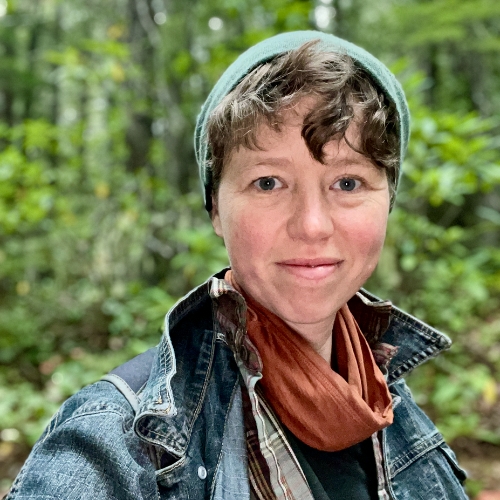
Meg Wade is a writer, community organizer, facilitator, and sometimes indie bookseller based in Southern Oregon. Their work in pro-democracy and climate justice movements often centers on place-based community building as well as mobility justice issues. Their writing can be found at Unsettling on Substack. They are a 2025 Oregon Humanities Community Storytelling Fellow.
Comments
1 comments have been posted.
I agree with your observations, and fortunately have avoided tragic consequences. My life changed about thirty years ago when my car moved from first option to the last option for travel. Walking, running, and biking occupy the first 3 spots. I could tell (brag) about the distances I have covered, but won't. I usually arrive energized, smiling, appreciative of nature and human encounters along the way. Car use usually means arriving tired, grumpy, and bitching about traffic. Start by using your own muscles to take you around the block. The world is at your feet after that.
Ralph Goldstein | August 2025 | Oregon City, OR
Add a Comment