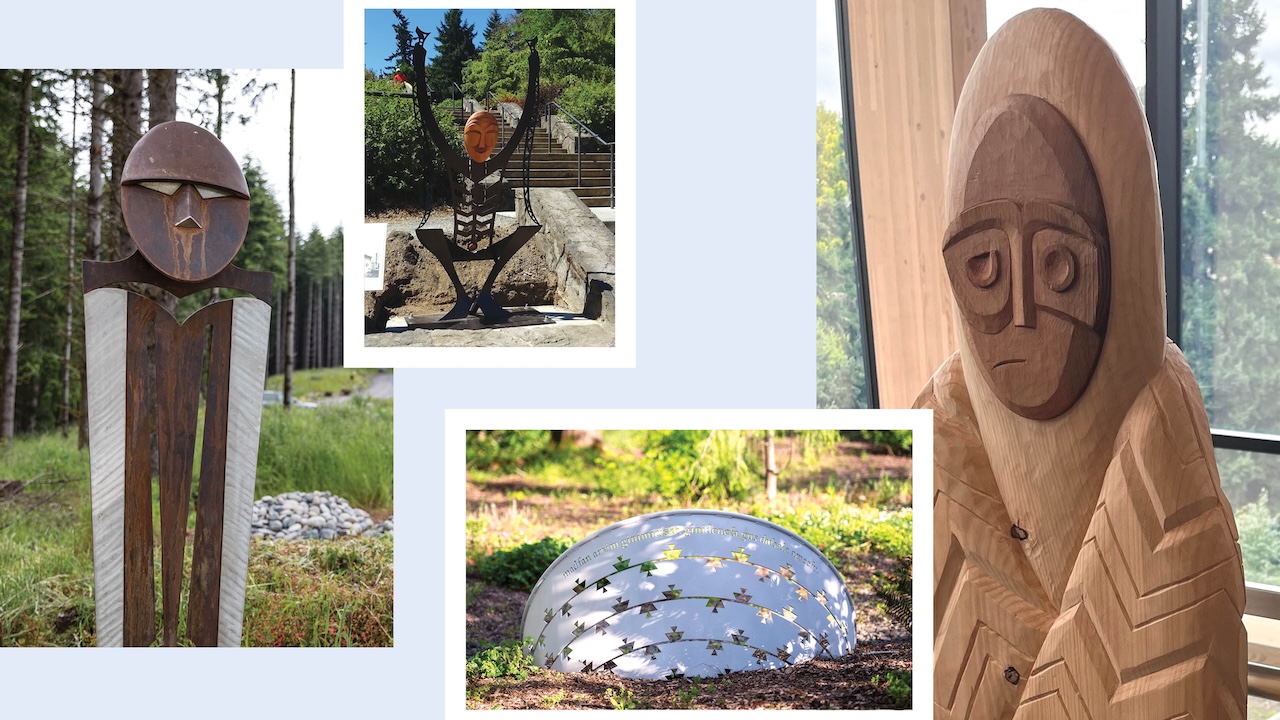
In the beginning there was a flood that covered the world. Perhaps you think you’ve heard this one.
Technically, this flood did not cover the world—but it must have felt like it did. It certainly changed the world for the people who experienced it. Around fifteen thousand years ago, the place now called the Willamette Valley was inundated by waters released from breaking glaciers in what is now eastern Washington. The water flowed down the Columbia River and then south to fill the valley. In the southern part of the valley, Chantimanwi (also known as Marys Peak, near Corvallis) was the best, highest place to retreat, so that’s where people went to escape the massive, world-changing events referred to in the scientific community as the Missoula floods.
According to a 1913 account by the Ampinefu Kalapuya man William Hartless, who was from the Corvallis area, Kalapuyan stories noted that the water rose slowly enough that people could run ahead of it, and even though the water ultimately rose some four hundred feet, they had time to seek refuge while the valley submerged. Hartless conveyed that some of the Kalapuya even traveled across the newly formed lake that filled the Willamette Valley in canoes to visit others or pick up stragglers.
This set of ancient stories about the flood is as remarkable as the event itself. The people who survived the floods passed these stories along to their descendants, who passed them along in turn until they reached us today, millennia later. The floodwaters receded. The stories persisted.
A series of recent public art installations in Oregon resonates with these stories of the floods and their persistence over time. These installations commemorate important Indigenous cultural and historic events, and provide physical reminders, or prompts, for storytellers, whose stories, in turn, help keep places alive. Artworks such as these are tools for the practice of Indigenous Placekeeping.
The concept of Placekeeping was first developed by Wanda Dalla Costa, a Cree architect and professor. But in using the term, I am also following the lead of David Harrelson, manager of the Cultural Resources Department at the Confederated Tribes of Grand Ronde, who introduced me to this term and has been using it in a range of public presentations and cultural support efforts in recent years. The Confederated Tribes of Grand Ronde in particular has turned to public art installation as a tool for re-marking traditional territories, promoting long-submerged traditional art forms, and enhancing their own current cultural and spatial practices.
Harrelson uses the term Placekeeping to describe how installing public art sustains specific Indigenous geographies and marks a continued cultural relationship to those spaces. He asserts that “art by Indigenous people is one of the most effective and recognizable ways that we as Indigenous people of place can hold space in our homelands to further our own recognition and persistence.”
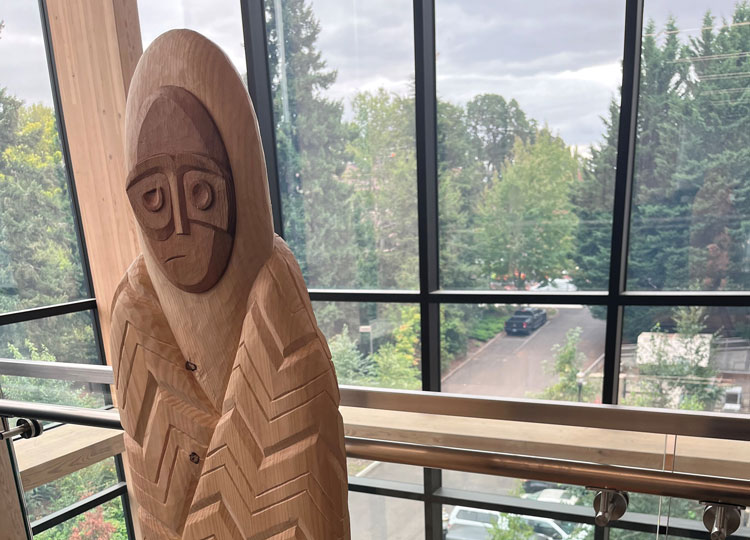
Wakanim Artist Collaborative, Things Remembered in the Flood, 2022. Commissioned through Oregon’s Percent for Art in Public Places Program, managed by the Oregon Arts Commission. Photo by Natchee Barnd
An example of this practice is Things Remembered in the Flood, which consists of ten wood figure carvings and five half-buried metal basketry sculptures on the campus of Oregon State University in Corvallis. In 2022, the Wakanim Artist Collaborative, consisting of four artists from four different tribal nations, installed this set of collaborative artworks within and around the Peavy Forest Science Center. Earl Davis (Shoalwater Bay), Tony Johnson (Chinook), Travis Stewart (Grand Ronde), and Shirod Younker (Coquille) worked together to represent the story of the flood using an artistic style shared by various Lower Columbia River cultures and peoples. Each of the artists comes from a distinct tribal nation, but all of them hold lineage with the peoples who remember the epic valley flood, and all have an interest in the continuation of Lower Columbia River art aesthetics.
The ten wood figures in the artwork represent the nine federally recognized tribes of Oregon, with the tenth standing in for those who remain unrecognized, lost, or unknown due to cataclysmic events. Like the surviving mountaintop ancestors they stand for, the Things Remembered figures are elevated, installed on the second and third floors of the Peavy center, where they perch above the metal baskets in the ground below—perhaps observing the reemergence of these items after the floods.
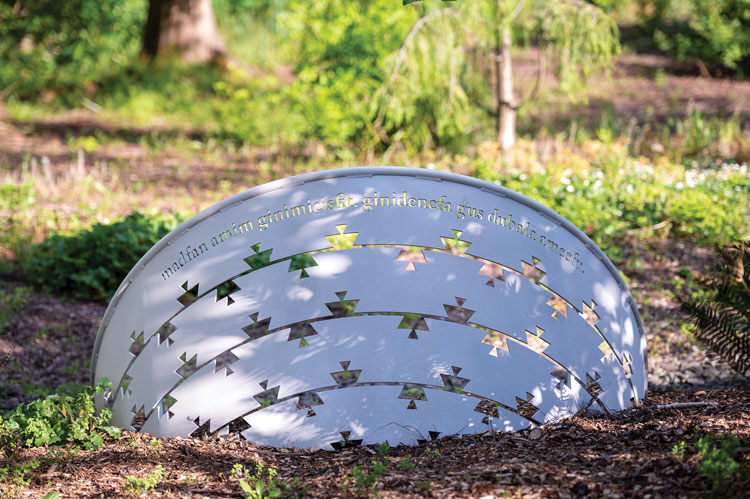
Wakanim Artist Collaborative, Things Remembered in the Flood, 2022. Commissioned through Oregon’s Percent for Art in Public Places Program, managed by the Oregon Arts Commission. Photo by Beth Conyers
The half-submerged baskets nicely embody such moments of return, as the land comes back into view above the water level and the baskets peek out from the post-flood sediment. In that moment when the waters began to withdraw, the ancient Kalapuyans also began their reengagement with the restored valley lands. Likewise, this installed artwork, both its aluminum baskets and carved wood figures, represents a cultural and spatial reemergence. As the aesthetics of Lower Columbia River art find new and reclaimed usage, tribal artists are deploying them to work toward the recovery of lands and land relations today.
Public art is being used as a form of Placekeeping.
What is Placekeeping? In addition to employing traditional aesthetics of tribal art, examples of Placekeeping make clear claims about belonging to the lands and waters where they are placed; originate directly out of ancestral stories or practices; and emphasize contemporary cultural and space-making practices.
Placekeeping moves beyond simple expressions of place-based attachment or sentiment. Using art installations as on-the-ground “mappings” helps manifest culturally rich visions of Indigenous life for later generations.
Lastly, it is important to emphasize that Placekeeping artworks are generated for the purposes of current Indigenous community needs, and are not primarily responses to the pressures and violence of settler colonialism. They are focused inward in terms of audience, and they look forward toward an Indigenous future.
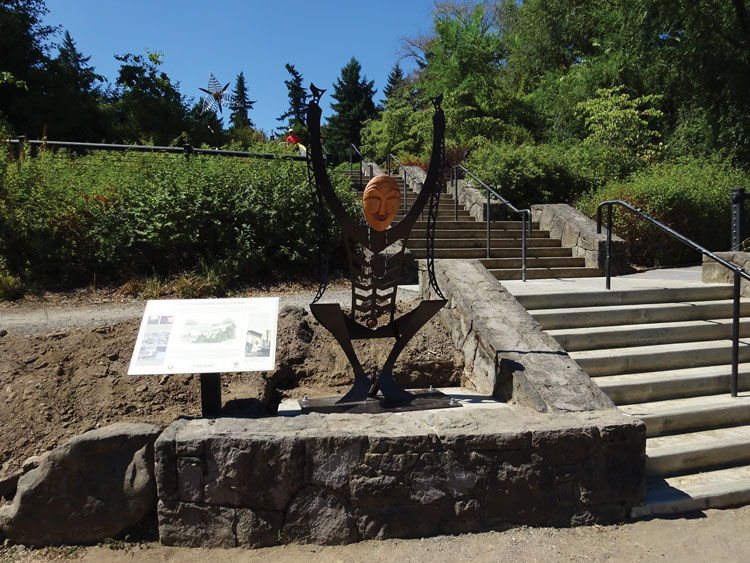
Travis Stewart, The Man from Kosh-huk-shix, 2015. Photo by City of Lake Oswego
An installation titled The Man from Kosh-huk-shix (2015) commemorates an ancient Clackamas village site and recalls an important story about harvesting “eels”—actually the anadromous Pacific lamprey, an ancient fish commonly referred to as an eel. Lamprey have long inhabited the ocean and river waters of the Pacific Northwest, first appearing in evolutionary fossil records more than four hundred million years ago, and have remained largely unchanged since before the emergence of dinosaurs.
The story of The Man from Kosh-huk-shix describes the valiant efforts of a headman and his wife to keep their people fed and warm during a long winter. In one version of the story, the headman follows a bird and comes to understand that his village is being supernaturally targeted for bad weather. He needs to take action to help his people, so he journeys away from the village. He soon finds that spring is flourishing elsewhere, which proves that the ominous winter is not naturally occurring. While away, the headman catches lamprey from the rocks at nearby Willamette Falls. Upon returning, he tells his people what he has found and explains how to prepare and cook the lamprey, as well as how much should be provided for each individual. Those who follow his teachings are well nourished and survive. Those who do not follow him perish, and turn into rocks at the village site.
Created by Grand Ronde carver and artist Travis Stewart, the sculptural installation recalls both the headman’s village (kosh-huk-shix) and the story’s teachings, as well as the people’s responsibilities to the lamprey, whose populations have been decimated over much of the last century. Looking over the banks of the Willamette River from George Rogers Park in Lake Oswego, this metal-and-wood sculpture features traditional figure design of Lower Columbia River art. The sculpture’s face and belly button are made out of western red cedar, a traditional medium, but the customary rib-cage design of the body and the two harvested lamprey, held skyward, are made from metal.
The installation’s commemoration of this traditional story conveys important lessons concerning leadership and knowledge sharing. From the perspective of Placekeeping, the artwork marks the ongoing connection between the village site and Willamette Falls, an important ancestral site of harvest and trade for Indigenous nations from across the region. Since 2018, the Confederated Tribes of Grande Ronde has operated a seasonal fishing/eeling platform at the falls, and has more recently purchased surrounding lands for additional cultural uses.
The Man from Kosh-huk-shix is a powerful example of Placekeeping. It uses a traditional art form and clearly draws upon site-specific stories. It also foregrounds ancestral and traditional practices, and supports future-oriented engagement
with traditional responsibilities while creating opportunities for new forms of engagement and sovereignty practices, like
the fishing/eeling platform.
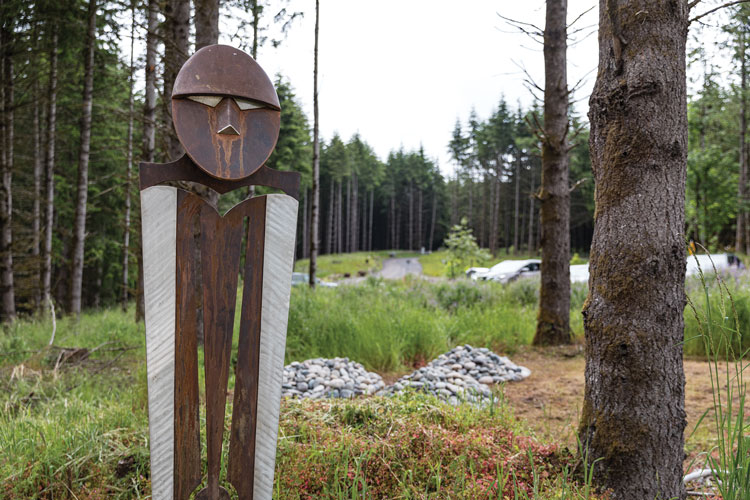
Bobby Mercier, Three Elders “Welcome Figure,” 2022. Photo by Natchee Barnd
Chehalem Ridge Nature Park, located approximately twenty miles west of Portland, now hosts an installation called Three Elders (2022). This artwork represents a unique collaboration between Metro, the regional government agency that owns the park, and the Confederated Tribes of Grand Ronde. The piece is made up of three related figures, a choice that responds to the extended geography of the park, where the dispersed pieces can cast an interwoven meaning-making “net” to try and encompass this expansive space. This strategy also mirrors the wider networks in the stories of this place, reminding us of the interrelationship of peoples, ecologies, histories, and cultures.
“This is our tribe’s ceded territory,” says Bobby Mercier, who served as cultural advisor and lead artist for the project. “So it’s kind of fitting that tribal members get to put our art back in our own place, especially over the tops of our own villages.”
The first elder of the installation series stands at the entrance to the park and serves as a Welcome Figure, its arms raised in a traditional gesture of greeting. This figure signals protocols of visitation, leadership, negotiation, and diplomacy.
The second elder is a Wapato Figure, referencing both the important traditional wetland food source and the various human and nonhuman peoples associated with the wapato plant and its ecosystem. A highly nutritious tuber, wapato historically served as a major food source during fall gathering periods, as well as a regional trade commodity. Designed with cutouts in its metal body in the shape of the arrow-like wapato leaves, this figure overlooks a historic Atfalati (Tualatin Kalapuya) village site and Wapato Lake. Recently, tribal members have been especially active in planting thousands of wapato bulbs and working to restore ecologies across western Oregon to further encourage the plant’s restoration. With this elder, the artists are doing more than just depicting a figure of cultural memory—they are signaling the tribe’s ongoing and rejuvenated engagement with the wapato and with their tribal lands; and they are confidently planting a vision for a flourishing future.
The third elder, a Dentalium Figure, references an origin story about the local waterways and its peoples. (Dentalium refers to long, toothlike shells used in jewelry and clothing and as a trade good throughout much of the West.) As Mercier explains, it is said that in this location Coyote tricked the Frogs who had dammed up the lake. Pretending he would trade a great deal of wealth for a drink from their lake, Coyote brought fake dentalium that he had carved out of deer bone. While drinking from the lake’s edge, Coyote deliberately broke the dam, according to Metro’s description, “to release the water for everyone to drink, creating rivers and streams that still nourish the region today.” Describing the moment a vast and interrelated landscape was essentially created, the Dentalium Figure references an extensive web of stories and cultural characters. It recalls Kalapuyan explanations about the origins of the world and its various (local) hydrological, geological, zoological, and cultural features. Referencing one of the most important characters in traditional storytelling, Coyote, this figure and its story reaffirm Indigenous ethical expectations and responsibilities.
Together, the Three Elders suggest that this remains a place worth returning to, but also a place that has never ceased to figure into Indigenous world mappings. As with each of the Placekeeping examples discussed here, this deceptively simple art installation makes claims of belonging to this specific land and water; is rooted in ancestral stories; and proclaims contemporary and future-facing cultural mappings for Grand Ronde geographies.
Looking at these public installations through the lens of Placekeeping, the unexpected practice of using the creative aesthetics of the Lower Columbia River cultures comes to the fore. On the one hand, these public installations intentionally serve as internally oriented examples of material, spatial, and cultural continuity. On the other, they provide an outward-facing tool that can contest and correct settler colonial mappings of lands and waters in a place many know only through a non-Native lens. By making this approach public and speaking directly about its purposes, Grand Ronde’s strategy has the potential to educate non-Indigenous allies and to build community with funders, practitioners, elected officials, park managers, scientists, and educators. This approach to art-making may lead to new opportunities and relationships, and to enhanced forms of collaboration and partnership. With broadened support, the work of Placekeeping might help inspire public interest in material and land-based decolonization efforts, and foster crucial legal or ecological restoration projects. Admittedly, this is a long game, but the vision of a flourishing cultural landscape reflects Grand Ronde’s expectation that today’s practices will benefit many generations down the line.

Natchee Blu Barnd is a comparative and critical ethnic studies scholar interested in the intersections between ethnic studies, cultural geography, and Indigenous studies. His research focuses on issues of race, space, and Indigenous geographies. He is the author of Native Space: Geographic Strategies to Unsettle Settler Colonialism (2017). He taught at Oregon State University for twelve years and currently teaches at UC Santa Barbara.
Comments
No comments yet.
Add a Comment