In 1995, my mom decided to bring me to the United States with her. This was toward the end of the Guatemalan civil war, a thirty-six-year-long conflict that I learned later in life was actually a genocide of Mayan communities. Aldea Sebep, San Mateo Ixtatán, Huehuetenango, Guatemala is where I came into this world, the home that saw me carried away in a rebozo to start a new life elsewhere and fulfill dreams I didn’t know I had yet.
My mom, like many of our undocumented parents, family members, and friends, did not choose to leave her home. She was forced to leave due to the poverty created by the greed and colonialism of European settlers like Pedro de Alvarado, the imperialist policies of the US under President Eisenhower, and exploitation by corporations like the United Fruit Company, now known as Chiquita—all of whom stole from our people and forced us to make our home theirs.
I was just a baby when my mom decided to leave our home and make the treacherous journey north. I am dos veces mojada, because we crossed two borders to get to the United States. This place has seen me grow up and fulfill dreams I never thought possible. The place where I was born is like a distant memory to me now, a memory that makes me think of the what-ifs from time to time: What if I had been left behind to be raised by my grandparents? What would my life be like then?
I’ve grown up hearing racist people say that people like me, who were born in a different country, don’t belong in the US. And in the Latino community, when I mention to elders that I came to the US as a baby, I often hear, “Oh, so in a way you’re not even from over there, ya eres de aqui.” You’re from here.
I am an Americana in the eyes of people from my first home because I was away for so long; because I did not learn my family’s Indigenous language fluently; because of my tattoos; because I listen to R&B and Chicano music. But this so-called Americana never forgot where she came from. I assimilated for survival, and out of love for the cultures I was exposed to.
I recently had the opportunity to go back to Guatemala after nineteen years away. The drive through the big city was a smooth ride because of the paved roads. I noticed people walking their dogs on leashes and saw cars parked at McDonald’s, Starbucks, and Dunkin’ Donuts. I knew we were far from the city when the car started jumping up and down on the dirt roads. The mountains got closer as we headed to my mom’s town: aldea Patictenam, Nentón, Huehuetenango.
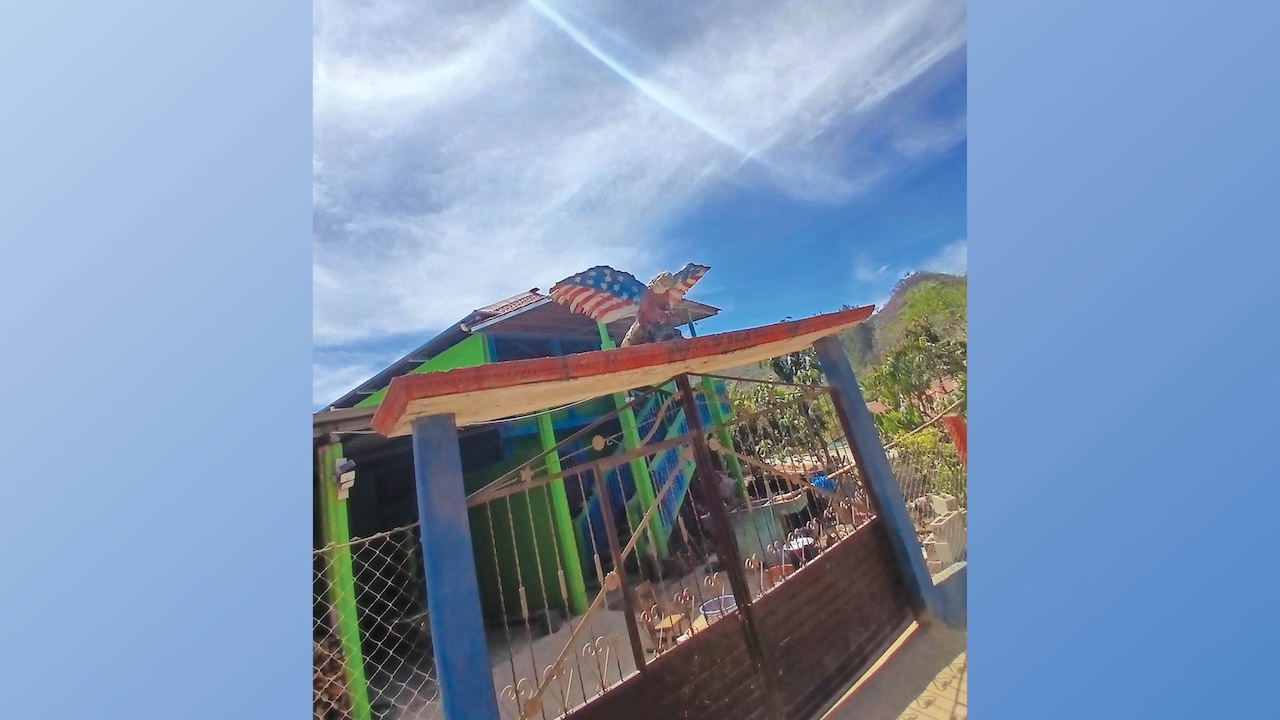
As we drove through towns along the way, the American dream was clearly visible in the form of brick houses built by those who’d left with visions of a better life, planning to return one day. Painted blue, orange, lime green, and purple, some of these houses had the US flag painted on them; one even had the words Made in Chicago painted on it. Seeing these houses made me think about the people working hard in the US to send money back home and create new opportunities for their loved ones. The people who left and then returned to Guatemala also brought back a piece of the US with them, memories of a place they once called home. These people are not criminals, only human beings trying to give their families a better life.
Eight hours into the car ride, I felt the hot sun coming in through the window as I saw everything my mother and I had left behind. I remembered the times as a child in the US when my mom would send me to the local Mexican store to buy her a long-distance calling card. I had to buy the right tarjeta because there were some that wouldn’t give her all the minutes she paid for. I would hear her talk in her native language, Chuj—not a dialect, but an actual language. I didn’t understand everything she said, but I’d see her eyes light up as she laughed, and sometimes I’d even see her cry when the automated voice message told her that her call was coming to an end. Other times, she’d mouth, “¡Tráeme otra tarjeta, córrele!” Bring me another card, hurry!—and I’d frantically look around, running back and making it just before her time was up.
During my trip back home, I reunited with some cousins who were born in the States but moved to Guatemala at a very young age with my tíos, who left the US without ever getting any kind of legal status. Two of my primos, who were in elementary school when they left, speak Chuj, Spanish, and English. My prima, whom I’ll call Carmen, only speaks Chuj and Spanish because she came to Guatemala as a baby, just like I came to the US. One day we were inside our grandpa’s house, waiting for the fire to start to warm up his home and preparing for a trip to Río Lagartero, Chacaj, the next day, when I asked them why they never returned to live in the US, given that they are US citizens.
“Why would we?” they responded. “This is our home.”
The following day, the truck was loaded with a grill, food, personal belongings, and pots and pans. My son, sisters, primas, and I squeezed ourselves where we could fit in the back of the truck. During the hour-long drive, Carmen told me that she was going back to the US and planned to live there for at least a year. Unlike her two brothers, who had traveled back and forth from one country to the other, she had only been to the US once, recently, for a very short visit.
“Do you know any words in English?” I asked.
She giggled and admitted she didn’t know any.
“You should at least know ‘Where’s the bathroom?’” I replied.
Laughing hysterically, we made jokes about the words she would use as she tried to navigate life in the US: “You need to start practicing how to say ‘I need toilet paper!’”
After the laughter died down, Carmen told us she would be going back to the US the same day we were leaving for the airport to return to Oregon. She was headed for another state, closer to her brothers.
On my last day in Guatemala, I stared out the window as we headed toward the city. I felt like I was abandoning my home country again to return to the place I now consider my real home. I thought about my prima, who was riding in a different car. She was leaving behind the mountain ranges, coffee plants, roaming dogs, and children running around freely. Like me, she was leaving behind a place that had become her home to return to an unknown country; unlike me, this unknown country—the US—would only be her temporary home. For her, Guatemala will always be home. There, she is considered part of the community, not an Americana like me. She speaks Chuj, washes clothes by hand, and knows how to use a molino for tortillas. In the US, she knew she would be viewed as an immigrant coming to steal jobs while trying to learn English, even though, because she was born there, she has more legal status than I do.
Undocumented communities of color in the US are often targeted and told that “home” is about a legal piece of paper. We are told that documentation is required to belong here, even though the White people telling us we do not belong in “their” home are the descendants of people who invaded many of our homes, including this one. Given recent efforts by people in power to end birthright citizenship, separate families, and fulfill the threat of mass deportation, it seems that for many Americans who ignore where their own ancestors came from, targeting immigrants on the basis of a piece of paper and where they were born is more important than going after real criminals.
But home is not a piece of paper, and an imaginary border cannot define where our homes are. Home is all the places we’ve lived. Home is every place that holds memories filled with tears, laughter, and joy. Home is the place that has seen us come with nothing and turn that nothing into something. This home is temporary for some, while for others it marks a new way of life for generations to come. We can have pieces of ourselves in more than one home at a time: a home that we yearn for and miss deeply in our hearts, even if we don’t really know what we left behind, and another where we create a new life.
For many undocumented people, the United States is home, whether it’s where they’ve created memories with their families or where they’ve lived alone, in solitude, always planning to go back home one day. Regardless of where we were born, those of us with Indigenous ancestral roots in the Americas are home no matter where we choose to be. Our Indigenous ancestors did not cross oceans to colonize and settle here. No matter how many times we’re told to go back to our country, or that we don’t belong, we are home.
Comments
No comments yet.
Add a Comment