It’s a cold January night on the Columbia River. The water is dark except for the bright whitewater churn of a tugboat, which has been lashed to this Panamax ship to help it find its way to dock. Bright artificial lights waver in the water like candle flames. Onshore, grain silos rise: fat cylinders buttressed with metal scaffolding.
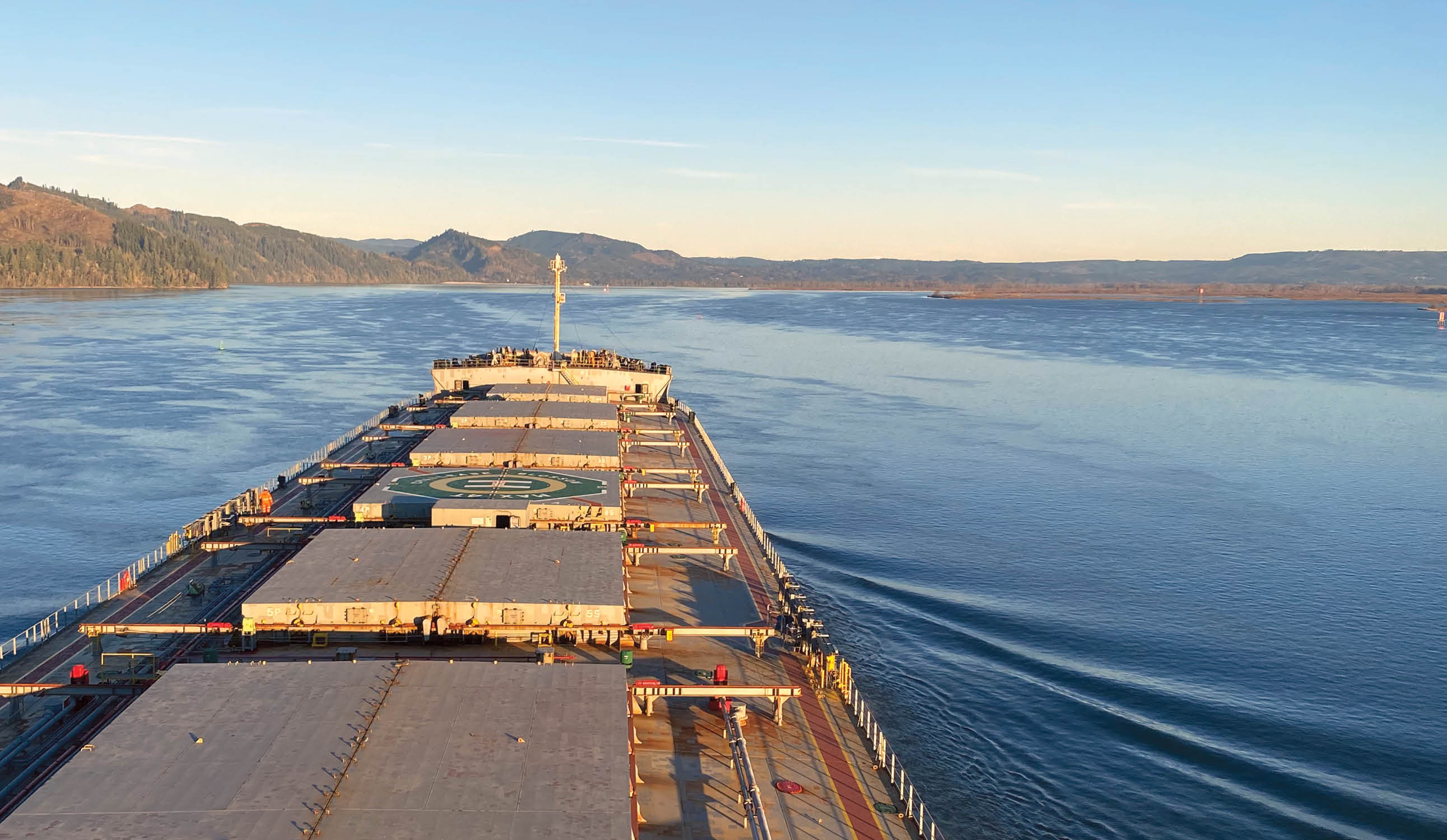
The tug strains at the rope, seeming to nearly tip sideways, like a kid in a game of tug-of-war who’s putting his whole back into it. Two men stand on the bridge wing, gazing down on the scene. Hundreds of feet of ship stretch in front of them, most of the surface covered with equipment. There are six sets of huge doors built into the deck, where potash and grain will be loaded, and pipe and ropes and the mechanical pulley systems used to pry back the hatches. The bridge wing is a small open platform in the deckhouse of the ship, from which the two men can look down and make sure docking maneuvers go to plan—which, at the moment, they are not.
“What is the issue with your engine?” the pilot asks. The wind bites into his words. He is wearing a thick waterproof coat with bright seams of glow-in-the-dark tape and an internal life jacket. The ship’s captain, standing beside him with a walkie-talkie pressed to his mouth, wears only a thin sweatshirt. He’s too worried, at this moment, to feel cold. He speaks rapidly in Mandarin Chinese into his radio. The ship slides forward, a motion that is almost imperceptible except that the deck slides farther down the length of the grain elevator, a slippage that the pilot notices immediately. Despite his instructions, the ship has gone too far. It’s continued to drift. A vessel of this size has no transmission; to reverse, the crew has to turn off the engine, put the ship in reverse, and restart. But earlier, when they tried to reverse, the engine shut off by itself.
“Before we load your ship, we want to make sure it’s safe,” the pilot tells the captain, with measured patience. The captain runs inside, yelling into the radio. If they can’t get this ship docked, he’ll miss his chance to get the holds loaded with wheat. He’ll be late turning around and heading back to sea, heavy with export goods, bound across the Pacific for Asian markets. It will cost tens of thousands of dollars to delay. From many decks below, the engineers tending to the behemoth three-story engine reassure them over the radio: All good to go. Skeptical, the pilot tries one more time: “Dead slow ahead.”
The engine isn’t responding. This close to the grain elevator, the ship risks a collision, and the port certainly isn’t going to load grain into a ship with a faulty engine. The pilot stalks inside to the bridge and declares: “We will go to anchor.”
“Anchor?” the captain repeats, but he looks resigned. The ship will be steered out into the deep water of the river, where it will await Coast Guard inspection. On the Columbia, a river pilot’s decision overrules a captain’s authority. The tugboats haul the ship back out into the dark, slippery water.
After the ship is anchored, the two men shake hands and the pilot prepares to disembark onto one of the tugs. There are frustrations, but also mutual respect. This is the job of a Columbia River pilot: to keep the river safe. When a cargo ship enters the Columbia, the captain turns navigation over to a pilot, who shepherds these huge oceangoing vessels to Kalama and Vancouver. They ensure the ships navigate the river safely, successfully drop off or load up with goods, and return without incident to the ocean. As specialists in the Columbia, they know every turn and sandbar and island. They keep the ships in deep water. When an issue arises, they make the call to stop. Most days, they make smooth transits from Astoria to Kalama and back. To those of us on land, their labor is essential and invisible, part of the landscape.
There have been fewer than 250 pilots in the history of Oregon. The first pilots appeared in the mid-1840s, when settlers began to penetrate the Columbia in search of land and fur. They quickly realized that navigating the river would be a challenge. Before that, for time immemorial, the Chinook people had steered these waters in canoes, passing their expertise on the river down through generations—knowledge that remains unbroken even today.
The training to become a Columbia River pilot is long and grueling, and the license they receive is both selective and highly specific: They serve the waters inland from Tansy Point, below the Astoria Bridge, and as far upriver as Pasco, Washington. Rarely, they pilot the Snake River as far as Lewiston, Idaho, as well as a limited section of the Willamette, up to the Ross Island Bridge. In many ways, this job represents the ultimate in place-based labor, so specific that the license is nontransferable; a river pilot is only a pilot on their own river. They know this water. While the labor might seem technical, piloting is also a job that requires a surprising amount of human connection, diplomacy, and hospitality. It is a job that relies on oral history and the body’s sense of place.
Thomas Thomayer
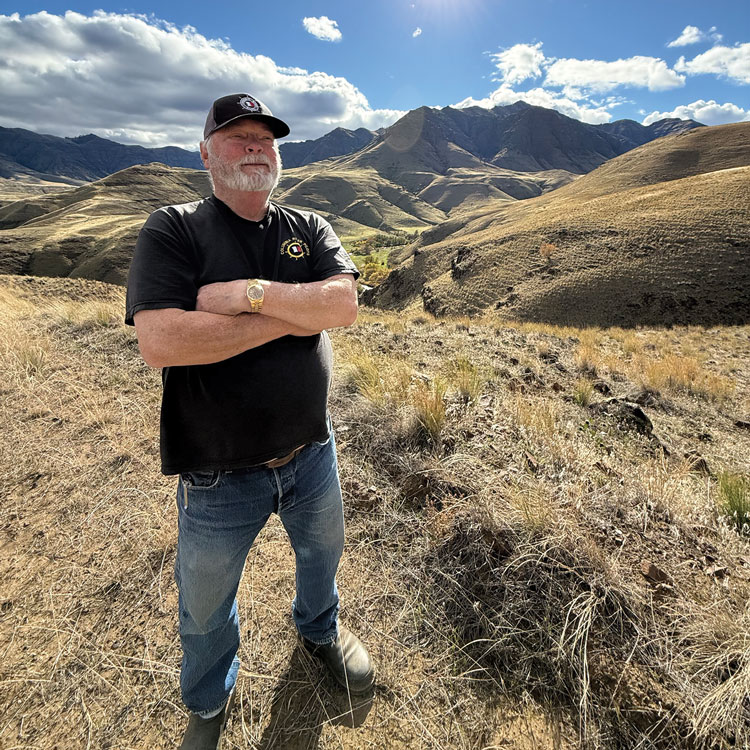
“I know that river,” Thomas Thomayer says. “I know where not to run. I know where, if I went certain places, my draft would exceed the depth of the water. I’d be aground.” A retired Columbia River pilot, Thomayer spent seventeen years as a tugboat captain. It’s a standard on-ramp for river pilots: Applicants to the pilot training program must have worked at least 730 days as a tow-vessel captain on the Columbia River, including its tributaries, learning the water firsthand. This experience, tugging barges through the windy passages, prepares them for piloting much larger oceangoing vessels.
Thomayer grew up in a boating family; he played in the scrapyards at Tidewater Barge Lines in Vancouver, pretending to shoot old turret guns and climbing on the shells of discarded boats. Out of high school he wanted to be a diesel mechanic and signed up with Tidewater, where he learned the ins and outs of pushing barges. For years, his schedule was two weeks on the boat followed by two weeks off, a punishing life for a family man. “You’re living two lives. When you walk out the door with your bag and you’re going to go get on a tug for fifteen days, you’re leaving your wife, and she’s all on her own,” he explains. “The day you get off a boat, you don’t look back, you look forward. But you also bring [home] those sometimes heavy burdens that you had to put up with for two weeks. And it can cause rough waters right off the bat when you walk through that door and you say, ‘Hi, honey.’” He was gone so much that sometimes his young children didn’t remember him.
After decades of that arduous schedule, Thomayer applied to train as a pilot. The hours were better—he could be home every other day—and more importantly, piloting was the pinnacle of river work. He wanted to be part of the “elite” who are respected because of the difficulty of the area they cover—what pilots call the pilotage grounds. Despite their relatively placid appearance from the shore, the grounds of a Columbia River pilot have a reputation for heavy flow, strong currents, narrow channels, shifting sandbars, and very shallow water; loaded bulk carriers sometimes have only two feet of clearance from the river bottom. That’s where the specific, place-based knowledge of a pilot comes in: “You know where the eddies are, where the deep water is,” Thomayer says. “I can close my eyes and visualize from the mouth of Kalama to Astoria, every nook and cranny and turn and course.”
The most important tool a pilot has is their personal knowledge of the river, built through experience, repetition, and wisdom passed down through oral tradition. After a transit, pilots often gather at their Pilot Station in Astoria, located in a bright red historic building on a pier, and unpack every turn from the trip. It’s not formal training, but something of a combination of stress release, after-work happy hour, and technical nerd-out over ship stuff. They review their decisions, holding each one up to examination, hearing the insights of the more experienced navigators. For all the chart memorization and technical acumen, this chain of human knowledge is an essential part of the work. It fills in the gaps between the radar and the depth charts, an inheritance of lived experience on the water.
 Cedric Barrett
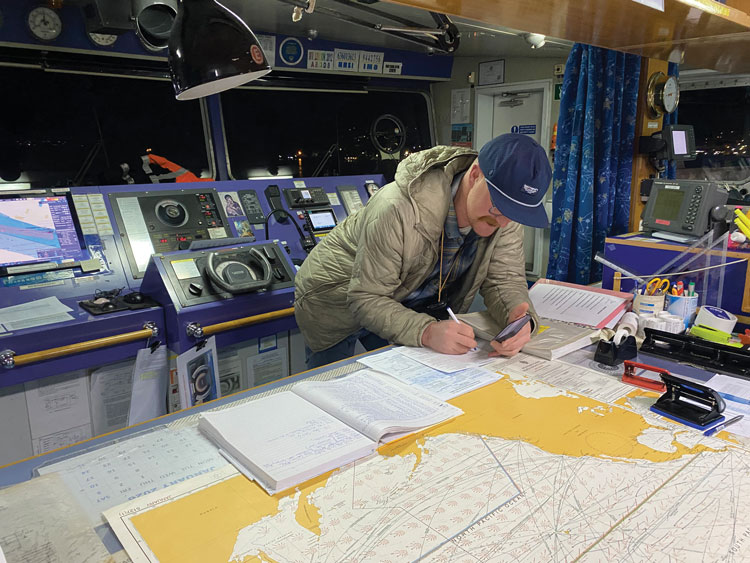
Cedric Barrett is converting to kilometers. He’s leaning on a countertop over a map of the Pacific Ocean, filling a worksheet with calculations in pencil. He smiles wryly. “Gotta convert to metric,” he says. Barrett is getting ready for a transit aboard a ship from the Philippines; the hatches have been loaded up and they are ready to go out to sea. The bridge is filled with constant beeps and boops. A bank of screens, visually not unlike a NASA mission control center, stretches the length of the room. One shows radar, the line circling the screen over and over, revealing green blotches like lichen on a log. Phones ring—the kind of off-white receiver with a curly cord that disappeared shoreside in the early aughts. A similarly anachronous printer makes a screech and spits out a weather report from Hawaii on paper with perforated edges.
Barrett is a friend of mine, and he’s graciously allowed me to ride along on this transit, so I perch out of the way on a padded bench. The bridge is high up in the superstructure of the ship, looking out over the deck and the river. Lining the walls are tens of three-ring binders filled with printed records, logs, and procedures. There are buttons, switches, little lights that indicate whether systems are on or off. A painting of Jesus is taped to one of the consoles. In the frictionless digital age, a ship is a refreshingly tactile machine.
When a pilot like Barrett boards, they have a master pilot exchange, or MPX, with the captain. Together they confirm the ship’s capacities and collaborate on any matters of concern. Often this exchange takes place despite some level of language barrier. There is a dance happening here, a transfer of control. The captain has brought this vessel over open ocean. The crew has been aboard for weeks, perhaps months. Now they are handing their ship over to a stranger whose job is to take them safely through the river passages. Barrett takes his relationships with the captains seriously. “We’re the representative of the state of Oregon,” he says. He sees himself as an ambassador and always tries to convey a sense of deference to the captain.
The MPX done, Barrett instructs everyone on the bridge to watch the rudder—on one of many dials high up on the wall—and gives a command to go. The ship’s movement is so slow that it’s imperceptible at first. It takes a long time to get something this big to overcome inertia. A mast sticks up off the bow, which sweeps across the landscape, scraping visually along the hills and water. Taking the ship out, Barrett will use motion as a reference; as he approaches a bridge, he wants to see both piers moving away from the ship, revealing more of the distant shore in the opening. If one of the piers doesn’t seem to move relative to the shoreline, the ship is headed for that pier. In this way, relative motion provides a clue to the ship’s heading. Barrett settles into an office chair and gives commands: “Ahead slow.”
From his seat, Barrett can see the radar, which reveals any hidden objects in the water and help calculate when to turn, and his laptop, which shows approaching ships and up-to-date water levels. He also relies on the crew: Far below, on the deck, a sailor cranks up a rope as wide as his thigh. Another sailor watches for kinks, and the rope writhes like a snake before it coils, docile, into a heap. Deckhands in orange suits and helmets secure the gangway, the metal staircase by which the pilots ascend to the ship. Belowdecks, tens of sailors tend to the multistory, ear-numbingly loud engine, which spins a shaft as thick as an Oregon old-growth tree. On the bridge, the mate makes Barrett an espresso; he is proud of the ship’s good coffee. A helmsman inputs the courses and steers the ship using a small wheel that would look at home on an arcade game. Everyone repeats the words of the pilot as he says them: “Midship.” And when the course is confirmed, an echo: “Midship.”
Barrett is looking for range markers in the distance. As the ship approaches, they appear to be scattered across the view; he watches for them to line up, one behind the other. They mark the channel of deep water where a ship wants to stay. Barrett also looks for visual clues in the landscape that tell him when to start a turn: particular trees, dikes, the tip of an island, a unique rock. Every pilot has their own landmarks, he explains: “You’re used to looking at the shoreline and you’re like, yeah, I should be roughly this far off.”
Like Thomayer, Barrett started as a tugboat captain and credits those years with teaching him how to handle a ship. Pushing a barge upriver “is the huge crucible [in] which all Columbia River operators are formed,” he says. “It is extremely stressful. You get cut loose and it’s like every hour you’re scared … and it’s like that six hours on, six hours off for seven days.” Over the years, as they habituate to the water, captains gain skill and confidence. “Then a little bit of time goes by and you’re like, man, I haven’t had a freaky watch yet … I’m not at my limit,” Barrett says. He believes that physically handling a boat teaches pilots to make mistakes, recover, and solve problems on the fly—skills that can’t be taught in a training manual.
It grows dark. The lights on the bridge are turned off so the pilot can see better, and the men’s faces are underlit with screen-glow. The ship slides past a factory, from which thick smoke steams up. Lights shimmer in blank water, briefly illuminating the shape of the current gripping the hull. Orion sizzles in the sky. Inputs come in from radar, radio, the soundings displayed on the laptop that show tidal depth. The pilot receives, interprets, and acts on the data, giving an occasional laconic command: “Heading 2-4-4.” A moment later, the helmsman answers: “Heading 2-4-4, sir.”
As the hours tick toward midnight, the mate, a man in a gray jumpsuit named James, offers Barrett another espresso. James helps manage the ship operations. A former naval officer, he has been at sea for three months now; he has three more to go until he can return to his wife and young daughters in Cebu City. He dislikes sailing, but it’s the only way he has to support his family, and he’s eager to get back across the Pacific. I’m sitting in the back taking notes, and he offers me a coffee as well, with cream and sugar, the way his wife likes it. He misses serving her coffee, he says.
The ship will not complete its transit from Portland to Astoria until 3:00 a.m., at which point there will be another MPX. The ship will not stop in Astoria. A pilot boat will come pick up Barrett, who will disembark down a rope ladder, and a different pilot, a Columbia River Bar pilot, will board and take the ship across the roiling, dangerous waters where the river crashes into the ocean. Nicknamed “the graveyard of the Pacific,” the Columbia Bar is considered one of the most treacherous bar crossings on the continent. Barrett’s license does not allow him to cross the bar; likewise, the bar pilot’s license is only good for crossing the bar, an expertise so specialized that the grounds extend only a few miles. Beyond that, the bar pilot will get picked up by helicopter or boat and be shuttled back to Astoria, and Barrett will be asleep in the Pilot Station, and James will be on his way home.
Barrett gets a minimum of eight hours on land before he’s called up again, heading back upriver. The rest period is essential for pilots, who get no breaks on their four-to-six-hour transits. He doesn’t know exactly when he’ll get called up. He consults a switchboard on his phone, which lists incoming and outbound vessels. Delays often make departure times uncertain. The trip he made the night before had been scheduled for 3:00 p.m., then pushed to 5:00 p.m.; then it finally departed around 9:00 p.m.—or 21:00, as pilots call it. The uncertainty doesn’t bother him. He’s home more regularly than he was when he captained a tugboat, and he’s used to a variable schedule.
In the Pilot Station, Barrett checks in. There’s a TV, a few worn-looking couches, a cribbage board, a glass bowl full of fake limes, and a pile of magazines: Guns and Ammo, Alaska Magazine, Roadrunner. He signs his name in a logbook: name, ship, time out. Like so much of this job, there is a refreshing analog quality to the act. This labor relies on humans talking to humans, using their eyes and ears, sharing their experiences, accessing their mental maps. In an age of cloud computing, this labor values a person in a place, their physical presence, their inherited knowledge, their decision-making. It does not outsource or automate. Barrett writes his name in ink.
Traveling on the river is different than traveling beside the river. Zipping over the I-205 bridge, or cycling along the riverfront paths, or swimming at Sauvie Island, the Columbia is impressive: a massive sheet of water pouring down between cliffs, a path scoured by an Ice Age flood that burst and carved the landscape from Idaho to the Pacific. Nevertheless, it remains scenery. On a bulk carrier, the water becomes so much more animate: a workplace with the standard annoyances and joys of a job well done; a sounding board for radar pings and radio communiqués; a maze of sand and shallows; an economic lifeline for farmers; and a place of welcome to crews from abroad. It is a powerful current of commerce and human industry moving constantly through our region.
Barrett and I get on a ship back upriver. They are heading out of anchorage, toward the narrower passages and the silos of grain waiting to be dumped into the holds. Astern, the Astoria Bridge is clamped like a barrette over the misty water. Lumps of ships lie anchored beneath, awaiting their pilots. Sandy islands upriver, made from silt dredged from the river bottom, are furred with leafless saplings. In the distance, Mount Adams and Mount St. Helens are both visible. Far below, a sailor walks up the side of the deck, on a painted strip of walkway between the pipes and ropes and hatches. He looks around briefly, as if to see if anyone is watching, leans over the railing, and snaps a picture.
Comments
1 comments have been posted.
Good morning Caitlin, I am the Executive Director of the Oregon Board of Maritime Pilots, and I absolutely love this article. Our 9-person board's mission is to ensure safe, reliable & efficient pilotage on all Oregon waters and have been doing so since 1846. One of our major goals, is to educate the Oregon public & legislature the criticality of our maritime Pilots & the safe manner in which they conduct business. As such, do I have your approval to post your fine article on the OBMP website?
Len Tumbarello | May 2026 | Astoria, Oregon
Add a Comment