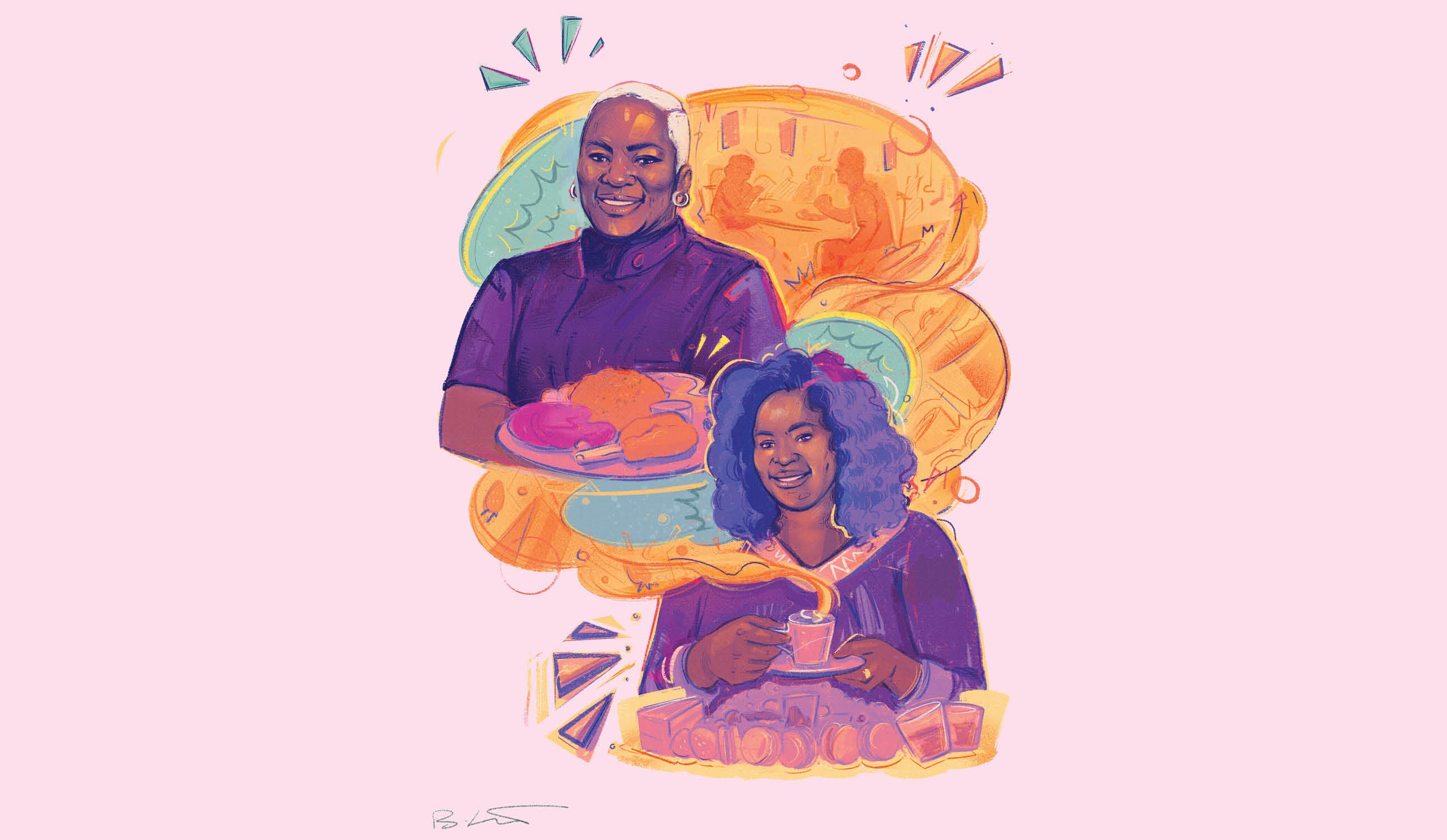
Steam curls upward as chef Fatou Ouattara brushes a tray of suya wings with oil and ground peanut spice. The scent of smoked pepper and grilled meat fills the dining room at Akadi PDX, Fatou’s restaurant dedicated to West African cuisine on Southeast Division Street. Near the corner stage, a sound check hums: drums tested, microphones adjusted. A customer leans over the counter to ask when the signature jollof rice and goat stew will be ready. Fatou tastes the sauce, nods, and moves quickly toward the pass.
Born in Bouaké, Côte d’Ivoire, Fatou moved to Portland in 2010, as civil war upended daily life in her home country and halted her education for several years. In Oregon, she enrolled at Portland State University to study marketing and finance, choosing a practical path shaped by her entrepreneurial family. Corporate work provided stability, but not fulfillment. What stirred her instead was cooking West African food for the people of Portland. In a city often praised as a “foodie” capital, Fatou was frustrated by the absence of West African cuisine and began preparing meals for friends and catering small events. She brought her dishes to farmers markets and community gatherings, where demand quickly grew. “We have a lot of East African food [in Portland], but no West African food. So I decided to change that,” she says. In 2015, she launched a food cart, but the physical constraints of the space made it difficult to prepare her cuisine with the depth and scale it required. She closed the cart and spent the next two years catering and planning for something more permanent.
That vision became Akadi PDX. Named after the Bambara word for “tasty,” a suggestion from her mother, the restaurant was conceived as a safe and welcoming space for the West African diaspora—a place where traditional foods could be shared without dilution. It soon evolved into something even larger: a cultural hub animated by food, music, and dance. “At Akadi, we wanted to make sure we get that part of Africa represented … show people what West Africa is about.” On opening day, more than four hundred people arrived. “It was overwhelming and beautiful,” Fatou recalls. “I knew then that this was needed.” The response affirmed a hunger for representation.
When African immigrants arrive in Oregon, they do not come empty-handed. They carry skills learned long before their visas are stamped: recipes memorized through repetition, culinary methods and crafts absorbed from elders, and habits of discipline shaped by family, schooling, and necessity. They bring philosophies of work forged in a place where survival and creativity are inseparable. Yet their lives are often flattened into crisis narratives or reduced to statistics, leaving little room to explore the everyday labor through which belonging is patiently built.
I write these stories as both historian and participant. As a patron, community member, and fellow African immigrant moving through these spaces where food, culture, and memory converge, I have eaten at tables, attended events, and listened to conversations that extended beyond transactions. As a scholar in Black studies at Portland State University, I am drawn to how such spaces preserve knowledge that rarely enters formal archives yet shapes communal life.
Fatou’s story begins long before her arrival in Portland. She started cooking at about six years old alongside her mother and grandmother, absorbing influences from her mother’s Burkinabé roots, her father’s Ivorian heritage, and a “second mother” (her father’s second wife) from Mali. Travel to Senegal and Ghana widened that culinary map. By adolescence, she had mastered clay pots, fufu mortars, spice blending, and the smoking and drying of seafood. Her grandmother approached cooking with discipline and reverence, instilling in her the belief that flavor must be intentional, layered, and earned. “Growing up with [these] women taught me how to put a lot of love into my cooking and take it seriously so that the flavors, I guess, make sense.”
In Portland, those generational practices appear in dishes like suya wings, jollof rice, and goat stew. Suya—a popular spice blend throughout West Africa, made from roasted peanuts, negro pepper, dawadawa, and paprika—is traditionally enjoyed as street food. Fatou puts her own spin on it with wings: “We always run out at the restaurant. It’s a fan favorite for sure.” Her menu also reimagines classics like Senegalese yassa as vegetarian and vegan dishes, translating West African flavors into Portland diets without surrendering depth.
The translation that Fatou performs every day goes beyond cooking—it is agricultural, linguistic, and emotional. “West African cooking is so vast, it’s so diverse. This is probably not even one percent of what’s being served in West Africa,” she says. Her menu encompasses Bambara, Dioula, and French culinary traditions, but she has to work with what’s available locally, while importing other ingredients—though, she says, high costs and freshness can be a barrier. She speaks longingly about African eggplant—often called “garden eggs”—a small, round, and slightly bitter vegetable common across Côte d’Ivoire, Ghana, and Nigeria that doesn’t stand up to traveling long distances. She has also partnered with several local farmers on a third approach: experimenting with cultivating cassava leaves and other West African greens here in Oregon. Some efforts have succeeded; others remain aspirational. The work is ongoing, shaped by climate, cost, and curiosity.
Sourcing fish presents the need for another layer of translation. “The struggle is translating those names from my native language to French, then translating them back into English before I can find them,” Fatou says. Many species are imported from overseas suppliers. Occasionally, she finds comparable varieties in local Asian grocery stores. In other cases, she adapts—substituting Pacific Northwest fish that approximate the texture or flavor of what she grew up with.
When Fatou opened Akadi’s first brick-and-mortar location in 2018, she envisioned it not just as a place to eat, but also as a performance space. “West African culture is not just food,” she insists. “It’s music, conversation, community.” In Côte d’Ivoire, celebrations—weddings, funerals, baby showers—require the presence of a griot, typically a revered storyteller, historian, and musician who recites family lore and animates the room with praise. Djembe or sabar drummers adjust their rhythms to the occasion; specific dishes anchor each ritual. Food, sound, and story move together.
That sensibility shaped Akadi’s design. The restaurant—one large yet intimate room lined with tables and a small stage tucked into the corner—has become a gathering ground for live concerts, griot performances, poetry nights, dance classes, and community workshops. On any given night, patrons might encounter a late-night Afrobeat set or a drumming workshop. In September 2025, Senegalese griot and tama master Massamba Diop performed with his band Walo Walo, blending mbalax, Afro-jazz, and cosmic Afrofuturist textures. “Come for the food, stay for the groove,” one of Fatou’s event flyers reads.
Across town from Akadi, in Beaverton, Anne Johnson stands over a marble worktable, watching a thermometer inch toward its mark. Melted chocolate ripples in a stainless steel bowl. She stirs, cools, and reheats with deliberate precision, waiting for the exact temperature that will give the finished bar its shine and snap. On nearby shelves, tins of loose-leaf tea release notes of cardamom and hibiscus into the air.
Anne’s story begins in Nairobi, in a household where risk-taking, discipline, and creativity were everyday facts. “I was born in Kenya,” she recalls, “and raised there all my life until my twenties, when I moved here in 2001.” Her parents sent her to Christian boarding schools for girls in the countryside. City life, they believed, could make children “spoiled.” Boarding school, Anne says, was “about maintaining discipline and keeping us out of trouble.” Discipline there was literal. “Everything was regimented,” she explains, “almost like the military.” Academic competition was public and unforgiving, but the experience shaped her relationship to time, effort, and expectation, placing her in a lineage of Kenyan girls trained to treat structure as preparation rather than punishment. Alongside her studies, Anne developed a deep appreciation for tea as a communal ritual, observing how families and neighbors used it to connect, celebrate, and pause together—a practice that would later shape her business philosophy.
Entrepreneurship ran in her family: Both parents owned businesses. Her father worked in land development; her mother ran a beauty shop and later a pharmacy, despite knowing little about medicine herself. Anne first experimented with business as a teenager. She persuaded a Del Monte distributor to give her cases of juice to sell, then recruited her siblings and neighborhood kids. “I charged them: ‘Here’s ten packs, go sell them, and I’ll give you five cents for each one.’” Her sisters complained she was too demanding. “No,” she remembers saying, “I’m motivating you.”
Anne came to Oregon in her early twenties because that was where family and possibility lay. Her uncle and aunt lived here, easing the transition. In Portland she worked as an office manager in an art gallery near Lake Oswego and completed an accounting degree. For six years she worked as a CPA. The work was stable, but—like Fatou—she grew bored after a while. “It was so regimented. There was no room for creativity. It just left your heart needing more. Like, I know the numbers, but what else?”
At the same time, Anne found herself missing the tea culture that she had grown up with. “In the morning when we wake up, we drink more tea than coffee. It unifies the whole family.” Tea happens again after school: “At four o’clock … the kids get home, they sit down, they have tea … with margarine and biscuits or bread and something simple.” For her, tea can be more personal: “Tea becomes about you. The connection that tea creates removes any unfamiliarity. If my friend walks up to my house and she just came over, the first thing I offer her is tea.”
Anne and her husband began searching for tea spaces that felt relational rather than transactional. Portland had plenty of coffee shops, and some teahouses, but no place that centered Kenyan tea culture. When Teavana, a national chain, closed its location in Hillsboro, she saw an opportunity. To develop her idea, she went to San Francisco in 2017 to train as a tea sommelier. There, she deepened her cultural connection to tea, learning the subtleties of individual blends and how to translate those experiences into a welcoming environment—knowledge she later brought to her business.
Sensing that tea alone wouldn’t be enough of an experience, Anne began researching chocolate, building her knowledge from scratch. “I wanted to know, What can I figure out about chocolate? How can I make it an experience, something cool?” Inspired by European chocolatiers and US bean-to-bar movements, she and her husband decided to bring it to their shop.
In 2018, Anne officially launched the tea and chocolate company Mamancy—an acronym drawn from the first two letters of her own name and the names of her husband (Mark), son (Matthew), and daughter (Mercy). (Editor’s note: Since the author’s interview, the business has been renamed Mwendya.) The first shop opened in Hillsboro that year, and she expanded to a second location in Beaverton two years later. Both shops offer carefully curated loose-leaf teas and handmade truffles and bonbons, combining flavors and textures in ways that honor Kenyan culinary traditions while appealing to local tastes. Opening the second shop during a pandemic presented challenges, but Anne steadily built her clientele. She also adapted by offering teas, chocolate, and honey for sale online, ensuring the business could reach customers beyond the storefront.
Many chocolates are infused with Anne’s own teas. She describes working with chocolate as “very relaxing, like clay work. There’s a creative aspect about it … Playing with color, playing with flavor, playing with different perceptions of what you want that tea to portray.” Even here, discipline returns. Tempering chocolate, Anne explains, is “finicky.” Couverture, a high-cocoa-butter chocolate favored by professionals for its smooth texture and precise tempering, must be melted, cooled, and reheated within precise temperature ranges—sometimes shifting by only a few degrees—to achieve the glossy finish and sharp snap that signal quality. Too warm and it dulls; too cool and it blooms. The process requires patience, calibrated thermometers, steady hands. Anne oversees the tempering herself, particularly for new flavor lines and special orders, though she now works with a small team of employees who assist with molding, wrapping, tea blending, and customer service. In the early years, she made nearly every chocolate by hand, often late at night after her children were asleep. Growth has meant delegation, but not detachment; she still tastes each batch, adjusts ratios, and refines texture.
Anne is also acutely aware that tea and cacao have long histories of colonial extraction. “Most of the time, that commodity—tea, coffee, cacao—they’re shipped out,” she explains. “Bigger manufacturing companies in Europe tend to own, basically, the crop … They process them, they package them, and then they sell it back to the country. So that’s like, what? Why?” Direct sourcing, she says, is an aspiration and a responsibility. The shop currently buys couverture chocolate from carefully researched manufacturers, and Anne is in exploratory conversations with potential partners, including organizations such as Micro Enterprise Services of Oregon, about developing a nonprofit initiative that would employ single mothers in Kenya in tea blending and chocolate production, creating both livelihoods and childcare infrastructure. Additionally, 10 percent of the business’s profits support the Angel Center in Nairobi, a child rescue charity, reflecting Anne’s commitment to giving back to her home community while extending the ethos of care and connection embedded in her business.
Running her business in Hillsboro as a Black African immigrant exposes Anne to subtle and blunt racism. “I think there has been a shift,” she says. “It’s not as challenging as it would have been maybe even five or ten years ago, but there’s still apprehension.” She remembers a local potter who suddenly became “very busy” when she inquired about custom cups. Looking for storefronts, she noticed that alone she met “a lot of question marks in people’s minds.” When she brought her White husband, “the body language changes. People are comfortable … you feel it. It’s like, oh, the temperature changed.” She shares that her name, Anne Johnson, makes her race legible only when she is seen. “On the phone … nobody really gets to see my color, but as soon as …” she trails off, implying how quickly perception shifts when she appears in person.
Language carries pressures, too, and early jobs made her hyperaware of her accent. “Every time I would say a word, people would be like, ‘Huh?’ I took really great offense.” She began altering her pronunciation to avoid such responses, shifting “colour” to “color,” for instance, moderating her Kenyan English. Her accent is now faint enough that an interviewer remarked it was “nonexistent,” a comment that both amused and saddened her. “I don’t think I’ve changed it,” she says. “Hang out with me a little bit longer, you’ll hear it.”
For chef Fatou, navigating Portland as a Black African woman entrepreneur required a recipe that went beyond cooking. “I was never so exposed to discrimination, racism … until I moved here. And it was so difficult dealing with that … It breaks your confidence. It breaks your spirit. It breaks your courage.” Back home, her race never mattered, but in Portland, she remembers being “reminded that I’m Black … And I’m like, wow, yes, I’m Black. So what? I’m not any less than the next woman.” Family, cultural, and social media pressures around age, marriage, and motherhood compounded the challenge, but Fatou chose a path aligned with her values. “If you focus on what your family is saying [or] what society wants you to do, you are just going to go into depression. You just literally have to first know who you are. Where do you want to go? What kind of sacrifice are you willing to make?”
Across African societies, women have long sustained markets, foodways, and social life through forms of labor that blur the line between work and care. Anne’s tea rituals and Fatou’s kitchen inherit those histories. But more than their countries of origin, which are distinct and shaped by different colonial histories, languages, and social worlds, what connects these women is how they use entrepreneurship as a way to make private memory publicly meaningful.
Anne envisions her tea shop as a haven for relaxation and human connection, aiming to create an environment where friends and families can slow down, converse, and build community. As she emphasizes, “The whole idea of ‘stranger’ around tea does not exist. It’s that traditional connection that just removes anything that is foreign or different. It’s a very deep-rooted thing.”
Describing the sacrifices she’s made, Fatou says, “Sometimes what makes your heart happy is not going to make your pocket happy … When it does, that’s a blessing in the sky. But you have to be okay with making just enough money to be happy.”
Fatou’s and Anne’s stories invite us to reconsider what counts as labor and to see their businesses as living archives. Though they work in different mediums, their lives intersect through shared practices of labor. Each arrived in Oregon through disruption—one through war, the other through migration shaped by family networks—and each carried a discipline they learned early. Both turned to entrepreneurship not simply for income, but to make home visible, collective, and sustaining. Much of what they do is a form of cultural stewardship that rarely appears on balance sheets, yet shapes the social life of a city: translating the names of fish across three languages, tempering chocolate to a precise sheen, hosting late-night concerts where drums carry ancestral memory across continents, assembling food baskets or Kenyan-style tea tables so that neighbors and strangers can eat, pause, and feel welcome. These acts, often dismissed as peripheral to “real” business, are the work.
In kitchens and storefronts across Oregon, immigrant entrepreneurs are not merely selling products. They are composing something durable—edible, audible, embodied—through which communities remember themselves into the present. Anne and Fatou remind us that entrepreneurship can be about more than profit, connecting to lineage, ethics, and the work of making belonging possible—for oneself and others.
Comments
No comments yet.
Add a Comment