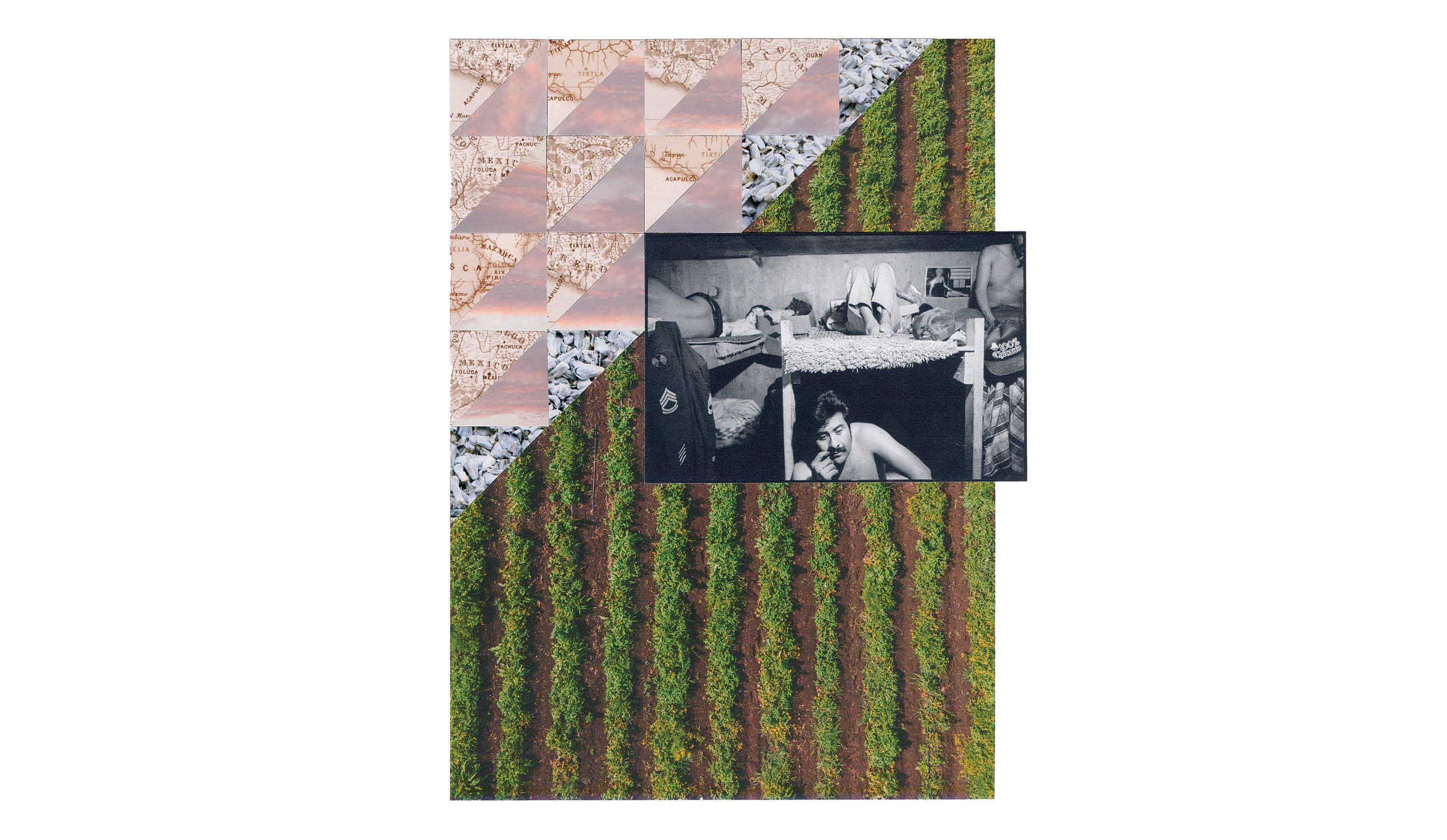
As a little one in Oregon, the years my father and family toiled as farmworkers in the Willamette Valley came through to me as whispers and gentle euphemisms. “Duré unos años viviendo en los campos,” my father might say about the seasons they lived in dilapidated shantytowns on labor camps.
I gathered only impressions of this time: the clattering of rain against the metal roof of a dwelling shared by a dozen people; an uncle telling of working without water, bathrooms, or functioning cookware, where the labor started before sunrise and ended when you could no longer see the crop in your hands.
In contrast, life before coming to the United States, in the mountains of Guerrero, was an epic poem replete with tales of creation and genealogy. It was a world built through conversations while we sat stripping veins from chiles, mixing moles over flames, and cooking goat underground in banana leaves. Our peoples were born from the mountain’s mouth. Ghostly tlanteteyotas lured an uncle to his watery doom. A beloved grandmother, Lola, honored the game animals she butchered by drinking their spinal fluid.
Somewhere in the journey from the mountain to the valley, that poetry had been disfigured and misplaced.
In Oregon, the average life expectancy for a farmworker is forty-nine years. Whole families make barely twenty-five thousand dollars a year. When half of all farmworkers are food insecure, and a quarter are hungry on a weekly basis, who has time for creation?
My father assures me that weighty conversations about the violences lived by our family were never avoided. As he recalls, he and my uncles reminisced about those days in the fields often, and in my presence. My cousins and I listened, with eyes wide and mouths agape, to an older generation straining to piece the world together. Even now, I struggle to reconcile those glimpses of grief with the life I knew.
Still, when I shut my eyes and try hard to remember, I recall no mention of deportations, not even the ones that happened close to home, while my father taught me how to finger corn seeds into the ground. Harvesting huitlacoche—if our maize was blessed with the delicious periwinkle fungus—was not, in my memory, interrupted by stories of starvation. During temazcalli ceremonies of hot pumice and rue vapor, elders pleaded for the future of our lineages, but even the most melancholic of them spoke sparingly of the omnipresent crisis that had enveloped our family—and tens of thousands of families from southern Mexico like ours—for generations.
This crisis of coercion and loss did not begin with our parents’ generation, nor that of their parents. It is a cyclical struggle that has enveloped Indigenous peoples in the Pacific Northwest for centuries. It has touched many families from many places, each with their own creation stories.
Here is one version: In the hot and sticky summer of 1789, Spanish vessels departed Mexico for Vancouver Island, traversing thousands of nautical miles and bringing with them a fierce desire to rebut Russian and British expansion into the Pacific. The Spanish ships carried war matériel and provisions intended to last a year at Nootka Sound, as well as dozens of Indigenous soldiers and laborers, likely Quechua- and Aymara-speaking peoples. Many of them were likely conscripted from brutal Andean silver mines and sent to the Mexican port of San Blas before braving the cold coasts of the Northwest.
Once at the sound, Spain built Fort San Miguel on land the Mowachaht call Yuquot. As Spanish soldiers erected outposts, Mowachaht peoples demarcated their territories through whaling, fishing, and trade. After confiscating Indigenous land, Spain seized British ships in the harbor and precipitated an imperial crisis. The Mowachaht leader m’ukwina (Maquinna) negotiated directly with Spanish and British commanders during the subsequent Nootka Conventions, which saw European militaries briefly withdraw from the region. Mowachaht peoples continued to assert their sovereignty after the European retreat, destroying subsequent ships that entered their waters and enslaving several captured Europeans.
Though San Miguel stood only intermittently until 1795, the encounters between the Spanish, British, and Mowachaht at Nootka Sound signaled the beginning of a widening system of extraction that would bind Indigenous peoples from distant lands to the Northwest for centuries.
A few decades after Nootka, during the region’s territorial days, the Hudson’s Bay Company disciplined Kalapuyan peoples and “wandering Indians”—many of them displaced Métis from the Midwest—into farm labor on the prairie lands between the Willamette and Pudding Rivers.
Indians were such productive workers that, in 1850, Commissioner of Indian Affairs Luke Lea urged more Oregon Indians to “engage in agricultural pursuits.” Settler authorities took note that Tualatin peoples, for example, were “very good farmers,” and made them labor extensively during the harvest season.
As Oregon settlers removed the peoples of Illahee (as the Indigenous world that became Oregon was known) onto reservations and waged genocidal campaigns into northern California, they cultivated systems of forced labor that would feed a hungry and expanding nation.
Early Indigenous seasonal farmworkers worked harvests that are familiar to migrant Indigenous farmworkers more than a century and a half later: hops, berries, and timber. Hundreds of families from tribal communities such as Grand Ronde, Siletz, Klamath, and Warm Springs, and even from the Arizonan borderlands, moved into labor camps. There, families lived in rough cabins and were grouped into neighborhoods of different ethnic communities. These camps endured through the termination of federal recognition of most Oregon tribes in the late 1950s, when many Native families moved to urban centers.
By 1989, two hundred years after the Spanish warships arrived at Nootka Sound, agribusiness had elaborated and grown a system of Indigenous labor. Agricultural contractors dragged Indigenous peoples to the Pacific Northwest through networks that extended deep into Mexico. Oregon greeted these “Indian populations of southern Mexico,” as one local paper put it, with starvation, disease, and other uglinesses: people “beaten, robbed, raped, treated like animals, cheated by their employers.”
Eighty thousand migrant farmworkers from throughout Mexico faced these conditions. They spoke dozens of languages, contributed $1.2 billion to the regional economy—and their labor, in turn, allowed for the creation of 350,000 jobs.
Strawberry growing and processing alone were worth about $100 million to the economy in the mid-Willamette Valley in the 1980s. But farmworkers were paid a piece rate, earning four cents per pound. Workers might finish the week with a few hundred dollars to show for their sacrifice, only to see most of it disappear into the pockets of the crew bosses.
In the spring of 1989, a grower lashed Indian workers with a bullwhip in Multnomah County. Nineteen eighty-nine. The year my father arrived in the Willamette Valley.
The beginning, for us, of those years spoken about only in whispers.
In the year I am born, twelve years after my father’s arrival, conditions for Oregon’s Indigenous farmworkers remain bleak.
Near Mount Angel, a mustached Mexican labor contractor picks up several Diidxazá (Zapoteco) families desperate for work and takes them to their new, temporary home for berry-picking season. In other camps, acres away, P’urhépechas, Ñuu Savis, and Triquis from Copala are kept distanced and divided from one another.
In this place of berries and survival, non-Indigenous Mexicans exercise so much power that the contractor’s eight-year-old son feels no shame in ordering the Diidxazá men and women to their bunks.
The berry pickers, far from Coatecas Altas, Oaxaca, adorn the walls with compact discs while banda music rings out from radios in the camp. In the barn, where sixty people are squeezed together, women fry crackling tortillas in a pan blackened with soot.
Pans caked with rotting rice and beans lie piled atop battered counters. Horseflies buzz. Meanwhile, the plywood shower walls rot with mold, and water pools on the concrete floor.
You get used to it, one man says to his bunkmate.
I can’t bear yet to ask how similar these conditions were to the ones my family lived in before me.
Our peoples came north for every reason imaginable, beginning in the 1970s. From Ashland to Portland, there are now more than seventy thousand migrant Indigenous peoples and a hundred thousand farmworkers, speaking at least fifty-four languages, raising children and grandchildren.
Before arriving in Oregon, Indigenous migrants may have left their ancestral lands for the tomato plantations of northwestern Mexico, escaping the Mexican military bombardment of marijuana producers in the Sierra Madre de Oaxaca. Other members of our community entered into contracts with Oregon growers that indebted them for years, making them, for a time, unfree laborers late in the twentieth century.
Many people, including my father, tell me that they had no idea what they were getting themselves into. The Mexico outside their pueblos, let alone the United States, was an unknown place, foreign in its pace and personality.
Don Santiago, a Ñuu Savi (Mixteco) from San Miguel Cuevas, Oaxaca, remembers the fields of 1980s Oregon as a place where “there was no nostalgia.” “Your cousins, uncles, and pueblo were with you,” he tells me. “Even if you didn’t know somebody from some other town, we were all indígena.”
My generation was born into and brought up in a world in which people brought languages, amulets, traditions, superstitions, creation stories, remedies, and seed teachers from the lands that made us.
Meanwhile, we watched others treat farmworkers as expedient scapegoats for the grievances of the times, collapsing people like my family into laborers without history, occupying realms apart from everyday Americans who benefited from their toil. Cast, that is, as casualties of American greed and convenience. And if not that, then as titular victims of Latin American violence and narco economies: Death and drugs coming to a neighborhood near you. Embodiments of a death politics, it would seem, slumped into a sea of brown bodies devoid of cultural content. Communities needing to be corralled and cast out.
I traveled to our pueblo for the first time in seventeen years last November. The violence that erupted there during my absence kept me apart from our lands for a lifetime. But turf wars are not the only thing different about the mountain.
The dirt road where my grandfather’s house sits is dirt no more. The mules that carried leña and supplies have been replaced by noisy motorbikes. And all of Ladislao and Victoria’s home has been demolished and rebuilt except for my grandfather’s woodworking shop. There, in the reincarnation of a once-familiar place, my father worked on a mask of colorín that came to him in his dreams.
On the third day, I found my grandmother’s metate and metlapil half embedded in the ground near the well on whose mouth I used to play as a child. Seeds that stayed south.
Though my grandmother died when my father was fifteen, I had seen many grandmothers in my community lift corn kernels from vats of limestone water where they softened overnight. My father would pretend to let me help pour the nixtamalized corn into the tlalchiquihuite to separate the nutritious film from the kernels. Elders would then take their wormy hands, grinding the damp corn with the metate against the metlapil, making masa destined to be tortillas.
In the mountains, my remaining family members face ferocious trials, ones that boil the blood and threaten to return our knowledge to the earth.
Upon seeing my grandmother’s stone tools in the ground, my father invited his brothers and sisters to rally my cousins, who then congregated in the clearing of my grandfather’s house. He jotted down a long shopping list and sent my cousins, aged nine to twenty-two, to the tianguis. Then he took his copal, offered a prayer, and lit a fire.
Over the next five hours the cousins made a black mole, one of our family’s many moles, with their parents. Gathered under the toronja tree, they mixed together lima reina, chiles secos, chocolate, and a dozen other ingredients for the first time in a lifetime.
Across generations of living and making life, our communities have found measures of social value other than work and hardship. It isn’t only that the Northwest’s vast valleyscapes continue to be landscaped by Indigenous bodies; our presence has changed the ecology of these places.
Migratory seeds, germinated in new soils, sprout new life, create new terrains. These lands could not have been tilled through our labor without themselves being transformed.
We now live in a world where huauhtli amaranths, kept alive in clandestine economies that survived the conquest and Christianization of Mexico, grow in the gardens of the same families terrorized by Immigration and Customs Enforcement.
In this new world, Señora Albertina, one of the hundreds of P’urhépechas from San Andrés Tziróndaro living in the mid-Willamette Valley, came together with her community in February to light the fire of Kurhikuaeri for K’uínchekua, the P’urhépecha New Year. Nakatamales, churipo, and corunda were on offer to the wide-eyed youth and grateful neighbors, feeding them not just for the evening, or for the celebration, but for a lifetime.
After a recent afternoon spent in her home, I like to imagine Señora Albertina on her way to K’uínchekua. The festivities are held in Gervais, named after Joseph Gervais, the French trader who settled the prairie lands between the Willamette and Pudding Rivers.
On her way to the door, she peels the dried marigolds that dangle on her walls, the ones plucked from the beds of gold and magenta that color the front of her home in the months of summer and fall. Pausing for a moment by the flowers, Señora Albertina smiles at the framed photos of her parents and children before slipping out into the cold Oregon winter.
Comments
1 comments have been posted.
Joaquin, what a vivid picture of a time and place and people that I never knew. Such a contrast to the wicked propaganda that has maligned and scapegoated generations of essential people. Thank you.
Reed Fraasa | April 2026 | New Jersey
Add a Comment