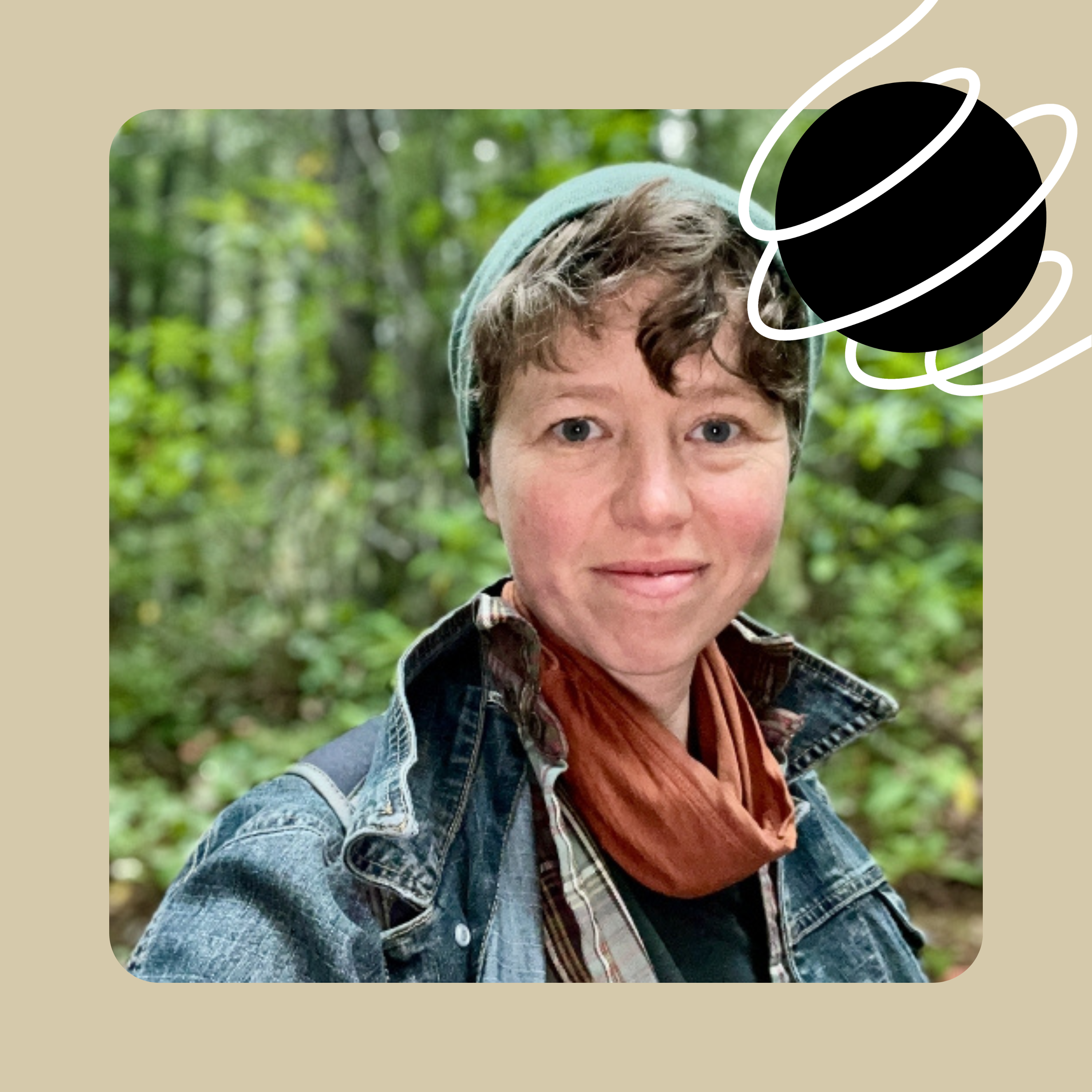
Meg Wade rarely drives. There are, in Meg's view, so many other ways to move about in the world, and most or all of these other modes—walking, taking the bus, taking the train, and more—have a lot to offer to us, our communities, and our world. Through Meg's writing with Oregon Humanities and other outlets, Meg provokes us to pay a lot more attention to where we are, what it means to move about in the ways that we do, and who and what we're sharing space with as we do so.
Show Notes
About Our Guest
Meg Wade is a writer, community organizer, facilitator, and sometimes indie bookseller based in Southern Oregon. Their work in pro-democracy and climate justice movements often centers on place-based community building as well as mobility justice issues. Their writing can be found at Unsettling on Substack. They were a 2025 Oregon Humanities Community Storytelling Fellow.
Stories by Meg in Oregon Humanities
- "Uncanny Cars: Seeing beyond the windshield in rural Oregon"
- "Wild Transit: How transit makes outdoor adventures possible"
- "Vanishing Lifelines: Rural Oregonians rely on transit to stay connected to community, but intercity routes are disappearing."
Further Detours
On February 3, Aron Klein will lead "Democracy in Motion," a conversation about how transportation reflects democratic values, at Portland Community College's Southeast campus.
Dawn Knopf wrote about the growth of the US highway system and its affect on the communities it connects and divides in "On Tender Systems" in the Winter 2026 issue of Oregon Humanities magazine.
Tashia Harris offers a different perspective on moving through the world in the face of hate and violence in "Cuts and Blows."
Transcript
Meg Wade: The reality is actually that every single mode of transportation is actually collective. We just don't necessarily recognize it, right? It's built by other people. It's maintained by other people. There are other cars out there on the road. It is never just an individual driving from point A to point B.
Adam Davis: Meg Wade rarely drives. There are, in Meg's view, so many other ways to move about in the world and most or all of these other modes, walking, taking the bus, taking the train and more, have a lot to offer to us, our communities and our world. Through Meg's writing with Oregon Humanities and other outlets, and in the conversation that follows, Meg's thoughts about getting around, about what in public is often referred to as “transit," have this effect:
they provoke us to pay a lot more attention to where we are, what it means to move about in the ways that we do, and who and what we're sharing space with as we do so. Meg joined us in early December 2025 for this conversation at the Oregon Humanities Office in Portland. After which we took a walk East through downtown and over the Morrison Bridge, alongside cars and buses, across some train tracks to another part of the city.
Throughout this episode of The Detour, in addition to the conversation with Meg, you'll hear some of the sounds along the way. We start with Meg talking about their trip from their home in Ashland to Portland.
So Meg, thanks for joining us here at the Oregon Humanities Office. I have to start by asking how you got to Portland and where you started your trip?
Meg Wade: So I came from Ashland in southern Oregon, and as I was explaining to folks out in the office, I was not able to take transit for this trip, which was frustrating because they played with the Greyhound schedules yet again.
So I ended up driving on this particular trip, but I was frustrated about that. I was really excited about like, oh, I'm gonna go talk about transit, so let me make sure I can take the bus across the state. But as I wrote about in one of my pieces for, I think the first piece I did, for Oregon Humanities, getting between cities in Oregon on the bus has become more difficult. And so yeah, so I was forced to drive.
Adam Davis: Uh, do you have a sense of whether most of the people that you live among in Ashland know that a bus might be an option for them?
Meg Wade: Um, I have learned that a lot of folks do not know about the bus, but actually what's interesting is I would say that that has changed this year.
And not just because I've been out talking to people about riding the bus, which I've been doing a lot of. But because of the crisis around transportation funding here in the state, and so there was a lot of news about the cuts that were happening to transportation districts, all around the state.
But in southern Oregon specifically, we have a really lovely district. It's just like all the folks on it are just people that I'm really glad to be getting to know. And the Rogue Valley Transportation District folks, I was at the meeting in which they had to cut service and they were so sad about it and because of the cuts to our transportation district, actually more people are aware of what they were missing beforehand, before these cuts came into play.
Adam Davis: Uh, do you weigh in your head whether that's a net gain or a net loss?
Meg Wade: Um, I mean, I certainly think for folks who are already relying on the bus, it's a net loss. Like that's clear in the moment, right? We have people's livelihoods just harmed because of that. I guess in the long term, might that prove beneficial?
Could we have done that in less painful ways? Absolutely.
Adam Davis: So we jumped right into the question of how you got here. But let me jump a little further back. Why the bus? Why does it matter to you?
Meg Wade: Um, I, I think that part of why I end up writing about transit and transportation is me trying to understand that question. Some of it has to do with early experiences.
I, we moved around a lot when I was younger. I come from a big family, there are seven kids, and getting us all around was not easy, especially my folks were never making very much. And so if I wanted to get anywhere, I was usually finding other ways to do it, right. I did not have the kind of parents that could take me to afterschool practices and clubs and things like that, pick up, drop off, none of that.
That's something people seem to take for granted in some areas. And so I was on foot, I was getting rides with other folks the best that I could. And then when I could, I was able to take the bus in Portland. Growing up in southeast Portland here was a really great space to get familiar with that. And it felt safe.
You know, I took the bus the first time at age 11. I got to start taking the bus to the library, and so it was just this expansive thing of being able to get out of my own house away from my younger siblings, exploring the world of books and feeling, I think very much like a citizen of the world as that like doing this thing that felt very adult.
You know, if you're in middle school and you're going, you know, you're going to go read great novels, you know, at the library, taking public transportation, you know, I can imagine myself being in New York, which felt so much more glamorous than Southeast Portland did to me at the time, and so that, that felt very freeing and very enticing in a way that I'm not sure is how other people experience the bus. But I think that's there, that's a part of public transportation as much as waiting in, you know, a gritty part of town in the rain is a part of public transportation.
Adam Davis: Yeah. It's interesting to identify autonomy, and an early sense of autonomy, it sounds like what you were describing. Even earlier than people often attribute to driving, where they're like, Oh, this is where I separated from my parents. I was able to get places on my own. But you're saying you could do that at 11 instead of 16 or later?
Meg Wade: Yeah, absolutely. Absolutely. I think we have this thing where we've put off adulthood for a lot of folks and we’re very precious about childhood. But I think I had a little bit more of, maybe it was more classic for folks who were older than I am. Right? That ability to sort of roam about, we take our bikes out, wandering over by Johnson Creek and all sorts of things and that kind of being outside and exploring on your own and having a little bit of trust that you would come back home and you would seek help if something went wrong. Uh, my folks really trusted, especially my older brother and I with that. And then taking the bus also got to be part of that long before we would've been able to have driver's licenses, whereas I think some folks are a little bit hesitant to put their middle schooler on public transit these days.
Adam Davis: Yeah, it's interesting. I grew up in Chicago mostly and I remember, very young, at nine, taking either the 36 Broadway or the 151 Sheridan to school. And also bringing my younger brother along when he was quite young, uh, a few years younger than me, and my parents didn't seem to think that was unsafe and it didn't feel unsafe.
Meg Wade: Mm-hmm.
Adam Davis: So can I ask you a little bit about that? I think I hear perceptions around buses sometimes that it doesn't feel safe, and you used the word safe earlier. So I just wanna come back to that.
Meg Wade: Yeah. I definitely remember having that feeling when I was younger. And I think when you're on the bus, you're in a public space.
So a lot of about how you feel, I think, has a little bit to do with how you feel about being a part of the public in general. I love public spaces where people know that they are part of that and they wanna be there together. And I've made many friends riding the bus, right? Because I'm willing to just talk to whoever's next to me.
And if you don't feel that, there's automatically a little bit less of a feeling of safety, because if you don't feel like you can talk to the folks around you and ask them for help, then you're gonna feel more isolated if something should occur, right? Whereas if I trip and fall on a bus, I have a perception that somebody's gonna help me out. Right? Somebody's probably gonna reach over and give me a hand up. 'cause I know that I do that for other folks. Right? I think some of it is perception. I do think there's been a shift though, right? Because I think that the association that most folks have between cars and autonomy means that where people have been able to, and we know that car ownership has just increased for decades and decades, people will move there because they associate it with success, with freedom. And so if we have class stratification on buses, right, and we have fewer folks from all of our city's diverse backgrounds on there, then it begins to feel like, oh, only folks who are, you know, maybe a little bit of mental illness going on and can't drive, are on here. Only folks who are sort of people that we want to say are high risk individuals, whatever that means, are on the bus. We begin to see a makeup change as opposed to the diversity that really helps knit together that sense of like everyone from the public is on the bus. And I think that, I do actually think that's been shifting in a way that I'm not excited about.
I'd like to see more of us on buses. You know, you have the same thing with a public street that you do with a public bus, right? The Jane Jacobs effect, like the more eyes that are on there, the safer it is, right? So the emptier they get, you know, the lonelier and less safe they feel.
Adam Davis: You said when you ride buses, you talk to people on the bus.
What do you mean?
Meg Wade: There's just always something going on, right? Somebody's wearing a nice jacket, it's a cool color. You wanna say something. There's just people to joke with. There's things that happen outside. You know, you pass a beautiful tree, you pass somebody on a weird bike and you can all start talking about that.
Um, somebody has a really tough conversation and they're on their phone. You're not excited that they're talking on their phone. Maybe on the bus if you're trying to read, sometimes I'm trying to read, but they get off and you're like, ‘Hey, wow, that sounded hard. How are you doing?’ And then sometimes people open up.
Adam Davis: So that sometimes is interesting. Sometimes people open up.. It's interesting. Really, I think what we're starting to talk about is the extent to which a bus is a public space. Or whether people are still trying to stay private. So I'm wondering, do you ever try to talk to people and get shut down?
Meg Wade: Oh, I mean, absolutely. If somebody doesn't wanna talk to you, you leave 'em alone. I don't always. Sometimes I am tired and I am socially worn out, and I don't wanna talk to anybody else either. Yeah, it's judging and being mindful of not being intrusive. When folks need that, the ability to, because I think we all do need that at times, the ability to be private and public.
Adam Davis: Yeah. Sounds to me like you've ridden a lot of buses.
Meg Wade: Yes.
Adam Davis: Uh, can you think of any one or two experiences on a bus, like specific instances where something happened that really stands out to you? And it doesn't have to be positive. It could be a combination, but something that felt like, ah, this is the bus and it's holding in my head.
Meg Wade: And we're sticking with buses or can I pull trains in there?
Adam Davis: You can pull trains. And you, you could talk about riding horses. I mean, you decide.
Meg Wade: Um, because I think in recent years, one of my most favorite times on a mode of transit was on an Amtrak trip that I took from Portland down to where was I going.
I think this was a multi-leg trip. Uh, I took the Coast Starlight down to Los Angeles, and then I got on the train that connects over to Tucson to see folks there. So it's a long ride and it's, uh, partially overnight. Right. And my seatmate was this amazing woman who I think she maybe had gotten out of doing finance recently, but she was newly into spelunking.
She was the most enthusiastic person about caves that I've ever met. But she also very much likes to talk to people on trains, on transit when she rides. And she had discovered that the way to really make that happen was to bring a lot of food and a lot of booze. So I basically sat down next to the party person on the train and she was a little bit older than me.
I think she was in her upper forties or whatever, but it was just there ended up being a whole bunch of us in the club car, like, you know, around midnight eating all of this delicious Thai food and other things that she had brought to share and more surreptitiously drinking the scotch, which was also very nice and just having a really fantastic time together.
I don't remember her name. I don't remember the name of anybody else that I spoke to, but we had such an amazing time together for like the four or five hours that we were all hanging out in the club car together. Yeah,
Adam Davis: That's a great story and I wonder if she's an Amtrak plant in some way. Can I ask if there's a, is there a challenging story, one or two that stand out to you?
A sort of hard story of taking public transit that really stands out?
Meg Wade: I think that there are probably plenty of those stories. I have some physical sensitivities that actually make transit pretty difficult. So in some ways it's been interesting that I choose to continue to do that. I have both a hypersensitivity to noise and to smells, so somebody can get on a bus with, oh my gosh, like vanilla body spray is like the worst product on the planet for me. And so I will just end up feeling quite sick for a while. COVID in some ways, in the introduction of masking, has been an amazing revelation for me because it's helped solve a lot of that problem. So I will often wear a mask on transit now, but, um, yeah, so there's just that, there's just that basic discomfort that can happen, right?
So plenty of low-grade ‘this was really uncomfortable and sad.’ I know that I have seen people get injured on transit. I know that I've seen people take a fall and have had the buses stopped and somebody has needed medical attention, and in that moment you're torn because you are wondering like, your day might be derailed. Like, am I gonna get to work on time? Oh, can I help this person? Maybe you're feeling helpless in the moment and lacking agency and, but also trying to be a person who's assisting other folks in that chaotic moment when something like that happens in public. I've definitely been on the bus when a driver has refused to allow someone to get on because they were, maybe they were pushing somebody around outside and, you know, we can't have that on here.
So lots of different things like that. Yeah.
Adam Davis: Do you tend to ride transit solo or do you tend to ride with people?
Meg Wade: I mean since so much of it has been commuting, so it's very frequently solo and I do a lot of solo travel, solo adventuring, which makes it particularly easy meeting people.
Right. I find that easier when you are not having to sort of bombard another individual with two of you or three of you. But it's been fun here in Portland. I don't live here anymore, but more of my friends here are taking the bus now, and so it'll be a conversation. They won't necessarily presume we're driving somewhere, but like, oh, we'll take the bus together.
Oh, I have a good story about when I got to teach a bunch of folks how to use transit for the first time. I was living in Los Angeles. So I've lived in a bunch of the big cities. I've lived in New York and LA and Chicago for a long time and done a lot of transit writing and all of those spaces.
But in LA I was working at a bookstore, and this was during the Occupy movement. Um, and there was a big mayday protest march that was happening and we convinced the store owner to let us close the store down for part of the day so that we could all go together. And I decided the easiest way for us to go downtown together was not for people to drive solo. There was for all of us to take transit if we could, but a lot of folks, given that it was LA, had never actually taken transit. Yeah. And just getting to teach folks the ease of getting a card, getting on the metro there, how fast and easy it was and fun because we weren't all individually driving down, searching for a parking spot and all of that, which in LA is quite its own thing to have to deal with, right? We were doing this collective political action and I think it just made it all the more powerful that we were also a lot of us took transit down there together.
Adam Davis: I Want to put two strands together for this next question. One strand, being that you have seemed to find yourself in situations where you're helping other people see that public transit can be a good thing.
Meg Wade: Mm-hmm.
Adam Davis: And the other strand is living more rural. You just gave some examples of urban transit experience. I think the stereotype about living rural is you don't have options for public transit, which is why I think these two strands might go together.
What's your sense of transit in rural Oregon, to the extent that you have a grasp of that big category, rural transit, and how much are you trying to help other people see that there's more to it than we might normally think?
Meg Wade: Yeah, so clearly some of the pieces that I've been writing for Oregon Humanities this year have been about trying to help people see that.
And I definitely have a habit of just bringing up the bus as an option in conversation and letting folks know how they can get around by it if they've never tried it. That is a tick of mine. But doing so through writing this year has been really fulfilling. And it was great to get to interview Katrina, one of our Rogue Valley Transit district Board members down there. She uses the phrase ‘bus blindness’ to describe the fact that, yeah, folks actually just don't realize that the bus is there. They literally can't see it because they've become so accustomed just to not thinking about it and only really seeing cars. So. Folks in, in Our Town, which is Ashland, is, you know, maybe just over 20,000 folks, which is not as rural as you can get by any stretch of the imagination, but is a lot smaller than many places.
We've had bus service down Main Street for a long time. For a very long time people just didn't know that there was a bus. And so, yeah, uh, Katrina uses the phrase ‘bus blindness,’ which I think is really accurate. And now I had, you know, I can talk about that with folks, you know, I can be like, ah, you're suffering from bus blindness, right?
Like, um, but here is this option. Right here is this option for when your partner has the car and you still wanna do something, you don't have to feel like you can't do it there. There is an option there. And I think when folks think about our current economic moment, a lot of folks are looking for places to save money and
they aren't always thinking about things like, oh, I can get rid of my car, or I don't have to pay for gas as much, what have you. And I can be like, ‘Hey, did you know this might be an option that helps you meet that challenge right now?’ Whereas for some folks, that's like the last thing on their mind. Yeah.
Adam Davis: So I hear lots of different, at least the beginnings of lots of different arguments for thinking about leaving the car behind. Safety in a weird way. I guess we haven't talked as much about that as we could have, but that it may be safer to take public transit than…
Meg Wade: I think it's definitely safer to take public transit.
Adam Davis: Say more about that.
Meg Wade: Just in terms of the number of people who die in car crashes every year. It's something that we do, we take so for granted and we don't realize it, but every time you drive by something on a highway, right? You're driving by somebody who has been possibly critically injured or maybe has died, and we just learned to, again, I ignore that. It's like it's another form of blindness in a way.
The thing that I learned this year that I didn't know is that actually rural communities bear the brunt of that. In the US rural communities are overrepresented in traffic fatalities. Multnomah County does not have nearly the rate of traffic death as Jackson County does, right? We lose people at a higher rate than places that are denser because we have to drive more places, uh, at this point.
But also road conditions are tougher. We certainly know that. If you don't wanna die, you are safer on a bus than you are driving,
Adam Davis: Why? Why do you think we have that particular form of blindness? Not bus blindness, so much as blindness to the risks of driving relative to the risks of public transit?
Meg Wade: We're really bad at judging risk as humans in general, right? Like we have trouble with the big existential things. Climate, for instance, we're not really good at thinking about air pollution, which is another way that lots of us actually suffer and die from cars that we don't want to talk about stuff that's hard to see.
But also we really prize convenience and I think that there is a tendency to push off the negativities of car ownership for the convenience that we think that it brings or that it has brought. I think that there are times where people get so tired of the ways in which it's increasingly inconvenient to be stuck in traffic, that they begin to seek other ways.
But, you know, our minds allow us to sort of skip past those really big negatives, it can't happen to us kind of things like I'm never gonna be the one to die in a car crash. Right. I'm never gonna be the one to accidentally kill somebody because I'm going a little bit too fast. Right? We're able to sort of rationalize that because of all of the perceived convenience and ease that they bring us, whereas we allow the slight inconveniences about transit, having to plan more, having to deal with other people in a different way, right?
They're maybe closer than they are when we're in cars. Um, we allow those to be bigger and present. For us.
Adam Davis: You said earlier in the conversation you said something about adventuring. You do some adventuring? What do you mean?
Meg Wade: Yeah, I do, uh, I do a fair amount of adventuring. I've done a lot of long distance backpacking and then a fair amount of solo travel in general, a little bit of international, not a ton, because, uh, those flights have big climate impacts and so I try less than that, but I also do a lot of just adventuring. Going on. I like to call them urban hikes in Ashland. They're sort of a combo like urban to wildland kinds of hikes. You know, just going and being out in the world for a day and seeing what happens.
Adam Davis: Yeah. I think the reason I asked about that, because I feel like you're sort of implicitly making an argument about getting places that is not only thinking about the destination, but thinking about the experience along the way, which is not, I think, how we usually think of, say, commuting.
Meg Wade: Right? But if you think about how much time we all use commuting every day. I mean, it's sad then if it's just like this empty time, right? We're talking lots about buses, but really my favorite mode of travel is still just walking. And part of why I've been in bigger cities for much of my life, even though I think that I really do prefer sort of the slower pace of small town life, is because it can be easier to find housing that is walking distance to employment.
And I have set up my life to be like that for pretty much as much as I possibly could throughout time, because then, yeah, every little 20 minute walk is totally an adventure of the senses. Of, you know, experiencing whatever the weather happens to be that day, of noticing what's going on in your own mind, of seeing who's out in the neighborhood.
It's all that. So if you take that approach to whatever mode of transportation you happen to be using right then, yeah, it's all a little adventure as opposed to something to just suffer through.
Adam Davis: You are listening to The Detour with Meg Wade.
This year on The Detour and in conversations all over Oregon, we're taking the 250th anniversary of the Declaration of Independence as an opportunity to explore questions related to democracy, equality and freedom, and we want to hear from you. What is your wish for the United States in 2026 or for the next 250 years?
What are your hopes or ideas for how this anniversary might be observed? Tell us by recording a voice message on your phone and sending it to detour@oregonhumanities.org. You can also call our phone line at 503 607 8592. We might share your message in a future episode. Let's get back to our conversation with Meg Wade.
It is hard to argue with the idea that, for example, the trip itself might be full of experiences that are valuable in themselves rather than just, as you said, empty space until you arrive at your destination. And it's also fairly easy to be convinced by the argument that it's good to interact with other people in public, and we can do that even while we travel to the places we're going.
And yet there are these huge cultural currents that move us away from doing those things towards an isolated car. Why is it so hard to do these things that sound so good?
Meg Wade: You know, there are billions of dollars that are spent each year to cause us to do some of those other things, right? I think we were talking earlier also about the sort of changing dynamics of what it's like to be on a bus and whether or not it feels safe or feels like it's public.
Um, I think the introduction of cell phones and headphones into that space is actually also a big thing. And obviously again, billions of dollars spent to capture our attention and push us into that. It's not just like each of us individually making some choice about how we wanna structure our lives, right?
We have these big forces that are putting a lot of power and capital into trying to, um, to shape our world. And we let them do that a lot. It's hard to resist, right? Given how much is put into that. And there are some, I think especially in the US there are cultural predilections to individualism. Oh obviously that.
We encourage folks to be like, okay, well how do I do this? How am I getting somewhere? Right? Um, and we have this myth that the car is an individual solution that you have control over as an individual. We get to choose, whereas the reality is actually that every single mode of transportation is actually collective.
We just don't necessarily recognize it, right? It's built by other people. It's maintained by other people. There are other cars out there on the road. It is never just an individual driving from point A to point B, but some of the blinders as individual consumers allow us to think we are making an individual choice in getting to be autonomous when we're in a car, even if we're not actually as much as we think we are.
Adam Davis: Through the experience of riding the bus, I can just talk about Portland or Chicago…
Meg Wade: Both
Adam Davis: feels different than getting in a car where you get in a car, you're kinda like, I'll put on the music I want to hear, I'll regulate the temperature the way I wanna regulate it. Maybe I can't control traffic, but there are more things I can control.
Or at least I have the illusion. But I think it points back to the question of how public we want our lives. To be that there's something about riding a bus that every time that front door opens, I think most of us cast a little glance towards the door to see who's coming down the aisle.
Meg Wade: Mm-hmm.
Adam Davis: Who's gonna join us for this trip and change our experience and our collective, and that can be exciting, but it can also be the opposite. And that doesn't happen in a car.
Meg Wade: Not necessarily, especially if you've got the windows up, right. I just really believe in the value of that public experience, and I think that we're all suffering from the lack of it.
I think it’s that inclination to choose that very tailored, personal, just dialed in individual experience every single time. Right. To have that be our default habit is really cutting us off from our fuller humanity and the really, like, almost like the ability to solve all of the big problems that we have.
I was listening to, one of your other conversations on my way up here listening to your conversation with Danielle Allen thinking about big problems of democracy. Her number one piece of advice is join a group. Right. You wanna solve these major problems that are facing our country and our world around creeping authoritarianism, blatant authoritarianism.
Number one thing you can do is join a group. It's go be with other people, right? So if we can't figure out how to be with other people in the everyday in these very basic ways, how are we gonna solve how to govern together? We think that we are choosing ease. We think that we are choosing the thing that makes our life better and it's actually eroding it bit by bit for the long term.
Adam Davis: It's because I agree with you that I want to keep asking questions about this. Part of it is that I agree. And so that makes me worry that what if we agree too much? The other thing is so many people choose the windows up.
Meg Wade: Mm-hmm.
Adam Davis: And sometimes I totally get it. Sometimes I choose the windows up.
Even though in my head I am completely aligned with what you're saying about a more public mode of existence, that we gotta do this stuff together and that it's actually enjoyable to do these things together. So I think I'm trying to ask a question about what seems like, again, that cultural push in the other direction against what seems like it's obviously good, why is it so hard to do this thing to lower the windows or to be on the bus instead of the car in the first place?
Meg Wade: I think, I think it's a hard question. Again, I think because there are many forces that want to encourage us to do other things. You know, we are better individual consumers if we are cut off from being able to be with other folks. Right? It is. There's a lot more money to be made selling individual cars, selling four cars to a family rather than a set of bus passes.
I think that being at ease with other folks in public, though also for a lot of us, takes being at ease with ourselves and how we're showing up in the moment. And that sense of like, however I'm showing up is enough. I don't need to be anxious about how other people are gonna perceive me. I belong here.
I deserve to be heard by this other person. Yet, yes, they might not want to engage, but I trust myself enough that I can start a conversation with them. I trust that other people are gonna catch me. All of that's a really complex, sort of inner psychological state. And if we don't have that, it can be hard to show up in public if you have the choice.
Right? I think a lot of us who take the bus also are just doing it out of pure economic necessity. Right. That certainly has a lot to do with why I've done as much travel as I have done by bus. A large part of my twenties was choosing how was I gonna pay off my student debt? Having no car makes it easier, but if you have an option and you're looking for, again, what feels like ease, right?
You don't have to cultivate a sense of belonging in the world to get into a car and drive. You can kind of deal with your own neuroses, whatever they are. You can keep 'em to yourself, right? But if you're out in public, it helps to have a little bit of that grounding. And we aren't all given that grounding.
We don't. That's a complex cultural situation about why we aren't. But I think that plays into it as well.
Adam Davis: I love that idea of being at ease in public and what it takes to achieve that. It does feel kind of like an achievement. Uh, probably something that. You need to continue achieving. And I was thinking back to what you said about when you were 11, taking the bus to the library when you were 11, did you have that sense of being at ease in public?
Meg Wade: I mean, I think I was learning it, right. I'm the, you know, one of the elder siblings in a large family. So I think one of my experiences growing up also is that sense of needing to be responsible a little bit earlier than other kids necessarily have that. You can give that a negative spin and call it parentification.
Or you can say that it gave me a place in the world, like very early on that I had people to care for very early on. And that I learned that ability. That's part of what it means to be in public, is to not be concerned about yourself, but to be concerned about others. And that too gives you a role, that sense of responsibility to be helping others.
It's sort of an antiquated cliche image at this point, but that helping an older person across the street, that is a real thing. And I've done it many times, and I don't know if we actually teach that to people anymore, but being taught that as a young person also just gave me a sense of like, oh, I have a role to play.
And I have a way to be here for other people that I don't know.
Adam Davis: Mm-hmm. I feel like as we've been talking, you've made several different kinds of cases for thinking about public transit differently than maybe, culturally, we tend to see it. One is a safety case, one is a case you just made, is kind of an ethical case.
That there are ways of being in public that call out more responsible modes of conduct when you're trying to get people to be open to this and people who are either gonna take transit more or legislate differently around transit. Have you found that there's certain kinds of arguments or certain kinds of invitations to think differently that are more effective than others?
Meg Wade: I mean, I think that's gonna vary, obviously, person to person. I mean, there are aesthetic arguments as well, right? I mean, if we're just gonna talk about how do we have cleaner air. Right? And that's it. That's environmental health, but it's also an aesthetic, right? Like how do we not have smoky skies and gray smudge in cities?
Well, we have fewer fossil fuels burning, and so we can have fewer cars, streets that are less car-filled are also more beautiful, or that sense of being able actually to relax and not have to be “on” (as the driver must) can be an invite for some folks, I think we don't always think of adding transit as adding to choice, right?
If you want more of a market approach, right? I think adding choices, adding options for folks. When we cut transit, we cut options, right? Is another way that we might talk about it. You can estimate that as many as one in three people can't drive, right? That includes folks with disabilities, elderly folks, people who've never been able to get a license, young folks, right?
We have a huge number of people who actually just can't drive. So if we wanna have an option for them to get anywhere outside of a, you know, two mile range, right? We need something that doesn't look like a car. We need a collective form of transportation. So I think just what does it mean to have options for everyone?
Right. It is a pretty persuasive argument as well.
Adam Davis: And we haven't talked about roads.
Meg Wade: Oh gosh. Roads.
Adam Davis: Yeah. Why? Oh gosh. Roads.
Meg Wade: Roads are pretty bad for the world, actually. You know, like we've always had trails and paths and things. We've had roads in some form for a long time. But roads, in terms of like the paved high speed roads that we have in the current form are pretty new, and they're pretty destructive of people who were on them, people who were by them, and the planet on a very, very basic level.
Adam Davis: Can we talk a little about walking?
Meg Wade: Sure.
Adam Davis: What's good about walking,
Meg Wade: I think, I think it's Rebecca Solnit who talks about walking as sort of the most human pace, right? The human speed is three miles an hour, right?
Which is, you know, many, many people can pull off a mile at 20 minutes, and so three miles per hour, right? It is like how our brains are tuned, you know, or evolved in terms of the information that we can take in, what we can absorb through our eyes and what we can listen to, and it's the right speed for humans.
And I find that to be true in terms of my own internal state, sort of feeling at rest and again, at ease while moving through the world. I feel it most while walking. Um, I think when I walk I feel a sense of connection to not just the human community, but especially the more than human community, than I do through any other mode of travel.
That's when I notice the trees, that's when I notice the birds. That's when I notice the wind and the air, and obviously the soil underneath my feet, all of that, and I love that, and that makes me feel more grounded and in place than just about anything else can.
Adam Davis: Yeah, I'm with you. I mean, I walk. I walked in today. Where I live, it's about a 50 minute walk, so that's a relatively long walk to work.
Sometimes if I tell people I walk to and from work, they look at me like, what you, that's a long walk. It feels just right. It feels like the right length. And today as I was walking in, I walked over the Morrison Bridge, which is not that walks involve a bridge in general. And I was thinking about roads and bridges 'cause I love walking over the bridge.
I love that I walk to work and cross the bridge and that when I leave work, I cross the bridge going the other way. A thing that roads are meant to be something like a bridge, like the best case for roads is they do precisely what bridges do. In more exaggerated fashion, they connect us to places more easily than we would otherwise be connected.
Meg Wade: Well, I think that they can be bridges, but in the way we tend to make roads, they work more like walls. Right? A book that I have been recommending just constantly for the last couple of years is Crossings by Ben Goldfarb, in which he writes that roads are walls, especially for animals, right? And humans are animals, right?
That they work as a moving fence, right? Especially when they have enough traffic, we can't get across them. And when you think about, something like I-5 right? And the number of lanes, right? That is a wall that is not a bridge, that is a wall that one cannot get across. And sometimes the wall, even if you're in a car, trying to get over the number of lanes that you need to get where you're going.
Adam Davis: Isn't I-5 a good example of something that is clearly a wall and a bridge, that it's like a perfect illustration of it is serving a function for some people. Some animals to get where they hope to go more quickly than they otherwise would at the cost of plenty of other animals and plenty of other people.
Not only not being able to get where they want to go, but being put at risk, but it's kind of both at the same time.
Meg Wade: It can be. Yes. Yeah. And I think a lot of what's moving up and down I-5 though, is not just people, it's goods. Right. And I think that we have those Interstates, those things that are really massive walls not actually to move us, but to move our things. And that's actually, that's like a different piece of the transportation puzzle that we have to figure out.
Adam Davis: As you think, I've been asking you questions about transportation stuff and transit stuff, and that's in part because that's what you've mainly written about for Oregon Humanities.
Does that fit into what you think of as a kind of larger concern of any kind? You've talked about the public. And ways of being in public. What do you feel like is the question underlying your concern with and your attention to transit?
Meg Wade: I mean, how to move about in the world is just a fundamental question for a lot of us, right?
Transit stands in for mobility in general, and movement, and I think I'm someone who gets a lot of joy from movement, and I've become somewhat fascinated in recent times. You know, we can talk about, say like I-5 being both a bridge and a wall, and we have a lot of forms of technology these days that things like that are meant to help connect us and they're meant to help us move, and they actually also freeze us in place. Cars are actually like that, right? They do help us go to many places, but our bodies actually become immobile while we're in them, right? We're very much stuck in place versus, the way I feel when I'm walking or biking or when I'm on a train and I can walk up and down.
Computers are to me like the ultimate. And that, right, that yes, I can see images from all around the world. I can chat with people from everywhere, but I'm actually locked in place. So there's these greater questions about mobility and our ability to actually move freely. But I think a lot of it is about like, well, what does it mean to be in community?
What does it mean to be connected to the places that I am? I have a deep belief that a strong connection to place is necessary for just about every form of good that we're looking for in the world, whether it's how our ecology functions, right? We have to be able to be in place and to notice and see things, right?
Whether it's how we connect to our neighbors, right? How we eat all of these things that can be really fundamental to our lives. We have to have some notion of place, and I think that I get a greater sense of the places that I am in and I'm better able to deeply know them when I move about them in many different ways and not just in a car.
I think so many of us get to know both the rural and the urban places that we live in a very narrow and restricted form because we take certain car-designated routes. I think about living in Los Angeles and the way it was so different for me. I lived there without a car for the three years that I lived there.
I was often riding with other people and just the views that you would see, right? Your sense of the city and what it was made up of was so drastically different between those two things. Right? Image of the city from those big interstates and those giant junctions in the sprawling cars and parking lots versus actual neighborhoods sprawling over hillsides.
Right. So dramatically different. I feel that even in the Rogue Valley sometimes going, yeah, whether or not I'm going along I-5, between Ashland and Medford in a car, the vistas there versus the way I am sort of held into the hills if I'm walking along some of the sort of more side streets on foot that I can walk. There's all, there are alleyways in Ashland that I love to walk along.
Right. And again, I can almost feel like held or hugged by the landscape when I'm there on foot in a way that is a little different than I can ever feel when I'm in a car.
Adam Davis: I love the question, how to move about in the world. That's just a beautiful big question that shows up in so many places.
You're just talking about the Rogue Valley, and I want to ask you again, because you've named so many places that you've lived, and been, why are you in the Rogue Valley now?
Meg Wade: I think this question about the fascination with place and questions about mobility. Some, some of them come from the fact that we moved very, very often when I was young.
We moved states, we moved houses. And about the time that I thought that I was gonna finally stop that as an adult, I ended up getting uprooted again and then moving even more often. That's jobs, partners, misadventures, adventures, what have you. And I just, I came to wonder if I was ever going to have a place and I felt like I was really listening, that I was like listening for a calling to the place where I was supposed to be. And so, like the most honest answer is I feel very called to be where I am right now. But that comes from years of listening. Uh, for that, the way I actually first arrived in the Rogue Valleys, I actually walked there for the most part. Uh, I was on the Pacific Crest Trail.
I wasn't trying to do a through hike, but I had hiked 950 miles roughly, and this was in the summer of 2015 and I got sick from Wildfire smoke and ended up in Ashland recouping from that, staying with friends of friends who turned out to be some incredibly amazing people. And I was like. Who are these people and what is this town?
I'd heard about Ashland growing up in, you know, largely in Portland but had never actually been there, right? But I was there and was like, wow, this is amazing. And I couldn't actually keep hiking, uh, northward on, on the PCT that year because Crater Lake was on fire. Everything was closed down. I was trying to figure out what on earth is going on.
But I'm hanging out in town and I see a notice about folks who are actually also hiking a very long distance, but they're walking the route of the proposed, uh, Pacific connector pipeline that was folks were trying to get put in for a long time and the community was not super excited about that.
And I'd be like, pipelines, climate change. Like those two things are not, I'm not excited about that and I can definitely walk that distance. I'm pretty qualified to do that at this point in time. So I got in touch with folks and ended up joining the small crew who hiked from, some of them hiked all the way from the Klamath Basin all the way to the coast.
But I ended up joining them for the part of the route that was basically Ashland to Coos Bay. Small highways. Forest Service roads, some other, you know, random trails and things like that. And we actually walked the whole route and met with community members along the way. And I think if you want to really get to know a place or to fall for a place, walking, with people who care enough to throw their whole lives into a radio walk for a month or two to, you know, resist a bit of harm they think is gonna come to it. That pipeline would have, you know, taken super flammable gas underneath the Rogue river, right? And through people's farms and forest land, all to export it, right.
And provide in the end very few jobs. And the community did successfully resist it. It took a number of years, but that little walk along the proposed route was one thing, and I got to meet folks who deeply cared about where they were at, and to do that very human speed of seeing Southern Oregon and in that way.
And I think that was a seed. It took a long time for me to be like, yes, I'm gonna, I'm gonna show up down there because I knew that the calling was strong enough that if I did it too soon, or I did it without the right level of commitment, that it would be the wrong time. And so, and it took quite a while, and then it was in 2023 that I finally made that jump and ended up down there.
But it, I feel like it was, it was worth the wait.
Adam Davis: What's your bus in Ashland? What's the main bus you take?
Meg Wade: Um, the main bus is the number 10 that connects Ashland to Medford. It's really sort of the spine of the Rogue Valley transit system. And yes, this, the number one bus that I ride, there was a route that until just a few months ago, actually also ran right down my street, the number 17.
But that is one of the routes that was cut due to funding issues over the summer.
Adam Davis: What is the number 10 cost per ride.
Meg Wade: So it is $6 for as many rides as you want to take all day. That is usually how I go about things as I get the full day pass. There's also discounts for buying 10 tickets at a time or a month pass, depending on how you wanna do it.
Adam Davis: I don't know why, I just remembered this while you were talking, but there's an express bus in Chicago, the 147. I don't know if that rings a bell.
Meg Wade: I don't know if I ever took the 147.
Adam Davis: It was my daughter's favorite bus when she was a little kid. I'm not sure why she thought of it as her bus, but we were once waiting for the bus, and when we got on, we told the bus driver that this was her favorite bus, and the driver said, yeah, it's the Jesus bus.
I said, why is it the Jesus bus? And he said, because when the 147 shows up, people say like, oh Jesus, it's here. The bus is here. It's an express bus. So that has always stuck with me. It's like this incredible excitement about the right route.
Meg Wade: Mm-hmm.
Adam Davis: Like this is the one that really I've been with, not the local.
I wanted the Express with the red sign, and here it is. We've been talking about transit for a while and also about the public and place. Do you feel like we're missing something that we should be talking about?
Meg Wade: I mean, you were asking me about arguments for transit, right? And you mentioned legislators and funding, and obviously I've been talking about funding cuts.
This touches on the public, but also takes it into another direction, right? Which is, it's not just about how are we with one another when we're actually sharing space, but we're always taking care of one another or not taking care of one another through policy and through the way, like our resources get pooled and shared in public domains, given that we live in a system in which we pay taxes or we support organizations. We pass policies that make decisions about where those pooled resources go. We seem really, really opposed to funding transportation, to funding public transportation and transit and modes of getting around that aren't a car. And we're really excited for some reason, to force people to pay 20 grand to go buy a vehicle, but really frustrated by paying an extra couple bucks per person a year to give everybody completely free transit.
And I am really flummoxed by that. By that, I mean, if you just think about that, the amount of expense we require everybody, when you talk about the cost of gas and you talk about what it means to maintain roads, we have to maintain roads so much less if we're running just a few buses on them versus running so many individual cars, and we could be helping everybody get around for free by just being a little bit more like, yeah, we're gonna just take care of that for folks and we seem so resistant to do that. And so I think we've been dancing around funding, but yeah, I wanted to name that for sure. I mean, like it doesn't take that that much to run some really effective bus lines and our legislators just kicked that discussion so far down the road last year and they had to come back how many different times? And these are people who were supposedly environmentalists and climate folks and this, and it took them how long to pass a transportation bill. Right. I just don't understand, it doesn't make sense to me.
Adam Davis: The example you point to in one of your pieces in Oregon Humanities Magazine about the changes that national parks have made is a kind of heightened version of the same question you just asked. That is we're actually gonna bring in buses and that's gonna make all sorts of positive differences for the experience people have here and for the land itself.
Meg Wade: Yeah, I think I, I talked there about Denali where like, you can't ride a personal vehicle all the way into Denali as it turns out. Like you have to take the bus. And they do that because there are animal species in Denali that can't survive. They're very car shy, and if they have to wait for the safe moments to cross to get between their grazing, they're never gonna cross.
And so they're never gonna actually access their food and they will die. So they've made decisions there, but folks still actually have their transportation provided for them, and they're still able to see wildlife. They're able to see the amazing vistas of Denali. When I found out about the buses, I was like, oh, I can actually go do that.
Right? It was like, oh, I will actually have that taken care of for me. So I think, yeah, for them it's such an obviously smart choice and we could do that for ourselves in so many other places and somehow we choose not to, right? We choose to fight over parking at a trailhead or fight over parking at the grocery store, right?
Rather than just having the service of being able to go to and from easily provided for us.
Adam Davis: So maybe the last thing I wanna ask while we're still recording is about the, I think relatively unique habit in Portland, that bus riders when exiting the bus say a very loud thank you to the driver. Have you noticed this here?
Meg Wade: Yeah. People definitely do that here.
Adam Davis: Where, how does that happen do you think?
Meg Wade: You know, I mean, don't you think it's polite? I think it's polite.
Adam Davis: I think it's great. I think it's great. I, in a way, I wanna know why it doesn't happen more. It also feels like it points to a lot of the things you're raising.
Meg Wade: Yeah, I think that there are bus drivers that encourage it. 'cause there are bus drivers that acknowledge you. Right? And once you've been acknowledged by them, then you wanna acknowledge them back. Um, I, I have had the rare bus driver that is really good at telling jokes or occasionally sings and that can be a great thing for the spirit. And you wanna make sure you say thank you to this bus driver. Right. And I think for folks who ride a route every day and have the same person, you're gonna do that. You know? I think it's mixed in the Rogue Valley. I think some people definitely do, but it does not uniform in any way.
In my experience, I think that I'm inconsistent in offering my gratitude, you know, and it's going to depend on how many people are standing between me and the driver, will they see it? How many of us are getting off at the same time? So density may be a factor there. You were asking me earlier about just the ability to have good moments on transit and what were some favorite moments, and I think that I've had some fantastic moments where there aren't very many people on the bus where it's even just you and the driver and you get to sit up front and they're chatty.
You get to hear about their day, hear about what's going on, or one time, you know, we haven't talked so much about the backpacking adventures that I've done by bus, but I know how to get on a section of the PCT i in Washington here, I took the route that goes along the gorge on the north side of the gorge in little, sort of almost like paratransit route.
Runs out to Carson there and the person who drove that bus had so many stories about all of the different hikers and it was like he had taken in all of their adventures and could relay them back to me. So it was just hiking, adventure upon hiking, adventure all the way down the gorge. And that was just a lovely moment of connection and that's what drivers are like these repositories for all that is coming in through their vehicles and um, they can be amazing folks to get to meet.
So, yeah. It's nice to say thank you for that on your way out the door.
Adam Davis: Well, let me say thank you for this as we wind up this conversation. Thank you for helping us think about how we move about in the world. It's beautiful to pay more attention to that and be more aware of all the things that go into it.
Thanks for making time for this.
Meg Wade: Yeah, I'm really glad that I got to do it. And maybe we get to go walk over the bridges now. Can we do that?
Adam Davis: That sounds great. That sounds great. Meg Wade is a writer, community organizer, and facilitator based in Ashland, Oregon. You can read their essays@oregonhumanities.org and learn more about their work in our show notes.
Thanks for listening to The Detour from Oregon Humanities. Anna McClain is our producer, Alexandra Silvester. Karina Briski and Ben Waterhouse are our assistant producers. This is Adam Davis. See you next time.