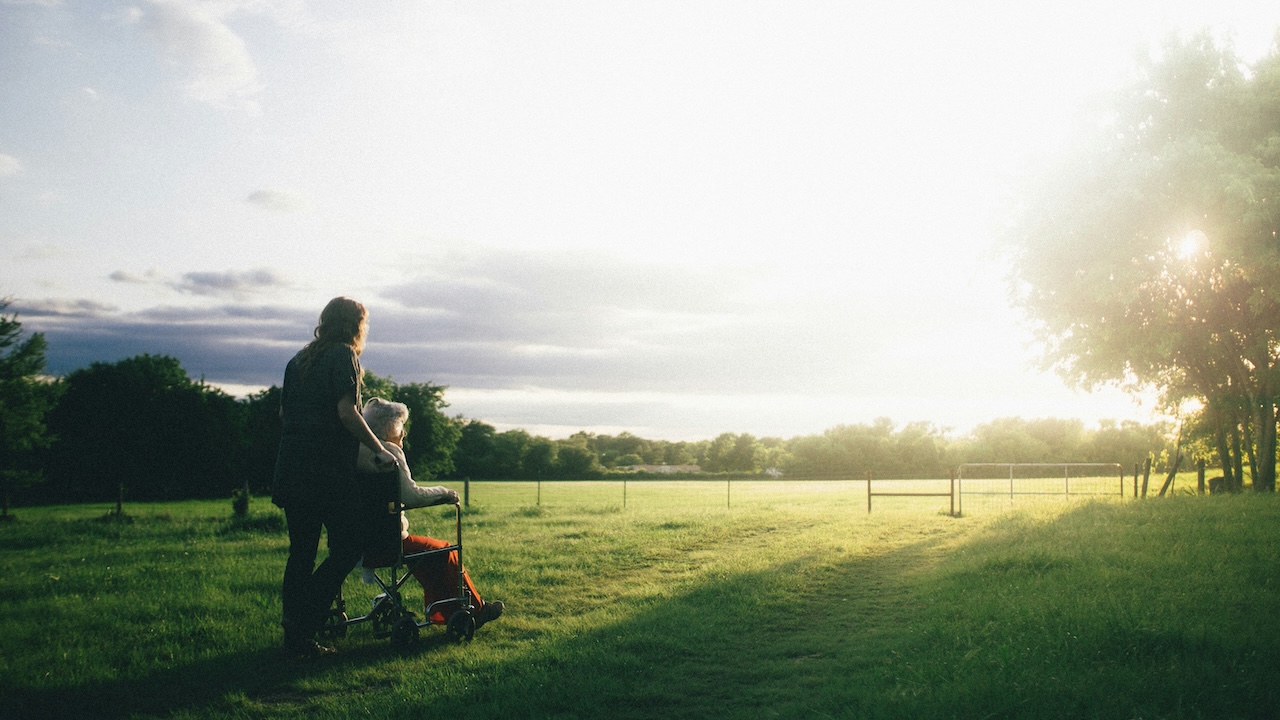
In 1980, when I was new nurse’s aide at a convalescent home, I was nearly fired for not tying a woman into her wheelchair. She had Parkinson’s disease that caused stiffness to the point of rigidity. Because she had difficulty sitting or standing, I had gotten her ready for the day, donning her undergarments, polyester dress, and nylon stockings while she lay in bed and her husband stood by. When I finally cradled her in my arms and moved her to the edge of the bed so that she could get in her wheelchair, her body was so rigid that I felt that she might slip to the floor, so I cupped my arms under her armpits, braced her weakest leg with my foot, helped her to stand, and pivoted her into the chair. I put the foot pedals down and got her feet adjusted against them for support. She looked surprised and relieved to be seated. I adjusted the skirt of her dress for comfort and bid her and her husband goodbye. But I forgot the cloth restraint, and an hour later I was in the head nurse’s office being reprimanded. The patient had slid out of her chair after I left, and her husband wanted me fired.
The cloth restraints that we used were long belts of fabric, required by law for patient safety. We were taught to put them around a seated patient’s waist and tie them at the back of the wheelchair. We usually looped them around the arms of the wheelchair once or twice before tying them in the back. Some nurse’s aides were experts at crafting an elaborate web underneath the seat of the chair and tying the knot down low and out of sight for reasons that were never explained to me. I remember wondering, as the nurse was reprimanding me, how much of a difference the restraint would have made. I could imagine our patient might have slid under it in her polyester dress. I was never assigned to that patient again. Our nursing director was lenient with me, warning me that if it ever happened again, I would be done.
I worked as a nurse’s aide in two nursing homes over the course of the next several years, and as an activity director in another. During that time, I saw people tied in recliner chairs, and their chairs tied to the hand railing. I saw people’s doors tied shut to keep them in their rooms, lest they wander off. I saw people tied ankle to ankle, wrist to wrist as they thrashed in bed. All this in the name of safety.
We had two break rooms in the basement of the nursing home—one for smokers, where most people hung out, and where the vending machines and magazines were, and a dark, empty classroom for the nonsmokers. The smell of cigarettes in that small break room made me ill, so I spent my breaks and lunches in the dark classroom. I was pious, a new Christian, believing that I was pressed toward some future goal that I couldn’t fully see. To quote the Blues Brothers, I believed myself to be on a mission from God. In the break room, on a ten-minute break, I would open my Bible at random to see what the good word for me might be on any given day. After the day I was reprimanded, while tearfully searching for some kind of guidance, I landed upon this passage from the Gospel of Luke:
The Spirit of the Lord is on me,
because he has anointed me
to proclaim good news to the poor.
He has sent me to proclaim freedom for the prisoners
and recovery of sight for the blind,
to set the oppressed free.
I was so new to Bible study that I didn’t know the context of this scripture, that it was Jesus announcing his ministry in the synagogue and proclaiming that the kingdom promised in Isaiah had come. I didn’t know that a few verses later the people in the synagogue were going to try to throw him off of a cliff for making that proclamation. I just took it in within the context of my work and felt galvanized by the emphasis on mercy and freedom. I took it as marching orders. The restraints we used might have been applied in the interest of safety, but they were also clearly inhumane. People fought them. They caused panic. As I got to know my patients and learned their habits and patterns, I became more savvy about the application of restraints. People who were without cognitive deficits could understand the rationale and were often willing to have them if they understood the purpose.
One woman in my care, Minnie, was the hardest kind of person to keep safe: both ambulatory and cognitively impaired. People who suffer with dementia lose their orientation to time and are often up and busier at night than during the day. Their ability to understand context is gone, and their decision-making is often at odds with personal safety. In these days before memory care, people couldn’t easily afford a 1:1 caregiver on top of nursing home care, so restraints, both chemical and physical, were employed to avoid risk of harm or death. People wandered away from nursing facilities (or their homes) all the time, and could die from extreme heat, cold, or dehydration, or become victims of accidents or abuse.
Minnie’s mornings were busy with getting her meal and getting bathed and dressed. She napped gratefully each morning before lunch, but in the afternoon she became active and full of plans. It was hard to keep an eye on her, but I also couldn’t stand to restrain her to keep her safe as I worked with other patients. I had seen her struggle against restraints when others cared for her. She cried and screamed and seemed like she might injure herself trying to get out of them. To avoid this, I asked her if she would do something for me, and she said yes. I brought her a large laundry basket of washcloths and asked her to fold them. This activity kept her busy for the remainder of my shift. The repetitiveness of the task did not seem to bother her. I would collect the basket of folded washcloths, leave the room, unfold them, and bring them back to her, and she would pleasantly take them on again. Sometimes I could finish up work with other patients early enough to walk with Minnie outside. That would expend her energy so that I could coax her to return to the familiarity of her room and rest.
My next job was activity director at a skilled nursing facility in Salem. Salem, at that time, was undergoing institutional reform. People in the State Hospital and Fairview Training Center were being relocated to small group homes embedded within the community. Our nursing facility was directly across the street from the hospital, and we functioned like a small field hospital with a large caseload of post-acute patients. As activity director, my job was to make sure that people had things to do while they endured the rigors of rehabilitation. Everyone was required to have a plan for life enrichment. I was also responsible for touring people through the facility prior to placement.
I showed frightened, heartbroken family members around the facility, introducing them to the stark semi-private rooms and hospital beds with thin bedspreads and plastic covered mattresses. We passed rooms where patients were tied in a stationary chair or bed, crying out or gesturing for help. Others sat quietly, slumped in their wheelchairs and obviously tranquilized. Families referenced the 1946 horror movie Bedlam, set in an eighteenth-century asylum. Looking at the nursing home through their eyes, I could see that the place conjured the worst imaginings about institutionalization.
About this time, my administrator and I began to share an office while some remodeling was being done to our building. As we got to know each other better, I shared my challenges with tours and some insights that I had gained from reading The 36-Hour Day, a book about caring for someone with dementia that had just come out. I suggested that the nursing home environment was contributing to the problems that people with memory loss faced rather than helping them. Our bright lights, rigid schedules, limiting safety precautions, and abnormal representation of “home” added disorientation to disorientation. The behaviors that we faced daily could be catastrophic reactions from people feeling overwhelmed by the environment. Wouldn’t you run away, fight, yell, and resist if you thought someone was trying to make you do something you didn’t want to do and insisting that what you knew to be true wasn’t? If these behaviors were not the result of psychosis, but a rational response to the environment based on cognitive impairment, why were people being treated with major tranquilizers and psych meds? Wasn’t this also adding confusion to confusion? I told my administrator about my experiments with washcloths and daily walks as Minnie’s caregiver and suggested that as long as we were required to tie people up who were at risk for wandering, we were going to continue to cause panic and misery.
To my administrator’s enduring credit, he listened. He asked me to research further and come up with a proposal, and he encouraged me to put together a “dog and pony show” to begin educating the community at every opportunity.
Liberated to pursue the ideal solution and assured of my administrator’s support, I searched for local providers who were doing innovative things for their dementia sufferers: At a sister facility in Albany, residents at risk to wander lived on a wing with a subtle alarm at the end of their hallway. When they walked past it, a beep sounded, alerting the staff so that they could redirect. Not perfect, but not tying people up. I took note.
A facility on the coast near a dangerous highway developed a series of environmental changes to anticipate the needs of people prone to wandering and reduce their anxiety. A pet cat (unheard of then and still controversial today) served as a pleasant distraction near the entrance of the building. Little kitchenettes stood in the corner of every hallway, and residents could help themselves to food. Each hallway led toward the building’s center, giving staff a line of sight on the entrance and exit. But what about those times when staff are distracted or working short? At night, the staff locked the doors.
A flagship nursing home that was managed by a religious order offered a walking club program that aimed to minimize the use of physical and chemical restraints. There, residents were accompanied on daily walks outside the facility with the idea that if they were awake and content during the day, they would be more likely to sleep at night. Patients were observed, known, and accommodated to improve contentment, adjustment, and success. When they observed one woman liked to nap under a desk, they made her a little nest that she sought out and relaxed into.
I searched the medical libraries at two Portland hospitals for information about restraint-free environments and innovations in dementia care. The more I read, the more convinced I became that violent and reactive behaviors among dementia sufferers were aggravated by or even caused by our environment. I suddenly saw from their perspective how terrifying these environments were: People coming at you with opaque agendas; people hurrying everywhere; noises, beeps, hustle and bustle that make no sense. Meanwhile, you, the patient, are just trying to live your life, pick up the kids, get dinner, or whatever ingrained sense of responsibility or physical need drives your motivation in the moment. The nursing home environment caused resistance and then medicated and restrained you to solve it. It didn’t feel fair.
Around this time, my administrator became a regional director in a small company where he had influence with the owners. He recommended me for an admissions/social work position in a nursing home located in the shadow of the Oregon State Hospital. My job was to help build census. In this facility next door to bedlam, I renewed our conversation about reform. People who suffer from dementia are not mentally ill, I challenged. What if, instead of tying people up because they can’t make sense of their surroundings, we created a safe space for them to be unrestrained with a coded entry and exit door?
Our challenge was to create a space within the safety of that restricted setting that was as comfortable and inviting as someone’s kitchen. The people who lived there would be closely observed, and their individual preferences would be provided for. We would enter their world and understand it rather than ask them to enter ours. We would hire staff based on their ability to use their imaginations in this way and provide them with extra training focused on dementia. We would provide an open and safe outdoor space with a continuous loop to walk. They could come and go inside and outside as often as they wished and just keep walking, if they were able, giving them access to natural light that could enhance their body’s ability to rest. Finally, we would have all staff who worked with these residents be responsible for directing their activity and we would hire a music therapist to provide music therapy during the week.
The part of the human brain that participates in music is not the same part that becomes impaired by Alzheimer’s Disease. Singers can still sing, piano players can still play, and people can remember and sing along with their favorite music. When we started offering music therapy, dementia sufferers seemed to come back to life. They danced and laughed, found their ability to access joy, told stories, even flirted.
This was the beginning of reform, and it was in no way easy or perfect. People are complex, and disease is relentless. This story doesn’t have a happy ending, because people with Alzheimer’s Disease still suffer. The limitations and indignities of memory loss deserve recognition and are to be grieved for the individuals who are afflicted, their families, and their caregivers. Setting up care for memory impaired people was an inexact attempt to provide comfort that helped some, but it was never and will never be easy as long as people experience the disease. The process of change is also incremental, at times excruciating.
I feel at times ambivalent about the role that I played in reform, especially when I see memory care units that appear more like a de facto prison than special care. I have often thought that this was my personal experience of being caught up in sweeping change in which the collective “unconscious” was seemingly at work inspiring many people who were all trying to solve a similar set of problems.
Within a year’s time from implementation of our memory care program, our facility was sold to a major, publicly held corporation, based in another state, that came with its own specialists and its own packaged program of special care. A lettered and published representative of that big corporation explained to me how our program, just born, was now going to run and handed me a manual. I handed her my own notebook full of articles, sticky notes, and milestones. They were not dissimilar. 
Recently my husband and I were given a tour of a memory care neighborhood in a multilevel care organization that is among the best in the country. We happened to be visiting during a mealtime. Residents were dining together family-style. Kind and attentive staff were quietly moving among the diners. I remembered the first caregivers on our team who really understood that the energy they brought to the people in their care was the energy returned to them. The food looked homemade and delicious. I remembered the discovery and implementation of these innovations as our entire industry moved away from institutionalization in the 1990s. I noticed the square, contiguous hallway with living areas and activity options in the center. Rooms around the square afforded privacy, and each had a personalized entry styled like a front porch. I saw a lush courtyard out one door that looked inviting. I noticed the beautiful art everywhere and the quiet, aesthetic choices that we once argued for along with the need for full spectrum lighting, therapeutic music, simple flooring patterns, horticulture therapy, pets, all parts of a massive move to reform institutions of care.
I saw my husband interacting with a woman with a bewildered look on her face. He was kneeling beside her. They were speaking quietly, and I could see he was putting her at ease. I thought of Minnie and Genevieve, Reverend P., Steve, Elsie, Violet, Elvina, Floyd, Leona, Nellie, Frank and Wendell, the real pioneers whose patience, suffering, and humanity taught us what was needed for change.
Comments
1 comments have been posted.
Well done, Laura Engle. Beautifully described; this is the hope of the future, born out of love.
Janice E. Gratton | October 2026 |
Add a Comment