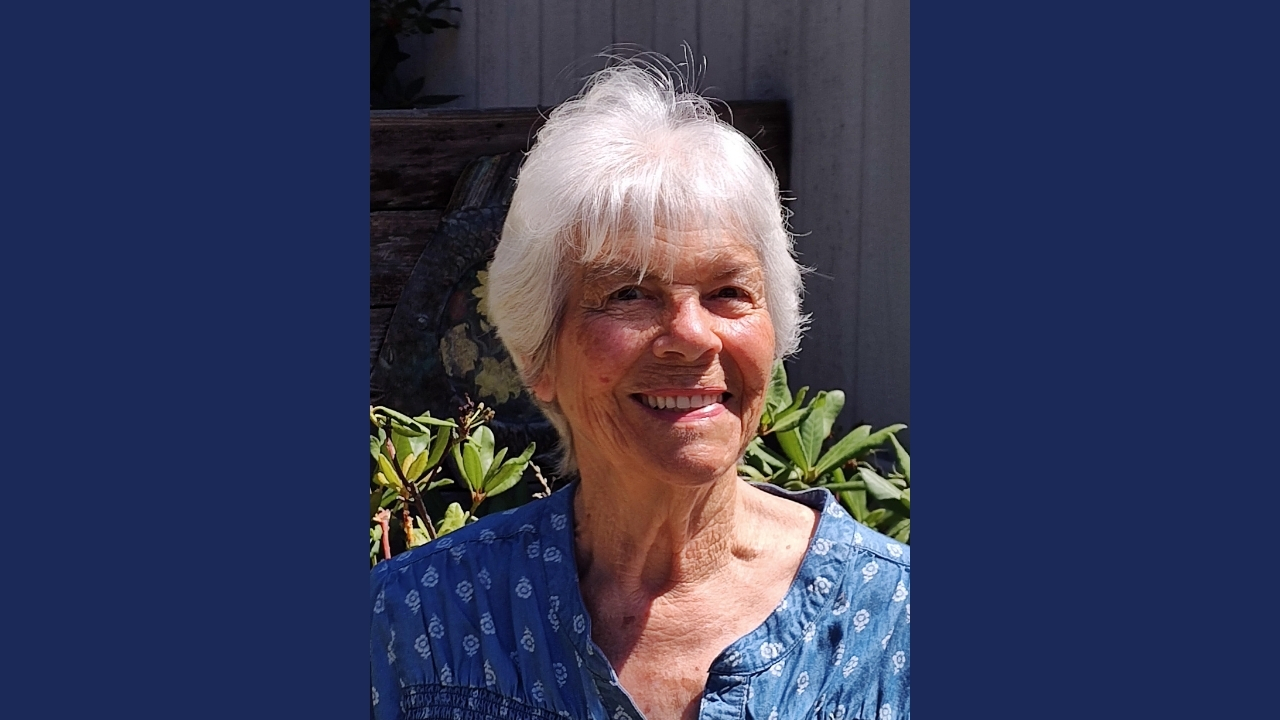
In spring 2025, I met with Ardean Maxey at the Fern Ridge Library in one of the library’s new bright, well-lit study room/podcast studios. In my Podcasting with Heart class series, funded by the Community Storytelling Fellowship I received from the Oregon Humanities, I teach podcasting to rural Oregonians to help them share the things that they’re passionate about and grow their communities, both virtually and in real life.
Recently, I had the pleasure of teaching eighty-one-year-old Ardean in my podcasting class. Her kindness, sense of humor, and gravitas impressed me. Her podcast idea is most intriguing: The Old Lady Podcast is a show where she hopes to share the way things used to be and compare them with her opinions on things as they are now. She wants to talk about movies, books, current events, things that she remembers fondly, and things she recalls that weren’t so great. After the initial class, I wanted to learn more, so I asked Ardean to join me for an interview. This conversation is also available as a podcast.
Jen: Why did you want to come to podcasting class?
Ardean: I had an idea of a podcast that would be aimed toward people my age. And it dawned on me that the two groups in our culture that seem to be the most isolated—and because of the isolation, the most depressed—were the young and the elderly.
Everybody else in between has things to do. They have contacts, they have community. The depression and the isolation in those groups are caused by different things, but the results are the same.
And I thought that, remembering my own childhood and my life and where I am now, what keeps me up and going is community, and podcasts are a great way to build community and connection and interest and joy and excitement and all those things that give us reasons to get up in the morning, other than our cats. That's what gave me the idea of a podcast.
What do you want to talk about in the show?
I was told that we should do a podcast on what we know, what we're expert at. I know about getting older. I'm an expert at getting older. I was born in 1944. I'm 81. I'll be 82. I have a favorite quote, and it's from The Once and Future King: "The best thing for being sad"—this is Merlin that's speaking—"is to learn something. That is the only thing that never fails."
I have found that to be true throughout my life. I end up doing things that I stick with at times because I'm really good at it. Then I try something new that I really am terrible at. And so I think, "Well, that was interesting, but I'll leave that to someone else."
How do you think you will find your audience?
I have no idea how to reach people in my group as far as actually doing a podcast, but it might be as successful or futile as a writer trying to get published. I don't know. But you don't know if you don't try.
Some of the things I'd like to talk about in my podcast would be fun things like what we all remember from our childhood. I remember cars with running boards on them. My dad would pull into this long, long driveway, and the kids would run out and jump on the running boards and ride down the driveway. I remember when the first frozen TV dinners came out. We were so excited. It was so cool. They were terrible. But we loved them. Especially the little plop of chocolate pudding in there was really yucky. But we ate it, and we loved it, and we enjoyed it because it was so new.
And, you know, we dressed differently. Our entertainment was different. Our food was different. And so now we have very slowly evolved into existing sixty, seventy, eighty years later when everything is different than it was when we grew up. But it's fun to get together with people my age when someone will say, "Do you remember the phone? It used to be a party line." We'd sneak over and we'd lift it and we'd listen in, and we could hear what was going on up and down the whole country mile.
I remember the things we did. I grew up on a farm, on a ranch in the San Joaquin Valley, and going into town was big excitement. I think about those things. That would be a fun aspect. I would love to do a podcast on adapting to change. The idea with change is that it's inevitable, and there's some change that I just hate. But I'll come back to it later on, and I'll go, "Yeah, but if I accept that, then I can do this."
What about the aspect of change interests you?
Frankly, I've lost a lot of friends. I've lost family members. I lost my husband. Terrible change. But your life changes, and you adapt, and you find, not “replacements,” but you find other things to do that bring you joy. And the alternative is depression and quitting and dying yourself, and I'm not ready to do that until I'm ready to do it. I've always tended to be a bit of an independent person, and I don't like people telling me what to do. But if I get around to it, the same thing on my own. And so I would love to do a program on change.
Do you think it will be interview-based, or will you do solo episodes too?
I would love to interview people. I'd love to do another show or a podcast on the way that certain people have lived their third and fourth chapter of their life. Maybe they went from being a high-tech CEO and retired and turned into a very happy, successful Pop Warner football coach. Volunteer work has a great lot of things to offer, and I generally enjoyed my volunteer work more than I did the work I got paid for.
That’s great. Do you have specific people in mind?
There's all kinds of things out there, and I think the more we hear about them, the more we'll start to put together ideas of, "Oh, that sounds great. What could I do?" I know that the further apart the elders get from the other generations, everyone loses. I remember some of the stories my great-grandmother and my grandmother told me about the San Francisco earthquake, because they were living in Palo Alto at the time. One of the daughters, my great aunt, her husband was in the city during the earthquake. He was a musician. All he saved from his little apartment was his horn. Nothing else mattered. He grabbed his horn.
What an amazing experience, to have that told to you.
If you're not in connection with all of the generations of your family, you lose out. People don't write letters anymore. They just text or send an emoji. I'd rather hear somebody, the timbre of their voice when they say, "I love you." I don't want to see a little heart stuck in my phone. Awful. So I think we need to keep the channels open between generations.
I was blessed with an extraordinary mother. We would just sit around and talk. My dad would tell me these fantastic stories about Prohibition time in Michigan. He was a pilot. He flew a Little Jenny, a biplane. He would “just happen” to fly it into Canada and load it up with very-legal-in-Canada, really good Scotch whisky and fly it back to the hotels in Detroit. Breaking the law? Yes. Enjoying every minute of it? I'm sure he did. So I wouldn't know those things if generations of people don't talk to each other.
That’s amazing.
The funny part of it is that my wild and crazy father then moved to California and married a very strict Methodist daughter. Enough love to go around, but I don't think my grandfather ever knew all the stories about my father. I did. That was probably a good thing. I remember living way out in the country, and that my brother and sister taught me how to print my name before I went to school.
At the library in town you had to be able to print your name to get a library card in the children's section. Once I could do that, it was one of the most exciting days of my life. I went with my brother and sister and mother, and we went to the library, and I got my library card, and I brought all kinds of books home. From that time on, the library, any library anywhere, it's become my favorite place.
I'd rather read than listen, so I've never checked out an audiobook. But they're great for people that drive long distances. I can't imagine a community without libraries. People like to chat. People like to share. My major in college was anthropology, and it's always amazed me that it doesn't matter what human being lives where. We all need the same things. We need shelter. We need food. We need safety. We need connection. We need community. And we all develop it in different ways. I don't care if you're living in a castle or a little shack somewhere. That's shelter.
Community, right?
We all fulfill our needs differently, but we don't do it alone. I think that community is in our DNA. We're tribal. We have to have each other. I'm very sad to see what happens when we go without community. We need our machines, but we certainly cannot replace each other with machines. They're just tools.
My dad was kind of an innovator. He always had ideas before they were even workable. And they were talking about being able to reach kids way out in the Alaskan tundra, whatever, and how to do that, and he was talking about this 50, 60 years ago. And, of course, there were TVs then. There were radios. Everyone kept in contact, and they never quite came up with the right connection to do it. But I think that now we have connections with people. Thank goodness for the technology.
I love history. And I think about those pioneers that got on the covered wagons back in Illinois or wherever and said goodbye to their families, knowing they would never see them again. They would have letters back and forth occasionally. The courage and the conviction that they had to be able to do that. The parents being left behind knowing they'd not see their grandkids.
I had a dear friend. She was a mother of a friend of mine, Ruthie, and she said, in her later years, she said, "I just think we're supposed to have fun." At first, I was a little stuffy about it. I thought, "We're supposed to accomplish great things, and we're supposed to do this and that." Then I've come around to Ruthie's way of thinking. I think we're just supposed to have fun.
Comments
2 comments have been posted.
When I read that you grew up in Central California, my heart fluttered! I'm also from there, a dairy town called Hanford. I moved to Oregon 12 years ago. Would love to visit with you, Jen.
Jennifer Tucker | August 2026 | Eugene, OR
Thank you for sharing your story. Your humor, wisdom, and vivid memories made the past feel wonderfully alive while reminding us how much community still matters.
Jeanne | July 2026 | Veneta, Oregon
Add a Comment