Every year, either my father or one of his ten brothers and sisters returns to Remedios for the Christmas festival, a kind of annual homecoming tradition that feels vaguely feudal and performative, like a medieval royal progress to the hinterlands. This time, I travel in my father’s place after he contracts Covid and has to stay behind. Remedios is the name of the “barangay,” or parish (similar to the parishes of Louisiana, a tradition that a lot of historically Catholic-colonized countries practice). It’s named for Our Lady of Remedies—to my mind, one of the more beautiful and compelling of the epithets for the Virgin Mary—and the local church is dedicated to her. In my father’s absence, I am invited to speak at his high school, where he had been part of the first graduating class. To this day, my family continues to provide scholarships for impoverished students at this school.
The village of Remedios somehow feels both intensely urban and intensely rural, simultaneously. There are vast crowds of people throughout the day: Mothers shop in the little rundown stores and market stalls, dusty men in flip-flops lean against their motorcycle tricycles and wait for taxi fares, while barefoot children in spotless school uniforms go home early to help on the rice farms or care for their younger siblings. Traffic crawls in every direction, since the village adjoins a major highway connecting Manila with the former US naval base at Subic Bay, still an important urban center and a slowly expanding commercial hub.
The rice paddies that surround the village are a vivid, shimmering green, humming in the heat. The squalor of stinking drainage ditches is all the more striking next to the immaculately swept and scrubbed tile floors indoors, and the shining chrome of the jeepneys and the home-modified sports cars. At night, small packs of feral male dogs patrol the streets, while their mothers and mates keep careful watch of their humans’ homes, everything meticulously fenced with wrought rebar gates and cinderblock walls.
On this trip, my friend Lyndsay and I are staying with my distant cousins. The Susi family home is protected by Junior and Honey, both adorably indeterminate mutts, something in between retrievers, corgis, and shih tzu. Junior is the alpha, who fearlessly challenges anyone and anything that comes to the gate, from small children to other dogs to vehicles to rumbling buses, whereas Honey is a bit of a pushover, who shows her belly to anyone who makes it past her mother. They do not look alike or even related, but they clearly love each other dearly.
My cousin Nel is the caretaker of this family home. Auntie Annabelle was married to Nel’s uncle long ago, and even after they divorced, she took in Nel and his little brother when their parents abandoned them. Nel is in his mid-thirties now and runs a small hardware store. His wife, Alma, and their daughter, Angel, also live on the property. Angel goes to the same school my father graduated from about fifty years ago. She’s twelve. Her family lives in a small cinderblock hut next to the larger family home, little more than a kitchen and a sleeping room.
This separation between Nel’s family and ours, and the discrepancy between his humble cinderblock hut and the larger, more modern comforts of the family home, are unmistakable class distinctions that no one in my family is willing to discuss, but ones we see every time we visit the compound. My aunties and uncles are clear about their expectation that we stay in four-post beds with mattresses when we visit, whereas Nel and his family live in a much more cramped space with bedrolls and minimal amenities year-round.
Nel is slender and lean, his arms sleeved with hipster tattoos. When he was in his early twenties, he lived a hard life in Manila, working his way up from tending night market stalls to driving tricycle taxis, to working facilities jobs at malls, before my family offered him a living taking care of the—by American standards modest—family home in Remedios. He is resourceful and kind, but also reserved. Not exactly secretive, but he is certainly more complicated than the wholesome family type my uncles and aunties believe him to be or that his youthful face suggests. During our stay, Lyndsay and I have several long conversations with him about drugs in the Philippines, about life goals, politics, and social values here.
Nel tells us that he used to want to emigrate to the United States, but that recently he’s changed his mind. It’s not the politics, or the violence, or the racism that discourages him. He’s heard from my younger cousins how difficult it is to make ends meet in the United States, and he isn’t so sure that he can do better in a West Coast city than where he is now.
Life in the Philippines is like a mirror-universe version of things in the United States: There’s a big appetite for conspiracy theories and fake news that feels familiar to what we Americans live with; the difference is the visceral income inequality and subsistence living, which we hide from one another and from ourselves so thoroughly in the States, but that can clearly be seen and understood everywhere in the Philippines. The history of the brutal twenty-year dictatorship of Ferdinand Marcos that my parents fled in the seventies has been recast as a period of prosperity and strength to Nel’s generation (essentially, MAGA Philippines edition).
I see him as a version of myself, if I’d been born and still lived in my father’s village.
My Auntie Annabelle, who raised Nel, was the aunt most sympathetic to my strange and estranged path. She was able to see me, most likely because she herself occupied a peculiar liminal space among her siblings. She was the peacemaker for them all. Of my father’s five brothers, only one has never divorced his wife; of my father’s five sisters, only Annabelle was divorced. The Susi men tend to seduce passionate, emotionally volatile women, strong willed and quick to temper (of which my late mom was an exemplar). The Susi women, on the other hand, tend to find polite, mild-mannered men willing to carry the shopping bags and drive the minivans, men who are self-effacing and quietly competent.
After her divorce, Annabelle opted to raise her children alone, without remarrying until many years after she’d immigrated to the United States. She was the approachable auntie: Whenever any of us cousins were fighting with our parents, or on the verge of breaking up with our partners or spouses, Auntie Annabelle was the one we went to for advice and understanding. Her own children made difficult choices with their lives and faced ostracism and prejudice, but Annabelle always accepted them and loved them unconditionally, no matter what they did or whom they loved. Her example helped educate everyone around her, both the elders and the young ones, but she was the first from the generation of my aunties and uncles to pass away.
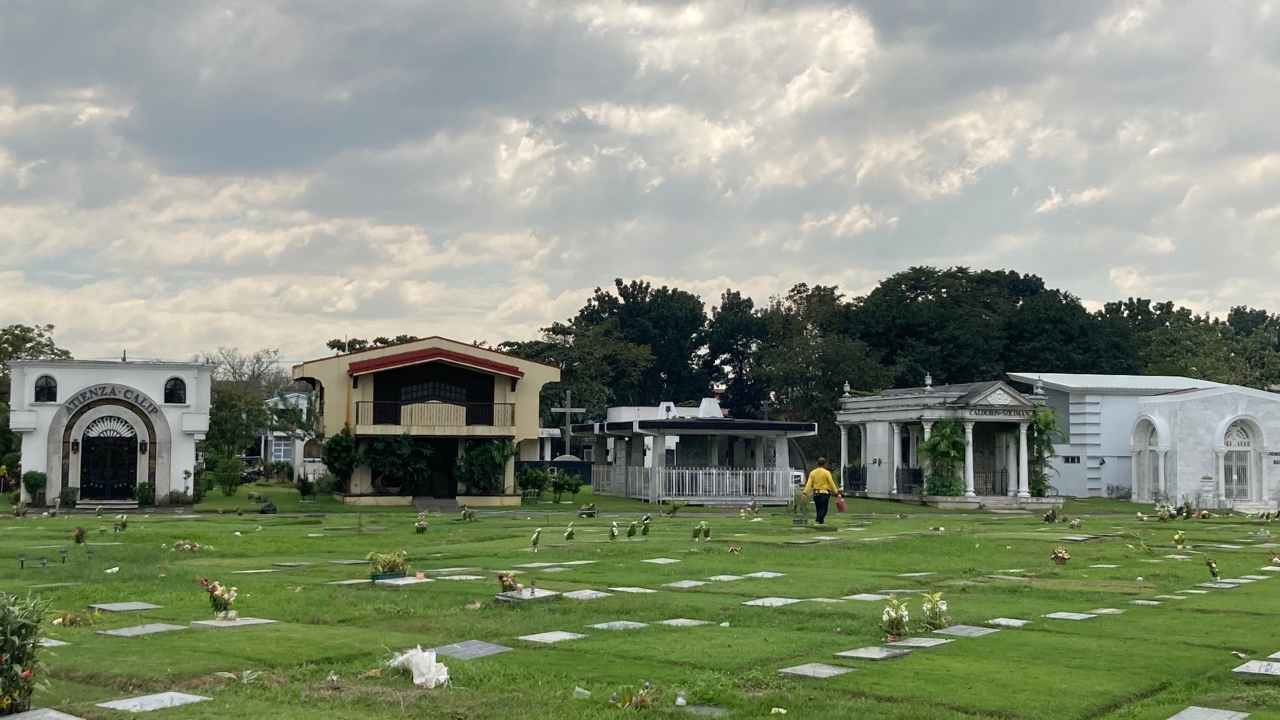
Cemeteries in the Philippines are crowded, eclectic, and crumbling at first glance; the humid climate seems to eat the sculpted concrete, and tall grasses proliferate endlessly. When you walk into a cemetery, whether in the city or in the countryside, the place seems abandoned. Overhead, skeletal canopies with tattered awnings trail to the ground, and small drifts of trash collect in the corners. But the monuments are opulently designed: Some of the urban cemeteries even contain what look like small homes—furnished buildings with electricity and plumbing, seemingly out of place amid the older gravestones. On the Feast of All Souls, it’s customary for entire family clans to spend a day and a night at their loved ones’ graves, bringing food and appliances, hosting visits from extended families and cleaning the family plots. I’m told that during the Feast, it’s like an entire living room is somehow transposed onto someone’s gravesite, complete with furniture and tables of food. Multiple generations will spend the day there, entertaining one another and playing, cooking, and eating together.
The plots are haphazard spaces; some are fully built and enclosed structures, as in the city cemeteries. Others look like the paved, unfinished basement level of a building, with a sink and drains, and a few graves arranged against one wall. The whole space is enclosed with a low garden wall and a wrought metal gate, studded with built-in sockets for a shade canopy that you can bring with you on the day you visit. And yet, for all this adornment, most graves appear as they do here: little gravestones crowded together without further ornament, overgrown with grasses and encroaching bushes and trees. But others are much more substantial: above-ground, lavishly sculpted concrete shells enclosing a casket or urns.
I try to imagine the cemetery during the Feast, with everyone crammed on top of one another, the living and the dead. To reach their homelike monuments, wealthier families must clamber over the graves of poorer families, who they will always be outnumbered by. I can’t help but wonder why the wealthy make such strange choices. How pointless it is to hoard money, when death brings us all to the same crowded spaces.
It’s Christmas in Remedios, and a cousin of my father guides me into the Lubao Cemetery to find my great-grandparents. Apung Quintin and Apung Pisang Susi—“Apung” is a Kapampangan gender-neutral honorific meaning grandparent, used with reverence—immigrated to the United States not long after my father, their grandson. When they passed away, their bodies were returned to the Philippines in accordance with their wishes. My father’s cousin and I spend the morning crisscrossing the dilapidated cemetery looking for dimly remembered landmarks until we finally find Apung Quintin and Apung Pisang Susi. Over time, their family plots have been concealed by newer and more built-up plots, whose grave markers and retaining walls jut out, sometimes blocking access to the cemetery’s narrow pathways. When we locate their graves, my father’s cousin and I triumphantly hug each other, and then we share a few silent moments of reflection. After taking some pictures and thoughtfully brushing away some trash, we leave.
A week later, I travel with Lyndsay to the neighboring town of Dinalupihan to look for the grave of Lolita Sarmiento, the mother of my half-brother, Than. Than’s cousins and aunties and uncles are waiting for us in their family home, and together we embark on a very similar journey as before in Lubao, crisscrossing a vast and dilapidated cemetery, as densely crowded with graves as a high-rise apartment complex is with buildings, its own super-dense neighborhood in the middle of another neighborhood. Tucked away in a narrow corner, we find Lolita with her long-dead grandparents and cousins. We clear away the gathered leaf litter, take a picture, and depart.
Looking for half-forgotten graves and then finding them is necessarily anti-climactic. No shattering insight or lost treasure emerges from the monuments to enrich you. The dead remain dead, even after you find them again.

Paul Susi is a writer, a theater artist, a social services professional, an educator, and an activist, born and raised in Portland. He is the peer resource navigator for Portland Street Medicine, a conversation project facilitator for Oregon Humanities, and the vendor program director for Street Roots. You can learn more about his work at www.paulsusi.wordpress.com.
Comments
No comments yet.
Add a Comment