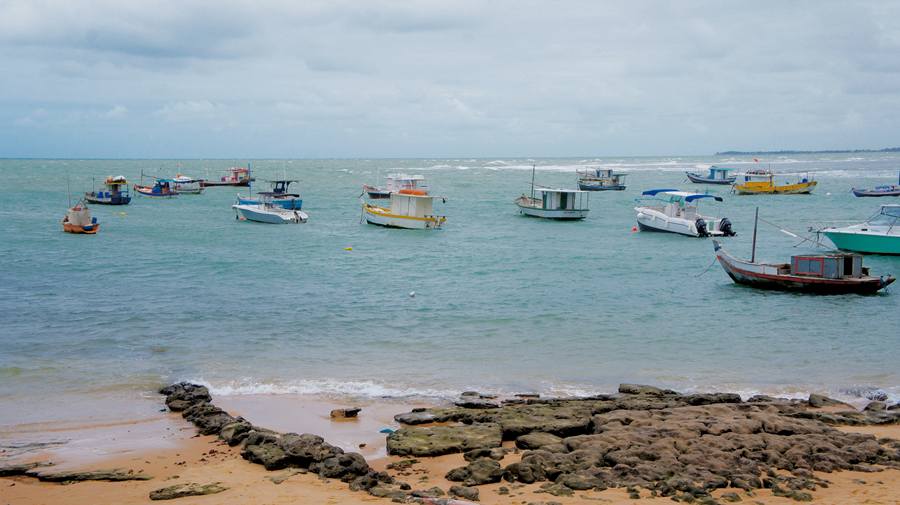
In 2012, I floated in the Atlantic Ocean off the coast of Salvador, Bahia. It had been four years since I stopped praying—God had let me down. During my trips to Salvador, I learned about another kind of spirituality, an African diasporic religion called Candomblé, which began to fill in the gaps that my ancestors had lost to the ocean.
As a child, I learned how to turn to bodies of water to hold me in my grief because I knew they could support the depth I craved in others. As an adult, saltwater has served as a medium and connective tissue in my artistic practice. Recently, this has led me back to Bahia and made me curious how other Black artists approach the ocean through their work, writing, and dreams. I seek not to resolve my relationship to the ocean but to find approaches to commune with something whose memory and depth exceeds my comprehension but insists on contact (waves lapping at my feet). Across these encounters, I am drawn to the ways we come to know water: the ways we enter it, take from it, are held by it, and become it.
I met Olivia while working at the farmers market. Over the past few years, they have brought me to coordinates they’ve plotted along the many rivers that snake through Oregon. After seven months of near-constant rain in the Pacific Northwest, I spend the dry season seeking bodies of water to bathe in. Without a car, I rely on my friends to take me there. During the last heat wave, Olivia and I drove in their old but sturdy car to a rocky spot on the Sandy River. It was near the foxglove bluff where I watched two monarchs mate. The car’s air conditioning was broken, and only the driver’s window opened, so we sat sticky and sweating in the mid-afternoon traffic, our bodies melting into the leather seats.
Olivia told me about a trip where they kayaked across Willapa Bay to Long Island in Southwest Washington to camp for the night. A former “logging-site-turned-nature-preserve” with massive cedar stumps, chanterelles, and oysters, they described the island as both solemn and enchanting. We talked about clamming, and I recalled my first November in Portland, walking along the coast at low tide with new friends and a headlamp. Attempting to find razor clams for dinner, we slowly drifted out onto the inky black beach holding PVC pipes that had been modified into clam guns. Clamming requires careful and attentive observation. When a clam’s neck is near the surface, it produces what’s called a show, a small hole in the sand. If you are lucky, the shows may simply appear. Otherwise, a delicate stomp is required to reveal the dimples on the ground. We shuffled around the beach looking for shows, wandering in various directions so as to not retread each other's steps. Finding a show was incredibly exciting. I’d set the clam pipe over the hole and drive it deep down into the sand. Then, I’d place my thumb on the hole near the top of the tool and lift upwards, bringing a column of sand to the surface. If I was successful, a long, skinny clam would wriggle out of the mound of wet sand. It felt triumphant and strange to play God, holding their slimy lives in my hand—wiggling, so viscerally alive. I don’t feel this way when I forage plants. Perhaps I can relate to the clams more because our bodies writhe similarly when we struggle.
Recently, I’ve turned to mermaids as a passageway to the ocean. While living in Brazil, my siblings and I would watch an Australian teen drama called H20: Just Add Water. The show follows a group of girls who miraculously turn into mermaids with supernatural powers when their bodies touch water. The logistics of the premise is a bit flimsy at times, as one would expect from a kid's show, but it was nonetheless captivating. Framing mermaids as a surprise encounter of something deeply familiar, the story eventually smooths the edges of the protagonists’ bewilderment, and they adapt to the water, the land, and each other.
As someone who moved around a lot as a child, I often think about adaptability. When I was younger, adults would tell me that I was strong for leaving and starting anew, as if I had the choice to stay the same. While I was privileged enough to experience abrupt but joyful transition, joy is not the typical outcome of migration. I often think about the immense pain the body must go through to adapt to displacement; the body swelling and distending to become a temporary embryonic home. (Perhaps we are not unlike clams growing protective exteriors to defend ourselves against predators and harsh waves.)
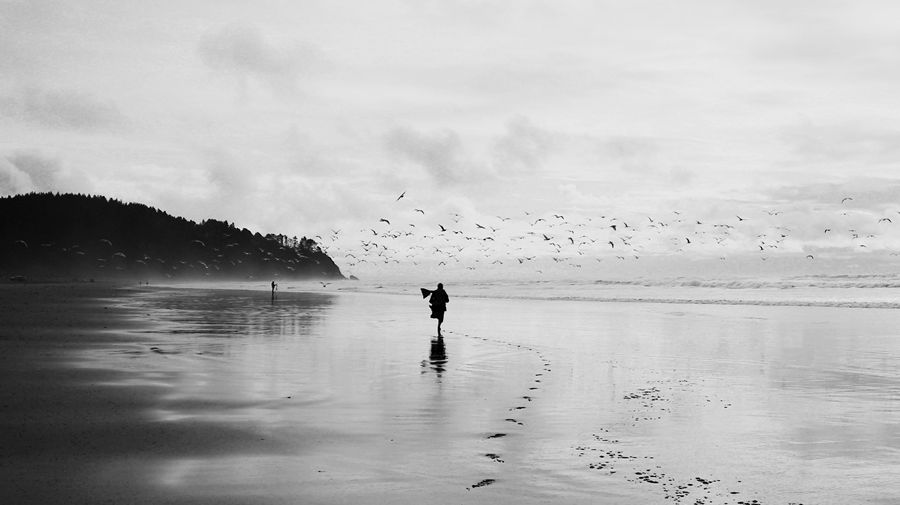
J.M.W. Turner’s 1840 painting Slave Ship (Slavers Throwing Overboard the Dead and Dying, Typhoon Coming On) depicts the true story of a typhoon-rattled slave ship whose captain threw enslaved people overboard to collect the insurance money. Author Rivers Solomon mythologizes this horrific reality in their 2019 novella The Deep, which imagines a mermaid society called the Wajinru, descended from the offspring of the pregnant women who had been thrown overboard. The novel’s protagonist, Yetu, is a tortured archivist, preserving a collective consciousness of her species’ traumatic intergenerational memories. Each year, Yetu is tasked with sharing these memories through a process called The Remembrance. By making the rest of the Wajinru remember, Yetu temporarily disperses the immense weight of their collective history, a process that is painful and possessive. During the Remembrance, Yetu’s “body was full of other bodies. Every Wajinru who had ever lived possessed her in this moment. They gnashed, they clawed, desperate to speak...she couldn’t determine what was worse: the pain of the ancestors or the pain of the living. Both fed off her.”
The Remembrance is a physical process. Unable to speak the history of the Wajinru into words, Yetu helps her community recall it, detailing how “they knew things with their bodies. Bits of the past absorbed into them and transformed into instincts.” I think about the middle passage as a black hole; huge concentrations of matter packed into very tiny spaces, crossing an event horizon of which there is no return. Perhaps the only container big enough to hold the grief of this passage is the ocean. Still heavily resisting the memories of grief, as the Wajinru remember, they appear as their species began, drowning, “born of the dead.”
Bridgette Hickey is an artist, poet, and medical anthropologist who explores interspecies and multidimensional communication with her ancestors and beyond-human beings. After explaining the broad strokes of this writing to her, I asked what draws her to the ocean and she responded that she is working her way toward the ocean through the rivers that flow into it. Hickey’s life is marked heavily by death, unsupported grief, and the loss of ancestral history. Thus, water, trees, and other beings that have lived for a long time reorient her toward these absences as archives and portals of communication. Coincidentally, The Deep is a book she was reading when her brother died. Identifying with the main character, she described to me the carnal ways that her body holds memories as a network within her family system.
As we spoke, we found a shared love of writing down our dreams. Hickey told me about a dream where she is sitting at a river facing an elder she’s never met who has his back to her. She is crying, afraid she doesn’t know the language she needs to communicate with him. He calms her by reminding her that they already are communicating, and describes how water is important to her people. He tells her that they can transform their bodies into water to travel through time. In her dream, she tries to turn herself into water, but instead finds herself in the treetops after turning herself into a sugar glider. She is frustrated but the elder laughs, telling her that she will learn one day how to become water.
Hickey brought the artist Michaela Harrison into the conversation. In her project Whale Whispering, Harrison sings with humpback whales in Bahia through a collaborative hymn. Her work explores the sonic traditions of the blues while attuning to frequencies that exceed the human, re-voicing the “moan” of the Middle Passage across two species that share ancestral memory of the trauma.
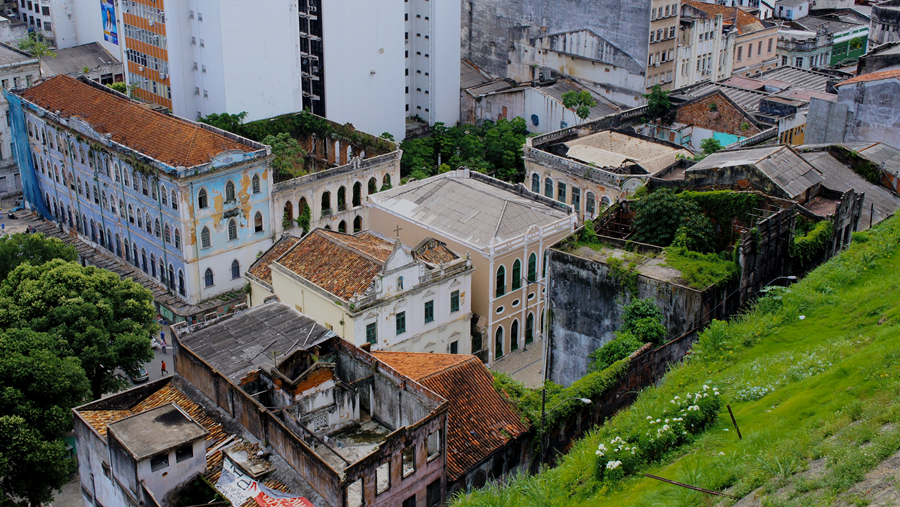
Located on a small peninsula separating the Atlantic Ocean from the Baía de Todos os Santos (Bay of All Saints), the city of Salvador, Bahia became the site of the first slave market in the Americas in 1588. Three hundred years later, Brazil officially abolished slavery, the last country in the Western Hemisphere to do so. Thus, the demographic makeup of Salvador today reflects generations of African enslavement, with an overwhelming majority of residents identifying as Black or mixed race. Even the name of Salvador’s famous downtown district Pelourinho is derived from the word pillory, a public instrument used for the corporal punishment of so-called criminals, namely enslaved people.
Pelourinho sits atop a steep slope in the Cidade Alta, or Upper City, which overlooks the Cidade Baixa, or Lower City. Contemporary Pehlourinho is perhaps most recognizable from the Brazilian version of Michael Jackson’s music video for the song “They Don’t Care About Us,” directed by Spike Lee in 1996. Throughout the video, Jackson performs alongside dozens of drummers wearing shirts that read Olodum, the name of a cultural group known for their activism and samba-raggae music.
The music video is filmed among the Black, working-class residents of Pelourinho. Lee initially faced pushback from Brazilian officials who feared the international exposure of the neighborhood’s socioeconomic realities. Ironically, Jackson’s lyrics reflect a similar sentiment: the government don't wanna see. However, this lyrical solidarity is contradicted by certain aspects of the video. By 1996, Jackson was a massive celebrity and multimillionaire. In the video, he angrily faces a group of stern, motionless cops while later his own security detail restrains a woman who knocks him over, seemingly by accident, in an excited hug. Jackson's appearance had also changed quite significantly by this point, far whiter and more plastic, starkly contrasting that of his younger self. Yet as he sings the titular line with a chorus of Black voices and percussionists— All I wanna say is that they don’t really care about us—for a moment I do believe in his ability to guide us towards something better.
Almost two decades after the video was filmed, I would walk down the same stone streets dancing with a new generation of the Olodum band and look up at the cardboard cutout that memorializes a scene from the video, of Jackson standing on a second-story balcony. His scale would appear slightly too small in proportion to the doorway behind him, but his energy would flow to me, God-like, through his paper fist.
On the streets of Pelourinho, there are deities everywhere. Baianas dress in plump white dresses, headscarves, and beaded necklaces to sell acarajé, a fritter filled with onions and black-eyed-peas freshly fried in palm oil. Wearing these voluminous lace garments pays homage to orixás, the divine spirits in the Candomblé tradition, created by Olodumaré, a God of Gods (like acarajé, the word Olodum is of Nigerian Yoruba origin). The baianas’ presence is essential to the cultural aesthetic and history of Salvador and makes visible the passageway from West Africa to South America.
In the cosmology of Candomblé, Olodumaré created orixás to help him form the universe. Each orixá mediates his totalizing power, managing various natural forces or temperaments. The orixá associated with saltwater, the ocean, and the moon is Iemanjá. Sometimes depicted as a mermaid, she is a mother whose children are fish. She provides good luck, health, fertility, or abundance through a variety of offerings including roses, daffodils, rice, perfume, candles, or mirrors.
Thomas (T.) Jean Lax, a writer and curator who specializes in Black art and performance, spent six weeks traveling across Brazil in the beginning of 2020, observing the country’s cultural and political parallels to the United States, especially within the context of Black death. In the two-part essay, “Searching for Iemanjá: On the Move in Brazil,” Lax describes how traces of lemanjá are everywhere in Salvador. He notes that “her smiling face beckons from the towels and tchotchkes that litter the gift shop windows…she advertises a deal in a restaurant named after her…promis[ing] fried acarajés filled with black-eyed peas, delivered by servers wearing lace tops, long flowing skirts, and headdresses.” While her presence is diluted today through tourism and consumerism, lemanjá’s divine powers come from both giving and taking life, as beautiful and unforgiving as the ocean. In Lax’s words, she provides “fishermen their catch and prevents their boats from capsizing…her outstretched arms extend[ing] her benevolence to those who seek her protection.”
It’s 11:37 p.m. on the last day of the year, and I am standing alone on a dark pier stretching into the Atlantic Ocean. I consider becoming water by jumping into the ocean. After a day of heavy rain, I am already wet. In the distance, a crowd is growing as the clock inches closer to midnight. Two different sound systems are playing pop electronic music and somehow, together, their mottled and disharmonious sounds create something quite beautiful. I stood on this pier earlier that morning, as the sun rose from the horizon. The tide is lower now, and there is a sand ridge illuminated by the moon and the bright party lights. Small waves crash into the sandbar like spirits appearing then disappearing into the water. A family of four walks up the pier and stands on the opposite ledge. Two young boys holding flashlights shine white circles into the ocean, but there is nothing to see besides the water lapping against damp wood. I close my eyes to shield the light because for once I am not afraid of the dark. I am the deep. I am safe here.
Comments
No comments yet.
Add a Comment